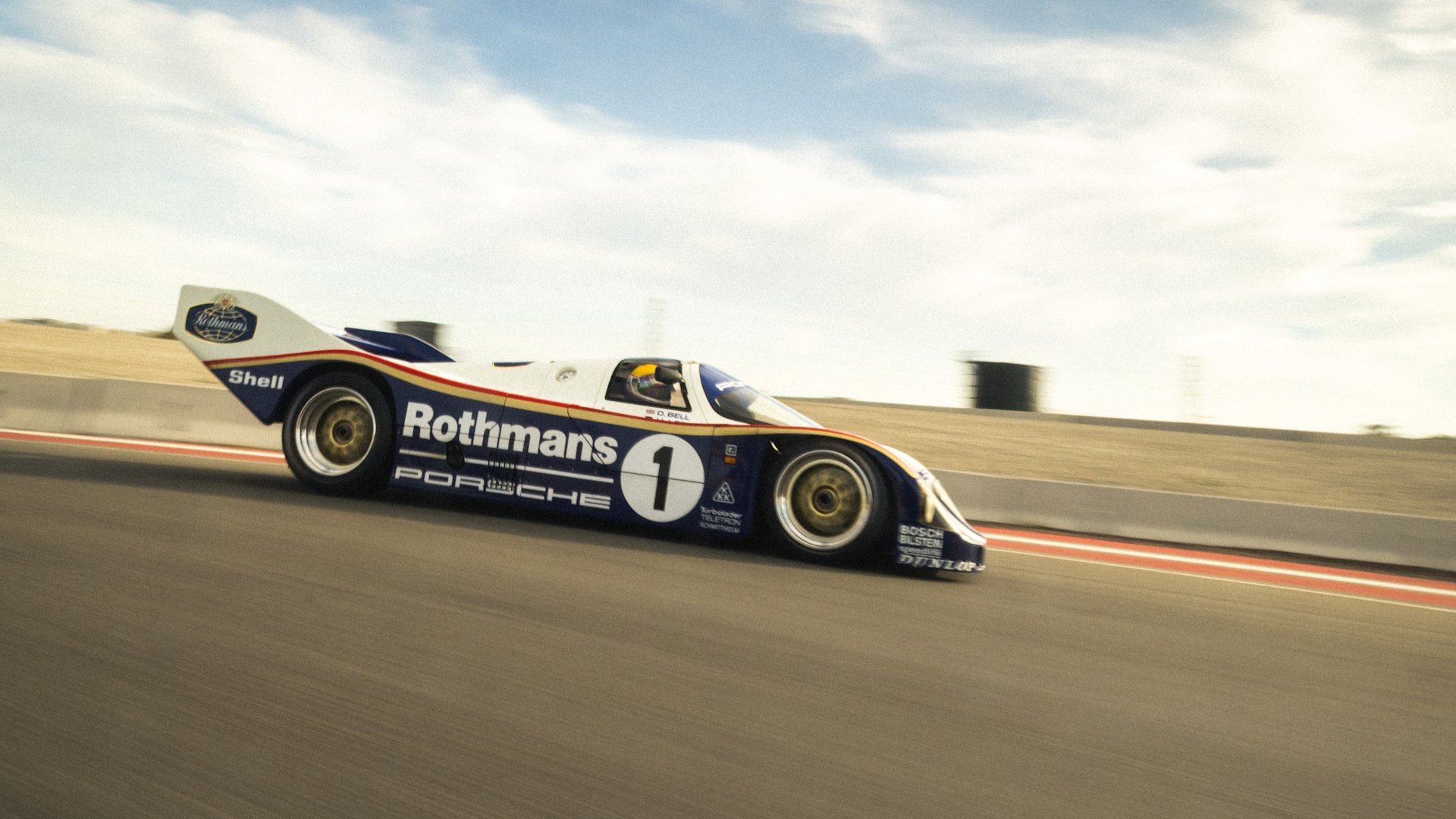
Photo: Porsche Motorsport North America
Charles Nearburg owns one of the seven factory Porsche 962s still in private hands, and until recently it was the kind of race car you admire from behind a rope. By his own description, chassis 962C-005 arrived as “basically a close-to-runnable show car” that had been sitting for a long time. Now it has done something most surviving Group C cars never do again: it has run a trouble-free session at Circuit of the Americas, under its own power, with its owner driving.
The work was done by Porsche Motorsport North America in Carson, California, and the timeline is the first thing that jumps out. The car arrived at PMNA last November and was back at the Nearburg Racing shop in April. Six months to turn a static prototype into something you can hammer around a Formula 1 circuit is quick. What made it quick is the more interesting part, because it wasn’t a secret stash of spares.
The scarcest part on a 40-year-old prototype is the truth
Anyone who has restored something rare knows the parts hunt is only half the fight. The other half is figuring out what “correct” even means. Prototype race cars were never built to a fixed spec. They were modified between races, patched at the track, and then passed through decades of private owners, each adding their own fixes and their own stories.
Nearburg put it bluntly: the biggest obstacles are “rumors and parts supplies.” His point is that a restorer can burn months chasing a detail that some previous owner or forum veteran swears is original. PMNA’s edge was access to Porsche’s factory drawings, manuals and records, which let the team check how the car actually left Weissach instead of arguing about it.
That matters well beyond bragging rights. On a car like this, originality is the value. A works 962 with documented, factory-correct systems sits in a different league from one rebuilt on guesswork, and every non-original modification is something a future buyer’s inspector will circle in red. It’s the same logic we saw when BRM’s one-off Le Mans prototype got its roof and V12 back after 30 years: the closer a restoration gets to documented period spec, the stronger the car’s story and its price.
Nearburg also had history on his side. His relationship with PMNA goes back close to two decades through earlier professional racing programs, and the shop had already handled an engine project on a Porsche 917 from his collection. He credited Alwin Springer, the ANDIAL co-founder and former PMNA leader, along with the PMNA staff, as a resource he has leaned on for years. He said he looked at options in both the U.S. and Europe before choosing Carson.
Why a works 962 is a different animal from a customer car
The 962 exists because of a rulebook. Porsche’s 956 was the dominant Group C car of the early 1980s, but it couldn’t race in America’s IMSA GTP series because of where the driver’s feet sat. According to Porsche’s own history of the program, an IMSA rule change in 1984 forced the redesign, and engineer Norbert Singer’s team moved the front axle 12 cm forward to put the driver’s legs behind it. The 956 became the 962, and the extra wheelbase gave the car a second life on both sides of the Atlantic.
Porsche built plenty of 962s for customer teams, which is why so many fans assume a Rothmans-liveried example is just a painted tribute. Nearburg says he gets asked that constantly. But only nine 962s were factory cars, and very few of those ran in the works team’s Rothmans colors. Porsche’s spec sheet for the 1987 Le Mans-winning 962 C lists a 2,994 cc water-cooled twin-turbo flat-six rated at 700 hp in an 850 kg car, and the model won Le Mans outright in 1986, 1987 and, in heavily reworked road-derived form, 1994.
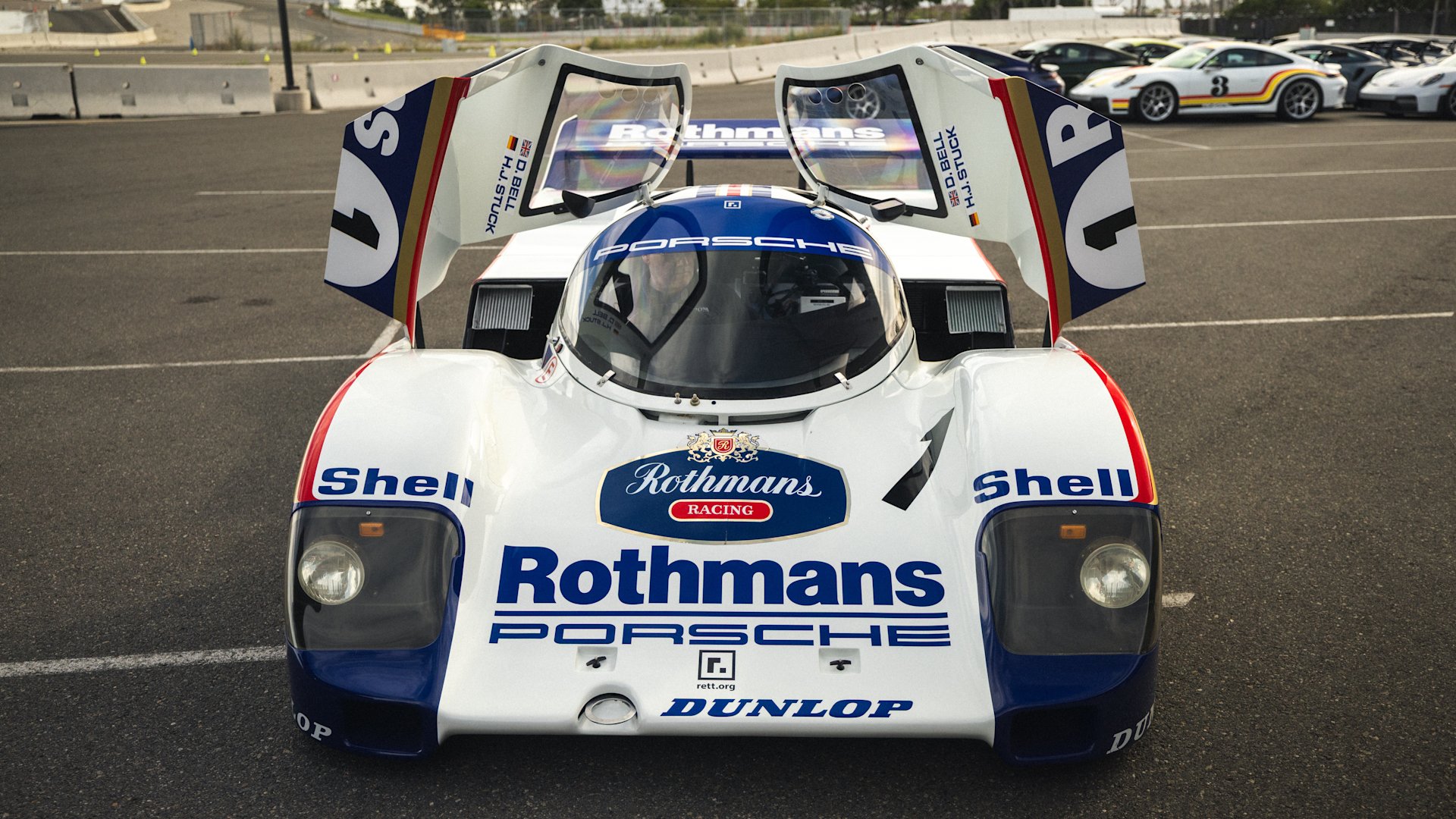
The wiring loom that predicts your Porsche’s gearbox
Here is the detail that makes 962C-005 more than a pretty survivor. This chassis raced with a prototype version of Porsche’s PDK dual-clutch gearbox at the Nürburgring and Hockenheim in 1986, and much of the original wiring from that system is still in the car.
Porsche began racing PDK in the 956 at Imola in 1984, and by 1986 and 1987 a refined version was running in its Group C cars. The logic was simple. A turbocharged engine loses boost every time the driver lifts to shift, and a dual-clutch box keeps the next gear pre-selected so the power delivery barely hiccups. The hardware of the era wasn’t reliable enough to take the fight all the way, and it took Porsche more than two decades to make the idea work in a road car. Today PDK is the default in most 911s you can buy.
That’s why the surviving wiring matters. It is physical evidence of a technology path, still attached to the car that tested it in competition. Rip that loom out to simplify the rebuild, and you’ve erased the most historically important thing about the chassis.
Dyno inside, racetrack outside
After the engine was torn down, inspected and repaired, PMNA ran it on its in-house engine dynamometer, handling mapping and calibration there. Then the car rolled straight out to the handling circuit at the Porsche Experience Center Los Angeles, which shares the Carson campus, for shakedown laps.
That’s a bigger deal than it sounds. A historic race car shakedown usually means trailering to a rented circuit, sometimes hours away, burning a day of track rental to find out a sensor is misbehaving, then trailering home to fix it. Nearburg acknowledged the PEC track isn’t a full race circuit, but said it lets the team confirm basic functions and performance and fix simple issues on the spot. For a car whose parts can’t be bought off a shelf, catching a problem at shakedown pace instead of at race pace is the cheapest insurance there is.
The modernization was limited to safety systems, which were brought up to current standards. That’s typical for historic racing, where items like fuel cells and harnesses carry certification dates that sanctioning bodies actually check. The Bosch engine management and ignition, however, are still the car’s originals.
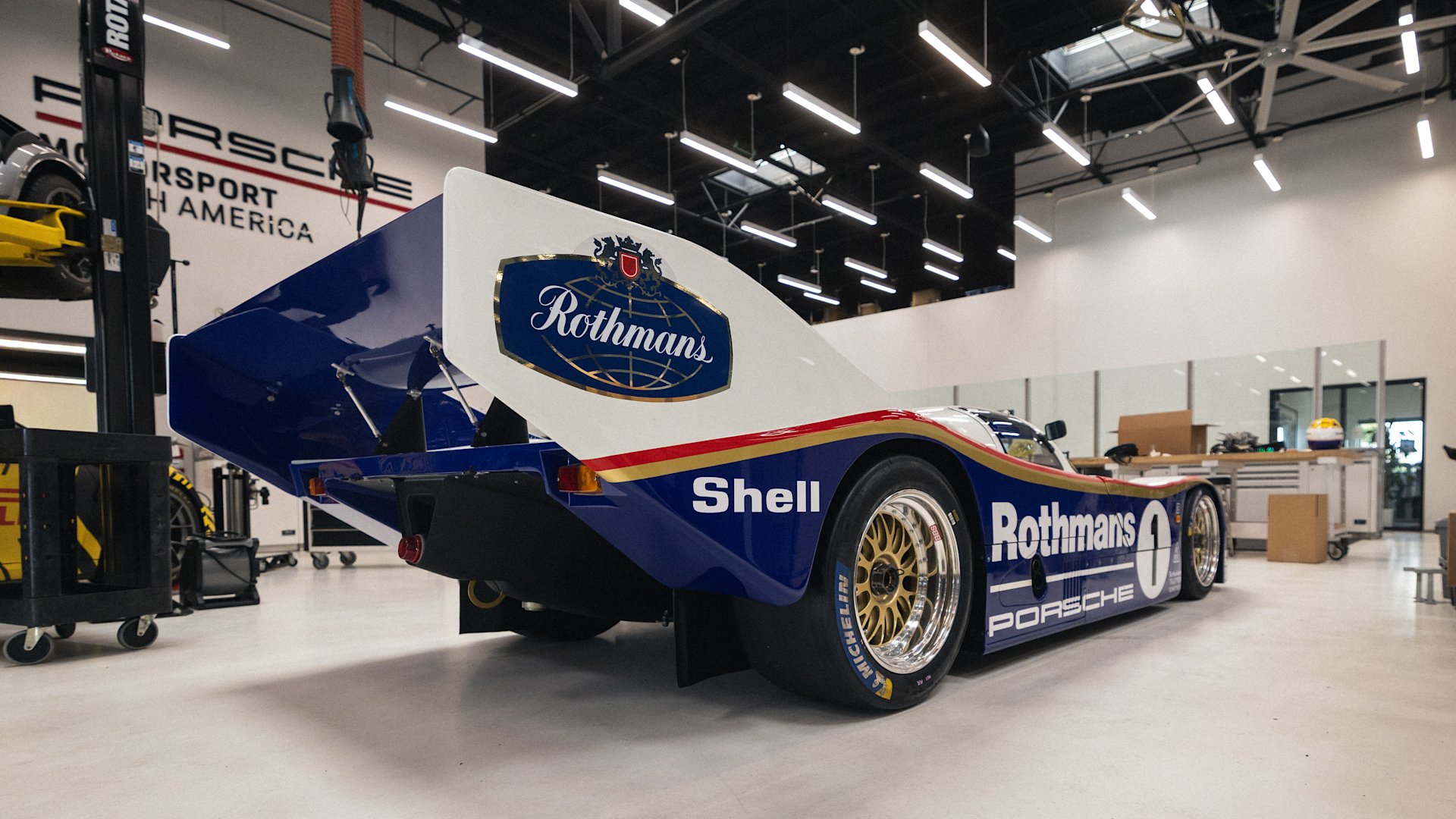
Late on the throttle? Wait your turn
Keeping the original electronics means keeping the original temperament. A 1980s turbo prototype has none of the boost management that makes a modern race car feel linear. Nearburg described the lesson in one line: “If you are late to the throttle, you simply have to wait.”
In practice that means getting back to power before the car seems to need it, so the turbos are spooling by the time the corner opens up. Add a conventional clutch and a manual shift lever, and the car rewards a driver who thinks a beat ahead of it. Get it wrong mid-corner and 700-ish horsepower shows up all at once. It’s the reason Group C drivers still talk about these cars with a mix of affection and respect.
Nearburg is well qualified to judge. He came up through SCCA club racing in the Southwest, finishing second in the national championship race, then raced open-wheelers professionally, including Walter Payton’s Reynard in the 1997 CART season. He has raced at Sebring and Le Mans, and in 2010 he set an FIA world speed record of 414 mph at Bonneville in his shop-built streamliner, “Spirit of Rett.” He also admitted that the kid racing a Lotus Super 7 and a Camaro around Texas never pictured owning a works 962.
Why this is also a Porsche business story
PMNA is best known as the arm that supports customer teams in IMSA and Porsche’s one-make series. Projects like this show another role: supporting owners of historic factory race cars with records, engineering knowledge and facilities. For Porsche, that’s more than goodwill. A company that trades heavily on racing history benefits when its most famous race cars are seen running, instead of sitting in climate-controlled garages. Porsche has been leaning into that heritage hard, as seen in its throwback liveries at Road America, and the timing is interesting given that Porsche has pulled its factory Hypercar effort from the World Endurance Championship.
For owners, the takeaway is practical. If you own a significant race car and want to run it, the best partner is often the one with the paperwork, not just the tools. Factory records remove guesswork, protect originality and shorten the timeline. That’s the same story behind many significant racers that come to market, from Paul Newman’s Daytona-winning Mustang Cobra to the ex-Andretti 1991 Lola: provenance and correctness drive the value.
Nearburg’s stated goal for his Howlin’ Collection is that the cars be able to run to their full in-period potential. Chassis 962C-005 now can. The next time one appears on a grid in Rothmans colors, don’t assume it’s a replica.
Photos: Porsche Motorsport North America. Sources: Porsche Motorsport North America; Porsche Newsroom archival history and specifications.
About the Author