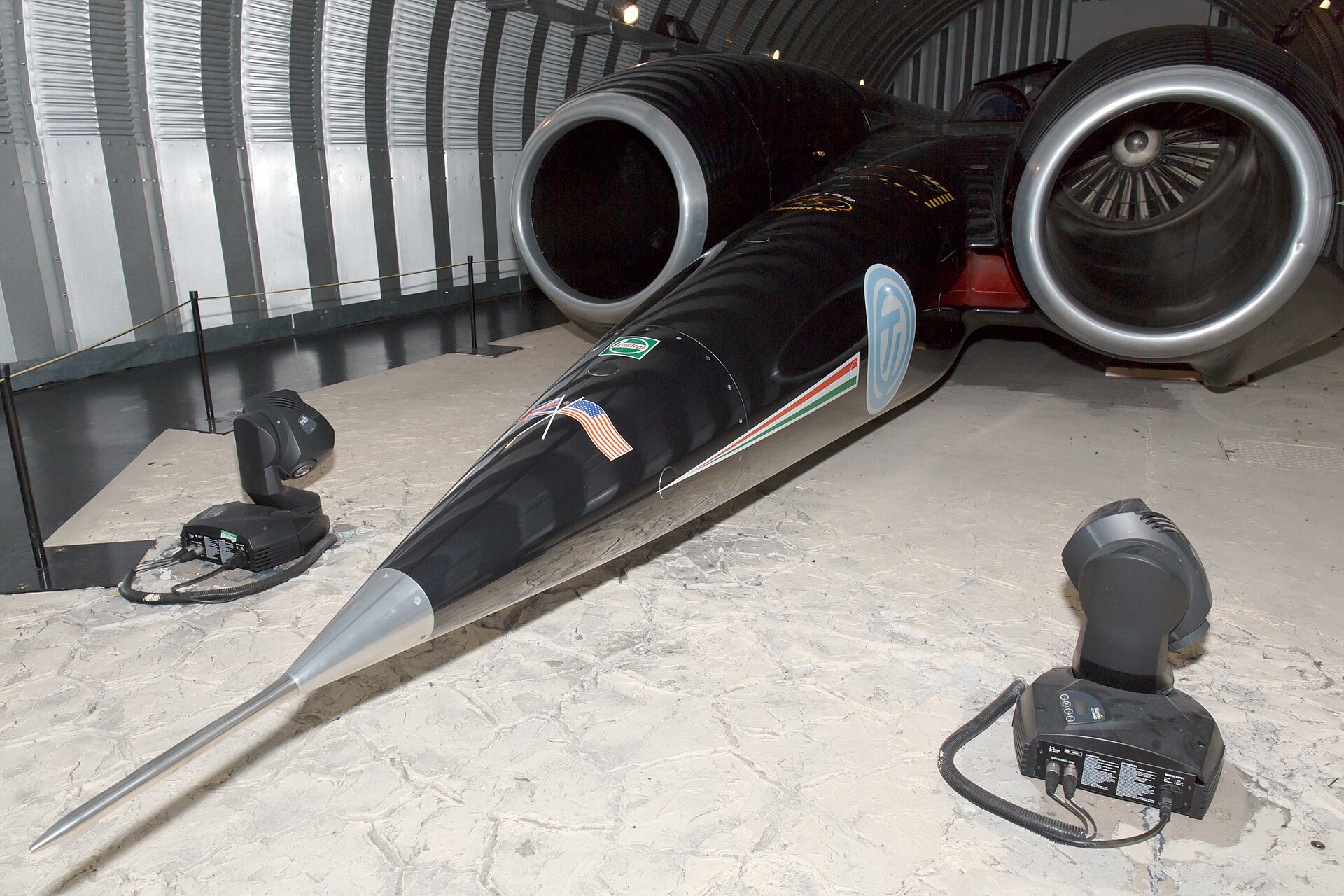
ThrustSSC on display at Coventry Transport Museum. Photo: Morio via Wikimedia Commons (CC BY-SA 3.0)
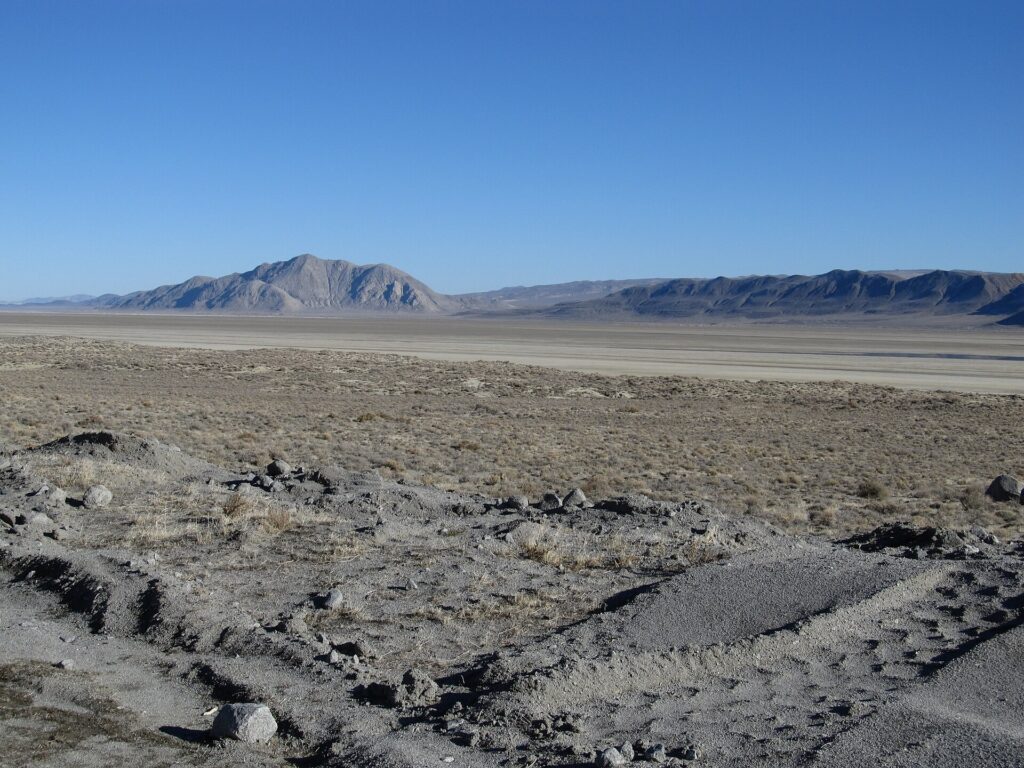
Twenty-nine years ago today, a Royal Air Force fighter pilot strapped himself between two jet engines on a dry lakebed in northern Nevada and made the fastest car on Earth obsolete. On September 25, 1997, Squadron Leader Andy Green drove ThrustSSC to 714.144 mph over the measured mile in the Black Rock Desert, wiping out a land speed record that had stood since 1983. The wild part? That wasn’t the headline. It was the warm-up act.
Three weeks later, the same car and the same driver went supersonic. But the September 25 run is the one that proved a 54-foot, twin-turbofan contraption could be driven, steered and stopped at speeds no wheeled vehicle had ever officially reached. Here’s the story of the day ThrustSSC stopped being a science project and became the fastest car in history.
The Record It Had to Beat Was Its Own Family’s
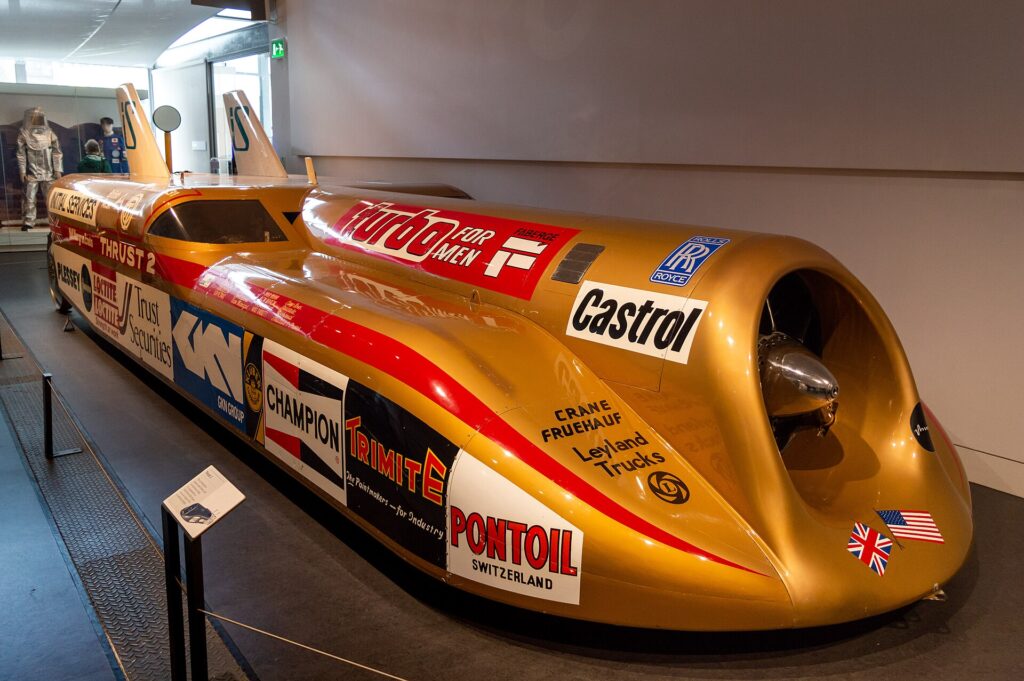
The land speed record ThrustSSC went after belonged to Thrust2, the jet car British entrepreneur Richard Noble drove himself on October 4, 1983, on the very same Black Rock playa. Thrust2 averaged 633.468 mph using a single Rolls-Royce Avon jet engine, the kind of powerplant that once pushed English Electric Lightning fighters around the sky.
Most people who set a land speed record retire happy. Noble decided to beat himself, and not by a little. The new target was the sound barrier, somewhere around 750 mph depending on air temperature, which meant building a car that could survive shockwaves forming along its body. This time Noble stayed out of the cockpit and ran the project.
What Exactly Is ThrustSSC?
Calling ThrustSSC a “car” is technically accurate the same way calling a Peterbilt a “vehicle” is. Designed by Noble with Ron Ayers, Glynne Bowsher and Jeremy Bliss, it measures 16.5 meters (54 feet) long and 3.7 meters (12 feet) wide, and it weighs about 10.5 tons. For perspective, that’s longer than most school buses and roughly the weight of three heavy-duty pickups.
Power came from two afterburning Rolls-Royce Spey turbofans, the same family of engines used in British F-4 Phantom II fighter jets, mounted one on each side of a narrow central fuselage where the driver sat. Together they produced about 223 kN of thrust, or roughly 50,000 pounds-force. Coventry Transport Museum, where the car lives today, puts fuel consumption at around 18 liters per second. That’s close to 4.8 gallons every second, or enough to drain a typical full-size pickup’s tank in six or seven seconds.
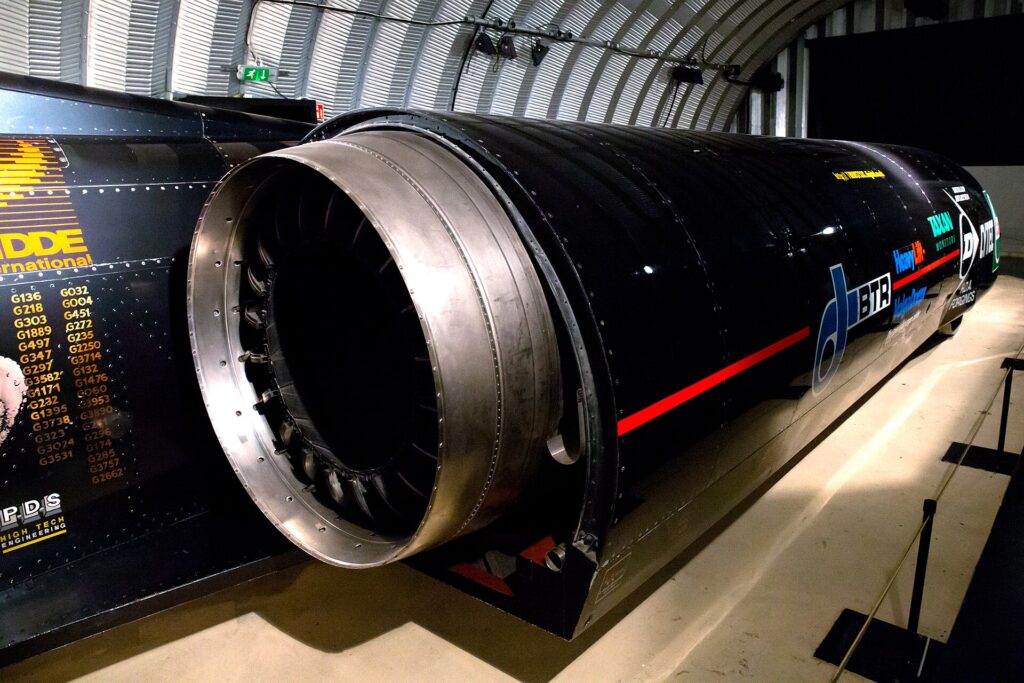
Why two engines out wide, with the driver tucked between them? It’s about stability and control. The layout gave the designers a way to manage the car’s balance as air started to behave very differently near Mach 1. Near the speed of sound, shockwaves can shift lift and pressure around a vehicle in ways that turn a stable design into an unstable one in a heartbeat. Keeping a 10-ton car glued to the ground was the entire engineering problem.
The Driver Came From a Newspaper Ad
Andy Green wasn’t a racing driver. According to Guinness World Records, he was a 34-year-old RAF fighter pilot who joined the ThrustSSC project in 1994 after answering a newspaper advertisement looking for a high-speed driver to break the sound barrier. He’d earned first-class honors in mathematics at Oxford before qualifying on Tornado fighters, which is exactly the résumé you’d want for someone who has to process data, feel instability and react faster than most humans can blink.
The team didn’t jump straight to Nevada. It tested in Jordan, alternating runs with design changes while using lower-powered engines. On June 3, 1997, its final test day on the Al-Jafr mudflats, Green hit 490 mph. That was fast enough to learn from and slow enough to survive. Then everybody packed up for Black Rock.
September 25, 1997: The First Car Past 700 MPH
Land speed records aren’t a single heroic blast. The rules require two runs through a timed distance in opposite directions within one hour, and the record is the average. That cancels out any help from a tailwind or a slight slope, and it means the crew has to turn a jet car around, refuel it and check it over in less time than a lunch break.
On September 25, Green’s two-way average came out to 714.144 mph (1,149.303 km/h) through the flying mile and 713.990 mph through the flying kilometer. That’s an 80.7-mph jump over Thrust2’s record, a gain of nearly 13 percent in one day. It also made ThrustSSC the first car to hold an official land speed record above 700 mph. At that speed, the car crossed the entire measured mile in about five seconds.
The mission wasn’t finished. The record was in the bag, but Mach 1 was still roughly 40 to 50 mph away, and the speed of sound changes with air temperature. That meant the team needed the car, the weather and the surface all working together at once.
Three Weeks Later, the Desert Heard a Sonic Boom
On October 15, 1997, Green went back out and did the thing the whole project was built for. His two-way average was 763.035 mph, Mach 1.02, the first supersonic land speed record. Guinness World Records says his return run reached 771 mph. The date wasn’t lost on anyone: it came 50 years and one day after Chuck Yeager first broke the sound barrier in the air.
The sonic boom was loud enough that, per Guinness, it knocked pictures off walls in the nearby town of Gerlach, set off the sprinklers at the schoolhouse and triggered a chorus of car alarms. It’s hard to think of a better endorsement from the automotive world.
That record still stands nearly three decades later. No car has officially gone faster.
Why Enthusiasts Still Care
ThrustSSC sits at the outer edge of what “car” means, but it came from the same instinct as every Bonneville streamliner, every banned Dodge Daytona chasing records on the salt and every backyard drag car: find out how fast it’ll go, then find out why it won’t go faster. It just happened to use military jet engines and a team of aerodynamicists to answer that question.
It also proved how hard the job really is. Bolting a fighter engine to a chassis is the easy part, as anyone who has followed this jet-powered record car that never got its shot can tell you. Keeping it straight, stable and on the ground at 700-plus mph is what separates a record from a very expensive crash. ThrustSSC’s successor project, Bloodhound, launched in 2008 to chase 1,000 mph, and the record still hasn’t moved.
Green never really left speed behind, either. In 2006 he drove the JCB Dieselmax to a diesel land speed record of 350.092 mph, and in 2026 he was back at the wheel when JCB’s Hydromax set a 406-mph hydrogen land speed record. Same driver, very different kind of power, same obsession.
Where to See It Today
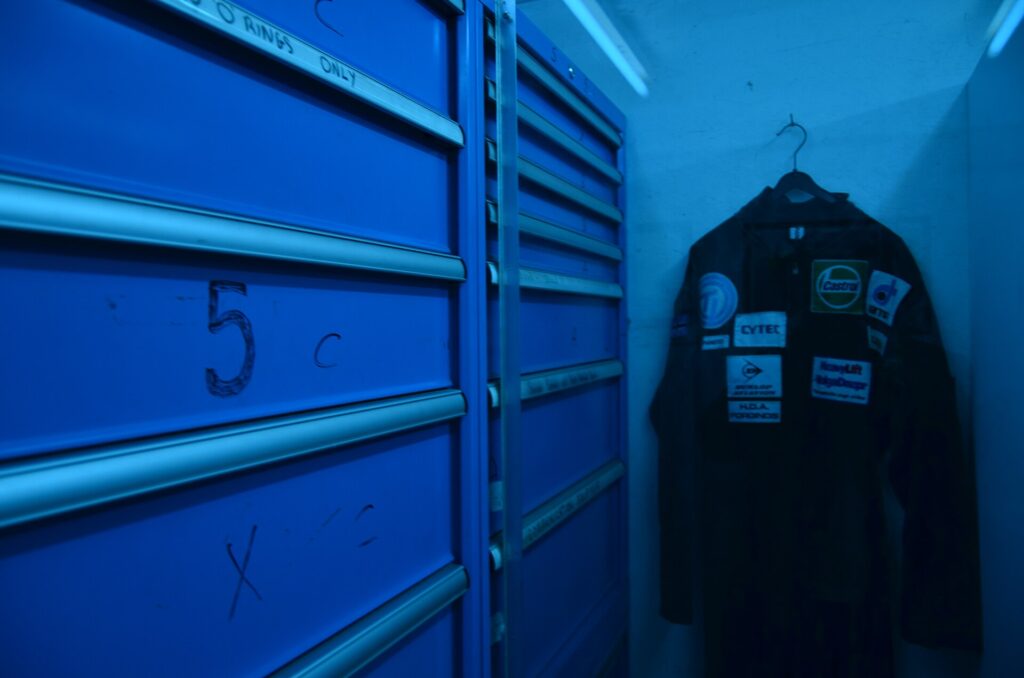
Both ThrustSSC and Thrust2 are on display at Coventry Transport Museum in England, in its Biffa Award Land Speed Record gallery, which opened in 2015. Standing next to them tells you more than any spec sheet can: the scale of the engine intakes, how little room the driver has, and how thin the line between “record” and “wreck” must have felt at 714 mph. The museum also displays Green’s driving suit, a reminder that a real person had to sit in the middle of all that thrust.
More From Today in Automotive History
This series keeps digging up the moments that shaped car culture. Catch up on how The Munsters gave TV its wildest hot rod hearse and how a tiny Pennsylvania carmaker delivered the first Jeep to the Army.
Sources: Guinness World Records, Andy Green land speed record hall of fame entry; Coventry Transport Museum, ThrustSSC exhibit information; official Thrust2 record of October 4, 1983 (633.468 mph). Photos via Wikimedia Commons under the Creative Commons licenses noted in each caption.
About the Author