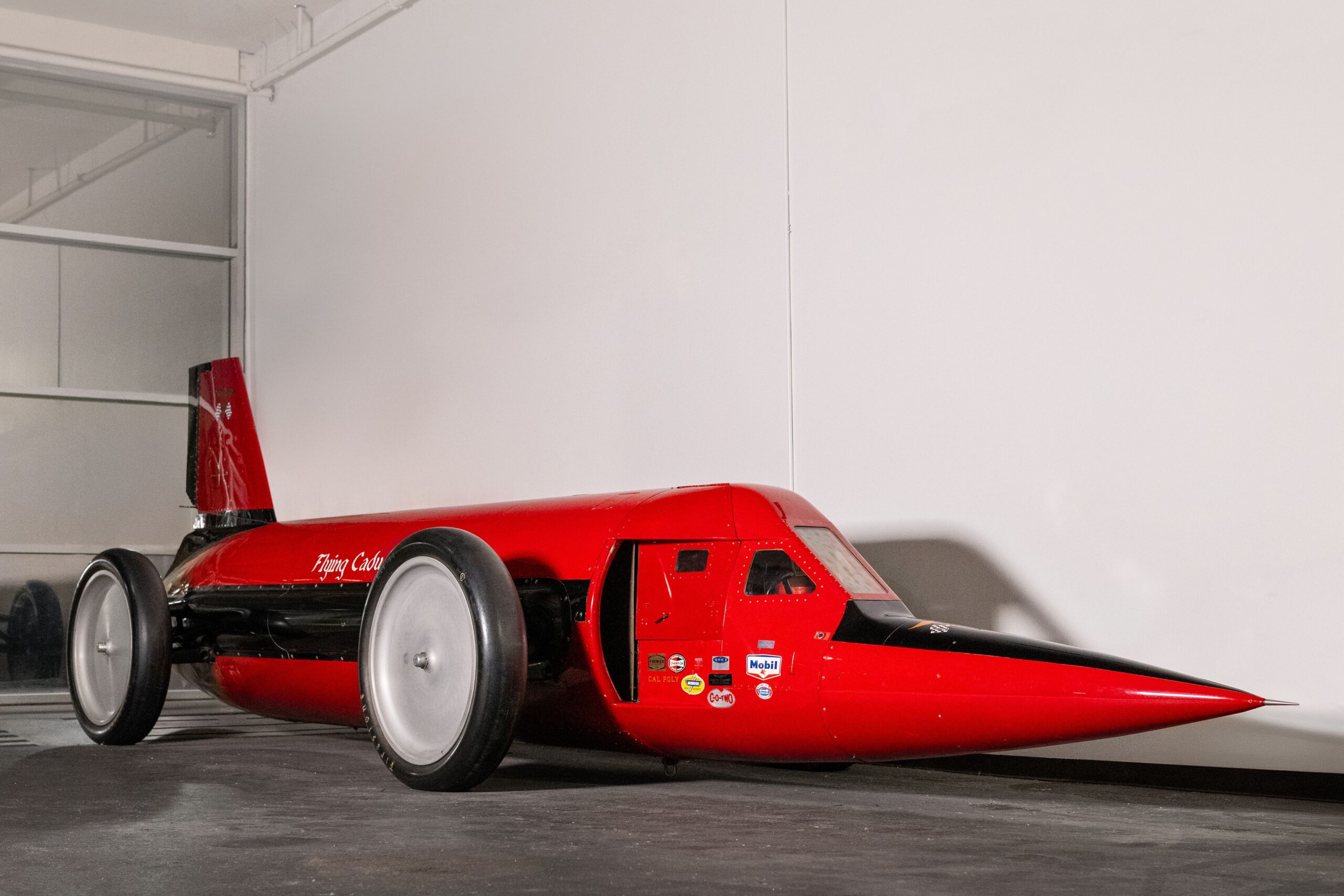
Dr. Nathan Ostich did not build the Flying Caduceus to end up as a museum deaccession lot with no price tag attached. He built it to break the outright Land Speed Record using a fighter-bomber’s jet engine and zero driveshaft, at a time when the record was still held by a wheel-driven car. He never got there. Now his creation is heading back to auction for the second time in two months, and this time Bonhams won’t even guess what it’s worth.
The Steak Dinner That Started It
According to Bonhams’ own lot notes, the idea began at a free steak dinner in 1957. Ostich, a Los Angeles physician who spent his weekends chasing speed on the Bonneville Salt Flats, pitched a group of hot-rodding friends on building a car that could push past 500 mph on pure jet thrust instead of a driven axle. It was an absurd ask for a self-funded garage project, and it took the group more than two years to turn the idea into a rolling test bed for problems nobody in production car engineering had ever needed to solve.
Solving a Problem Nobody Had Solved
The scariest problem wasn’t the engine. It was the tires. A standard 20-inch wheel spinning fast enough to carry a car to 500 mph turns over at roughly 8,400 rpm, subjecting the tread to something like 20,000 g of centripetal load, enough to tear a normal tire apart long before the car reached record speed. Ostich talked Firestone into solving that problem from scratch, and the company built a bespoke set of 34-inch solid aluminum wheels wrapped in oversized 48-inch tires, tested in-house before they ever touched salt.
For power, the crew sourced a General Electric J47-19 turbojet, the same engine that hung in sets of four off the wings of a Convair B-36D Peacemaker bomber alongside six piston pusher engines. Bonhams lists it at 5,200 pounds of thrust at 7,950 rpm, translated into roughly 6,930 hp, a figure that only works in the loosest apples-to-oranges sense since a turbojet doesn’t put torque through a driven wheel the way a piston engine does. The rest of the car followed the same aerospace-adjacent logic: a four-foot-diameter steel tube structure wrapped in aluminum skin, a low beaked nose flanked by twin intake ducts, four-wheel independent suspension built from 1960 Chevrolet front-end components, four 14-inch Halibrand disc brakes, and an 8-foot ribbon parachute to handle what the brakes alone couldn’t.
Three Summers on the Salt
None of it came together cleanly. The Flying Caduceus made its first runs at Bonneville in 1960 and immediately exposed how little anyone understood about stabilizing a jet car at speed. It returned in 1962 and ran into the same stability problems above 300 mph. By 1963 the team had welded on a tail stabilizer, and Ostich drove the car to a two-way average of 359.7 mph, a real and independently documented number, but nowhere near what the project had been built to do, and not a record by any measure.
That same year, Craig Breedlove ran his three-wheeled Spirit of America to 407.447 mph at Bonneville, technically the first car over 400 mph and technically not a land speed record either, because FIA rules at the time only recognized four-wheeled, wheel-driven cars, a category no pure jet car could satisfy. The FIA rewrote its rules the following year to accommodate jet-thrust cars and retroactively crowned Breedlove, the regulatory footnote that turned one 1963 also-ran into a footnote and the other into a folk hero.
The Unlikely Legacy
What the Flying Caduceus actually won was harder to put a number on. It proved the tire problem was solvable, and it set off a chain reaction. The Arfons brothers, Breedlove’s later Spirit of America cars, Gary Gabelich’s Blue Flame, Richard Noble’s Thrust2, and Andy Green’s Thrust SSC, the only car ever to go supersonic on land, all descend directly from the engineering lessons the Ostich crew paid for in 1960. Bonhams calls it the base of that entire lineage, and for once a sales pitch happens to line up with the historical record.
Twice Offered, Still Unpriced
Here’s where it gets genuinely interesting for anyone who follows how auction houses price the unpriceable. The Flying Caduceus first came up for sale on June 13, 2026, as Lot 79 of a 110-car deaccession by Reno’s National Automobile Museum, formerly the Harrah Collection, which is trimming its holdings as part of a $4 million renovation. Bonhams put a $70,000-to-$90,000 estimate on it and offered it without reserve, the same no-reserve structure auction houses increasingly lean on for pieces with more story than sales history behind them, not unlike the instinct that turned a Ferrari 288 GTO into Bring a Trailer’s 250,000th auction lot on pure milestone appeal. The Flying Caduceus didn’t need a gimmick to be interesting, and it still didn’t sell. The saleroom notice simply says the lot was withdrawn.
Now it’s back, re-listed for Bonhams’ Laguna Seca sale on August 13 during Monterey Car Week, still without reserve, but this time the estimate field just says “refer to department.” That’s auction-house shorthand for “we genuinely don’t know,” and honestly, it’s a more useful answer than a made-up number would be.
What You’re Actually Buying
Whoever buys it should know exactly what they’re getting and what they’re not. The car sells on a bill of sale, not a title, because it was never registered for road use and never will be. There’s no path to license plates for a vehicle whose entire suspension geometry was designed around a dry lakebed instead of a DMV inspection lane. It comes paired with a display example of the J47-19 turbojet rather than a running one, so there’s no fuel system to insure or maintain, which simplifies storage considerably compared with, say, a period race car that still gets fired up for demonstration laps. Bonhams notes the car remains in largely original condition, still riding on its original Firestone Bonneville tires, the kind of unmolested-metal claim that serious collectors treat as close to gospel, and the kind that would cause the same purist outrage a certain repainted Ducati got from the green-is-not-original crowd. Provenance sells on its own anyway, the same way Tupac Shakur’s old Hummer H1 doesn’t need to be fast to be desirable.
What the Market Says a Jet Car Is Worth
For a sense of what jet-powered Bonneville history can actually fetch, look at Breedlove’s own Spirit of America Sonic I, the car that carried him to a genuine 600.601 mph record on November 15, 1965. RM Sotheby’s sold it out of the Indianapolis Motor Speedway Museum’s collection at its Miami sale in February 2025 for $1,325,000, well past its $500,000-to-$1,000,000 estimate, roughly the same territory a charity-consigned Ford Mustang Dark Horse SC hit last year when it hammered for $1.25 million with no production precedent to price it against. That’s the premium the market pays for a car that actually holds the record, or the milestone, it was built to chase. The Flying Caduceus never got there, and Bonhams’ refusal to publish a number this time is a quiet admission that valuing the record-chaser is a fundamentally different exercise than valuing the record-holder.
That’s not necessarily a bad trade for the right buyer. Whoever writes the check on August 13 isn’t buying a car that resells easily against comparable sales. They’re buying a museum-grade artifact built around a piece of aviation surplus, closer in spirit to the kind of one-of-one oddity that made Rick Hendrick reach for a decommissioned war machine instead of another blue-chip Corvette. If this sale goes well, expect the next Bonneville pioneer to come out of hiding priced with a lot more confidence.
About the Author