There’s a certain breed of motorcycle collector who treats a rare bike like a religious relic. They lose sleep over factory paint codes, period-correct bolts, and whether a decal sits a few millimeters off from where the assembly line stuck it five decades ago. To these people, originality is everything, and any deviation is something close to heresy.
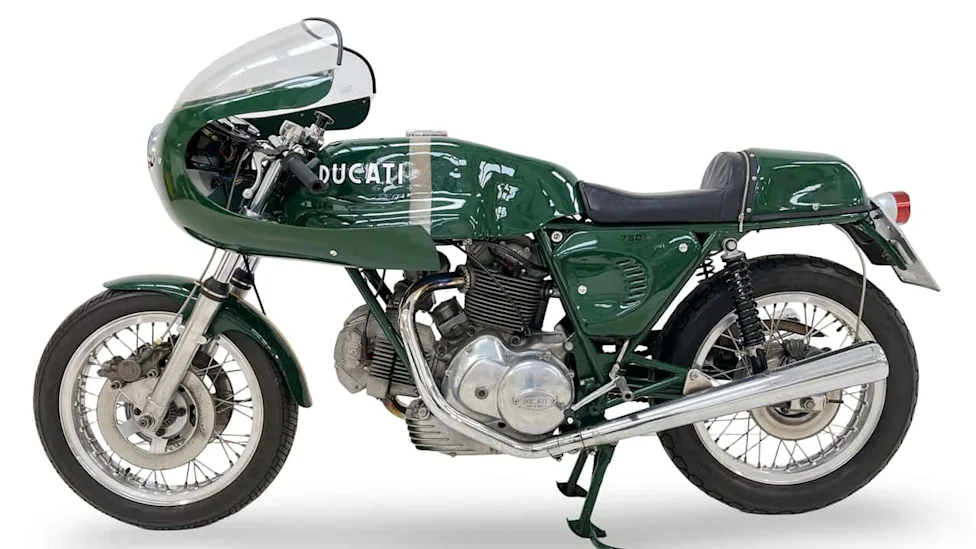
Then there’s the owner of this 1974 Ducati 750SS, who looked at one of the rarest motorcycles his money could buy and decided he would rather have it in British Racing Green. It is the kind of bold move that puts him in the same camp as builders who refuse to leave a rare machine alone.
That decision alone is enough to make hardcore purists wince. But the full story behind it is far more interesting than a simple act of rebellion, and it forces a real question about what these machines are actually for, rather than being left to rot as untouched investments.
A six-figure motorcycle by any measure
Let’s start with what this bike is worth, because the number explains why the paint choice raises eyebrows. This is one of just 401 round-case examples ever produced, and the Bonhams auction listing pegs its estimated value at £70,000 to £90,000. In American money that lands somewhere around $93,000 to $120,000.
That is serious cash for a motorcycle. It is also exactly the kind of figure that usually convinces an owner to park the thing in a climate-controlled room and never let the tires touch pavement again. Bikes at this level tend to go from machines to museum pieces in a hurry.
This owner didn’t get the memo.
Born from a legend
The 750SS story begins where every 750SS story begins, with Ducati’s stunning win at Imola in 1972. That victory turned the company’s V-twin into an instant hero. Paul Smart took down factory-backed heavyweights from Triumph and MV Agusta, and the road-going 750SS that followed rode that wave of glory straight into legend status.
It was essentially a race bike with a license plate, dripping with enough charisma to convince otherwise sensible adults to spend money they probably shouldn’t. Most surviving examples now live pampered lives under soft gallery lighting, barely ridden, endlessly polished.
This one took a different path entirely. It got used the way a motorcycle is meant to be used.
Two decades of actual riding
A Danish enthusiast bought the Ducati back in the 1980s and then did the unthinkable for a bike this valuable. He rode it. Hard. Over the next twenty years he piled on thousands of miles, taking it across Denmark, throughout Scandinavia, and even all the way back to northern Italy.
10 Best Car Accessories for Summer
This wasn’t a trophy he wheeled out for shows. It was genuine transportation, a bike that earned its keep mile after mile. And then came the moment that would send certain collectors reaching for the smelling salts.
The repaint heard around the forums
In 2005, the bike went in for a restoration. Here’s where most owners would have carefully returned it to its original factory silver-and-green scheme, chasing that all-important originality. This owner went the other direction. He had it finished in British Racing Green.
On paper, that is the sort of move that ignites days-long shouting matches on internet forums. Rare motorcycles are supposed to be preserved exactly as they left the factory, not reimagined to suit personal taste. The collector world tends to treat that rule as sacred.
That backstory reframes the whole decision.
The green wasn’t a vanity decision. It was chosen as a tribute to the owner’s father, an English RAF pilot who was shot down over Dortmund during World War II and later worked in Jaguar’s design department. Once you know that, the paint stops being a modification. It becomes a memorial, and it gets a lot harder to work up any real anger about it.
Why the money is still there
Here’s the part that matters most for anyone worried that the repaint torched the bike’s value. It didn’t. The Ducati remains highly desirable despite the color swap, and the reason comes down to what was actually changed and what wasn’t.
Ducati historian Ian Falloon reportedly inspected the machine years ago and confirmed it as a genuine, sound green-frame 750SS. The stuff that truly drives value on these bikes, the frame, the engine, the documented history, and the underlying authenticity, all remain intact. The paint sits on top of a bike that is still very much the real thing.
That detail is what makes this Ducati so fascinating. The collector market loves to crown originality as the single highest virtue. This bike quietly argues that motorcycles are also supposed to carry stories, and not just the famous ones about Imola and Paul Smart. The stories of the people who owned and rode them count too.
The next chapter belongs to someone else
Soon another enthusiast will get the chance to write themselves into that story. The Ducati is heading to auction with that £70,000 to £90,000 estimate hanging over it, roughly $93,000 to $120,000. In the rarefied world of round-case Ducatis, that is simply the price of admission.
For the right buyer, this is more than a shot at owning one of the most sought-after Ducatis ever made. It’s a chance to own one with a backstory as compelling as the machine itself. The question is whether the winning bidder will see that green paint as a flaw to correct, or as the very thing that makes this bike impossible to replace.
Source
Images Via: Bonhams
About the Author