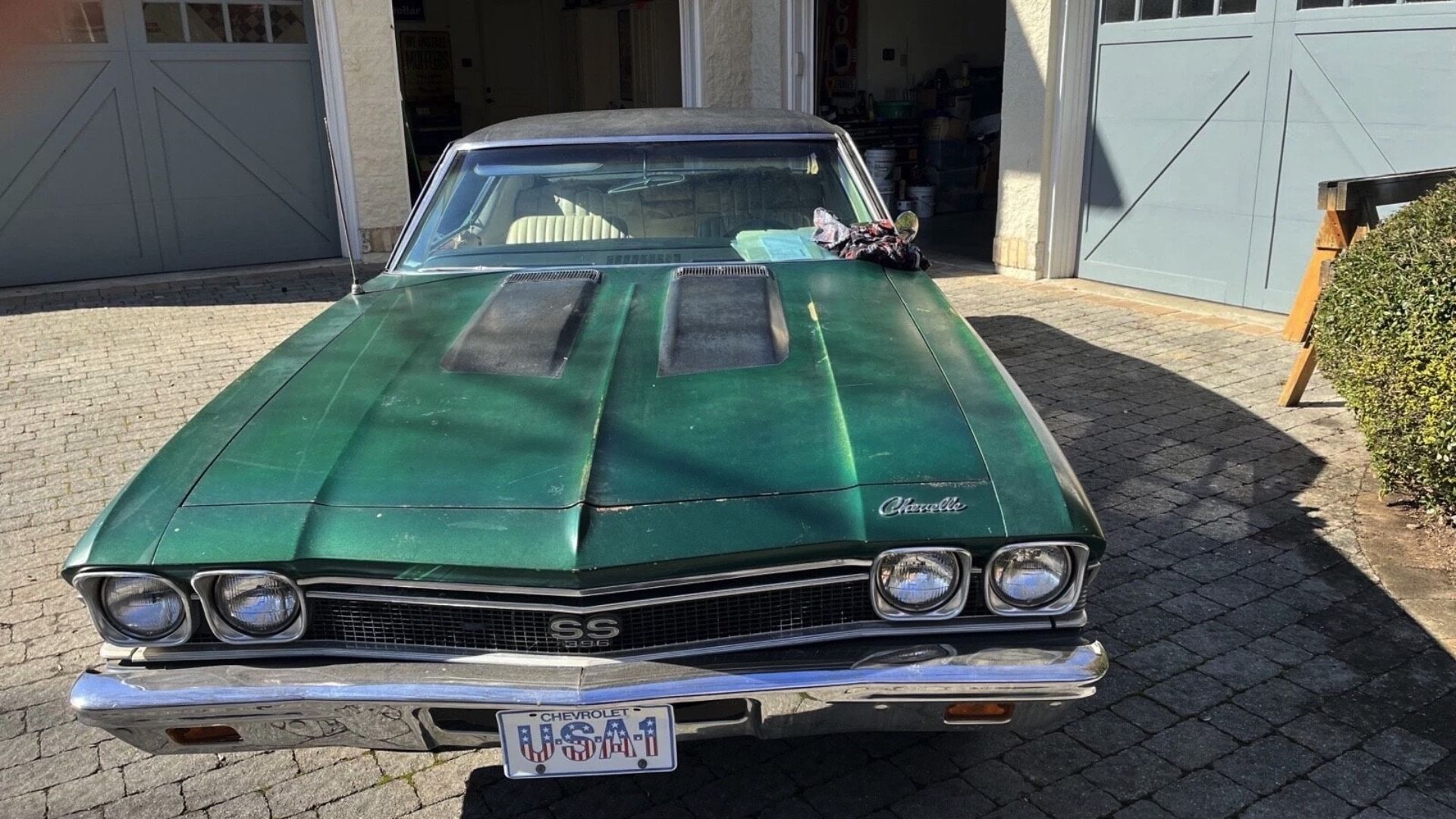
At 11:47 p.m. on July 1, a Ring camera mounted above a garage in Centereach, New York was still watching a 1970 Chevrolet Chevelle parked in the driveway below it. Two minutes later, the homeowner says, the car was gone, and so was the footage that should have shown how it happened. That gap is what turns this into more than a routine theft report: somebody made a six-figure muscle car disappear inside a blackout nobody can explain yet.
The Chevelle belongs to Owen and Leah Fitzpatrick, who say it vanished from their West Court Drive home while their attention was locked on something far more urgent. Leah was in the hospital preparing for quadruple bypass surgery when Owen found the driveway empty. The couple puts the car’s value between $80,000 and $100,000, a range that only makes sense for a Chevelle carrying real documentation, a numbers-matching big-block, or both. For a sense of what that kind of pedigree looks like, we recently covered a 1970 Chevelle LS6 that had hidden its own build-sheet proof for 55 years and is now headed to the block at Mecum Harrisburg, the sort of paper trail that separates a $25,000 Chevelle from a $100,000 one.
Owen Fitzpatrick has described the timing as its own kind of cruelty, losing the car at the exact moment his wife’s health mattered more than anything sitting in the driveway. Leah has said the theft left her feeling targeted in her own home, which tracks: a stranger walking up a residential driveway and rolling away with a parked classic is a different kind of violation than a smashed window or a stolen catalytic converter.
No arrests have been announced, and investigators reportedly have no usable video of the theft itself. Centereach falls under Suffolk County Police’s Sixth Precinct, and as of this writing the case remains open with the car unrecovered.
A Two-Minute Blind Spot
The missing Ring footage is the strangest thread in this story, and it’s worth understanding why a gap like that is even possible. Most Wi-Fi security cameras aren’t recording to a hard drive sitting in the garage; they lean on a home’s internet connection and a cloud server to process and store clips, which means anything that interrupts that link, a router hiccup, an ISP outage, a dead battery on a wireless unit, can blank out exactly the seconds you needed. A deliberate Wi-Fi jammer is technically capable of the same result, though it’s the less likely explanation and, worth noting, illegal outright under federal law. The FCC prohibits the marketing, sale, or use of signal jammers under 47 U.S.C. § 333, precisely because they can knock out far more than one neighbor’s doorbell camera.
Whatever caused it, the family’s account of the footage is specific: “At 11:47 the car is there. At 11:49 the car is not there.” That two-minute window doubles as a mechanical clue. A 1970 Chevelle has no transponder key, no immobilizer chip, and nothing resembling the rolling security codes built into a modern ignition, which means it doesn’t need to be hacked, only lifted. A quiet, practiced crew with a flatbed or a tow dolly can have a driveway car up, strapped down, and around the corner in less time than it takes to read this paragraph.
Where a Stolen Six-Figure Chevelle Actually Goes
Classic muscle cars without modern anti-theft hardware have become an attractive, low-risk target precisely because auction prices have climbed so far past what casual thieves, or their fences, expect. Some stolen classics get parted out for engines, trim, and sheet metal that are worth more separately than the car was worth whole. Others get repainted, retagged with a cloned VIN, and quietly resold to a buyer who never asks enough questions; we covered exactly that scenario earlier this year with a stolen classic Mercedes that was headed for a container ship out of San Francisco before investigators caught up with it. And sometimes the car simply sits in storage for years until someone finally runs the numbers, the fate of a 1985 Camaro Z28 that turned up decades after it was stolen and sold for $21,000 once its history checked out.
Whichever path this Chevelle takes, its recovery will hinge on paperwork the Fitzpatricks may or may not have kept off-site: high-resolution photos, casting numbers, a build sheet, and the VIN itself, all cross-referenced against the National Insurance Crime Bureau’s VINCheck database and stolen-vehicle alerts from Chevelle-specific enthusiast clubs. On the financial side, a car insured on an agreed-value classic policy pays out the number written into the policy regardless of what a generic used-car valuation guide says, while a standard actual-cash-value policy can leave an owner arguing with an adjuster over what a 55-year-old Chevelle is actually worth. Given the family’s own $80,000-to-$100,000 estimate, how that Chevelle was insured will matter almost as much as whether it’s ever found.
Protecting a Driveway Classic From the Next Two-Minute Gap
For anyone else parking a valuable classic outside overnight, this case is a useful prompt to check a few things Wi-Fi cameras alone won’t cover. A hardwired camera system with local, onboard storage keeps recording even when the internet doesn’t. A hidden GPS tracker wired into a permanent power source, not a battery that dies in a glovebox drawer, gives investigators something to chase in the first hours, when recovery odds are highest. And an old-fashioned steering wheel or pedal lock still slows down a crew that’s used to keyless ignitions and nothing else. None of it guarantees a car stays put, but it stacks the odds back in the owner’s favor.
For now, the Fitzpatricks are left waiting on a case with no suspects and a two-minute hole where the evidence should be. If their Chevelle resurfaces the way plenty of stolen classics eventually do, through an auction listing, a VIN check, or a tip from someone who recognized it, it won’t be because the technology watching their driveway worked. It’ll be because somebody, somewhere, finally asked the right question about a car that shouldn’t have been for sale.
About the Author