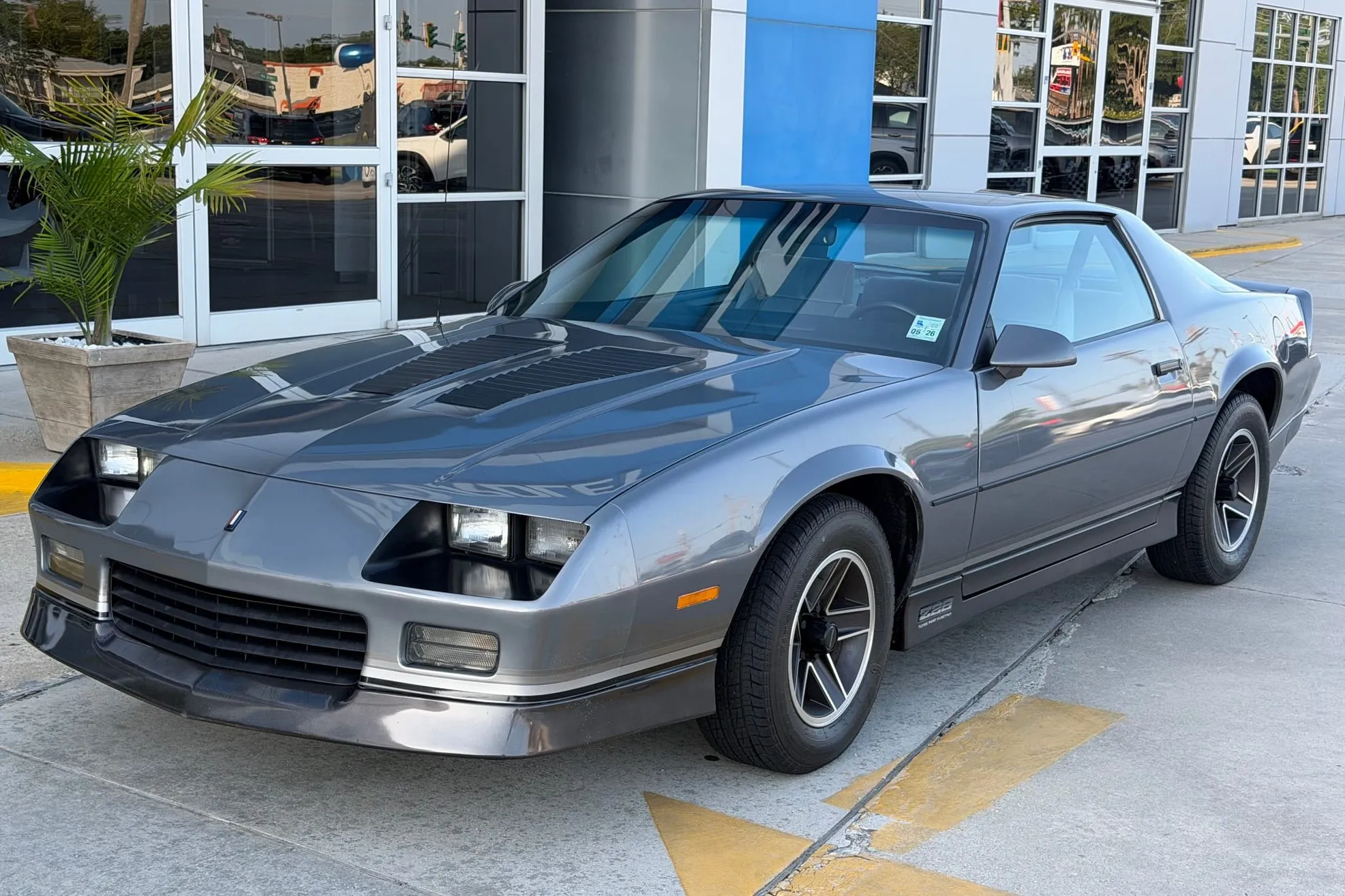
Most survivor-car stories start with an owner who parked the car and never got back to it. This 1985 Chevrolet Camaro Z28 skipped that step entirely. The paperwork bundled with its recent sale (a window sticker, a prior owner’s letter, and a clean Louisiana title) tells of a car reported stolen before it ever reached Knapp Chevrolet, the Houston dealership it was originally billed to, and one that didn’t resurface until someone found it sitting inside a mini-storage unit in Houma, Louisiana, nearly two decades later. It just sold on Bring a Trailer for $21,000, with a five-digit odometer showing 864 miles.
That gap between built and titled is the real story here, and it says as much about lien law as it does about muscle car nostalgia. When the storage facility eventually needed the unit cleared out, a towing company took possession of the Camaro in exchange for handling the cleanout, a mechanism most states allow for abandoned property once a facility satisfies its lien-notice requirements. The tow operator then reported the car to General Motors, since it was still technically unsold factory property rather than something with a retail owner attached. GM’s response is the more interesting data point: rather than pay the accumulated storage bill, GM simply signed ownership over to the tow company’s owner. That transfer is why the Camaro didn’t receive its first title until 2004, essentially two decades after it left the assembly line.
This isn’t the first time we’ve covered a Camaro that went missing for reasons that had nothing to do with anyone wanting to lose it. We wrote about a Z/28 that spent decades sitting at the bottom of Maine’s Sebago Lake, a very different kind of disappearance with a similarly unresolved backstory. Whatever the mechanism, cars with gaps like this in their paper trail tend to be more interesting than cars with clean, boring histories, right up until a buyer needs to insure or finance one, at which point those gaps turn into paperwork headaches instead of fun trivia.
The current owner bought the Camaro in 2026 and turned around and consigned it almost immediately, which is its own small lesson in how these time-capsule cars move through the hobby: whoever finally solves the mystery rarely holds onto the car for long. Two decades of static storage left fingerprints of its own. The listing notes chew marks on the seat-back release handle, a polite way of saying rodents found their way in at some point, along with damage to the emergency brake handle cover. Recent work included replacing the heater core, hoses, and battery, and there’s a noted oil leak from the rear of the engine, the kind of wear that has little to do with mileage and everything to do with time. Rubber, gaskets, and seals break down on a calendar, not an odometer.
We saw the same disconnect between mileage and mechanical readiness in a 12,000-mile barn find Buick Gran Sport that needed real recommissioning work despite its nearly untouched odometer. Anyone chasing a low-mile survivor should budget for that kind of work up front rather than assume a low number on the dash means the car is turnkey.
There’s a wrinkle in the Carfax report that deserved more attention than it got during bidding. The report lists registration history in a Louisiana parish that FEMA declared a flood disaster area in September 2005, timing that lines up with Hurricane Katrina. No accident or flood damage is reported, and the car was already parked in storage by that point, but it’s a useful reminder that a clean accident history and a flood-free history are not automatically the same thing. Anyone shopping a low-mile classic should cross-reference registration counties against disaster declarations for the relevant dates, not just scan the accident field and move on.
Mechanically, the car is an honest snapshot of where the Z28 sat in Chevrolet’s 1985 lineup. That model year introduced the IROC-Z as the flashy top trim, which pushed the standard Z28 into more of a value-performance role underneath it. This particular car got the optional Tuned Port Injection version of the 305, the LB9, which Chevrolet had just introduced that year to replace the old four-barrel carburetor setup. It’s rated at a factory 215 horsepower and 275 lb-ft of torque, sent through a four-speed automatic rather than the five-speed manual that tends to command a premium among today’s buyers. Fifteen-inch Z28 alloy wheels, power front discs with rear drums, and cloth upholstery round out a spec that was solidly mid-pack for the money in 1985, not top-shelf IROC territory.
$21,000 for that spec, even with the mileage and the backstory attached, says something about where the third-generation Camaro market currently sits: solid, not frothy. Compare that to the far end of the Camaro market, where a drag-prepped first-generation car built for small-tire racing pulled $425,000 a few months back for reasons that have nothing to do with factory originality. Between those two sales sits the entire spectrum of what Camaro money means right now, from race-prepped weapons to unmolested factory time capsules, and both ends are finding real buyers.
Twenty-one bids and a winning number from a buyer listed as RRinke closed this one out. Whatever recommissioning bill comes next will likely outpace what most 864-mile cars need, which seems like a fair trade for a Camaro with a paper trail this strange.
About the Author