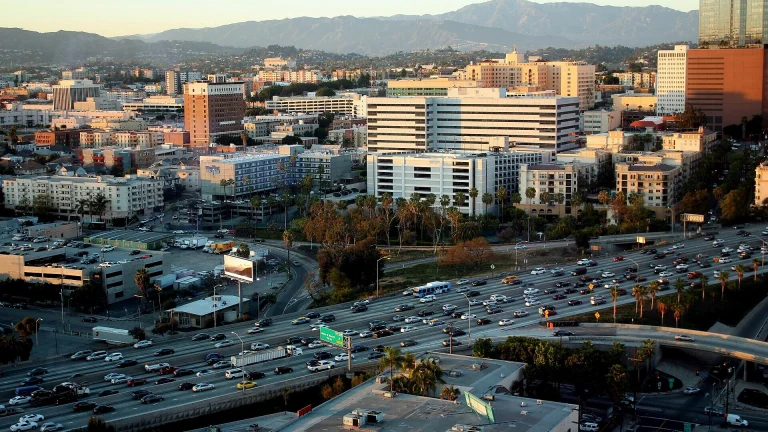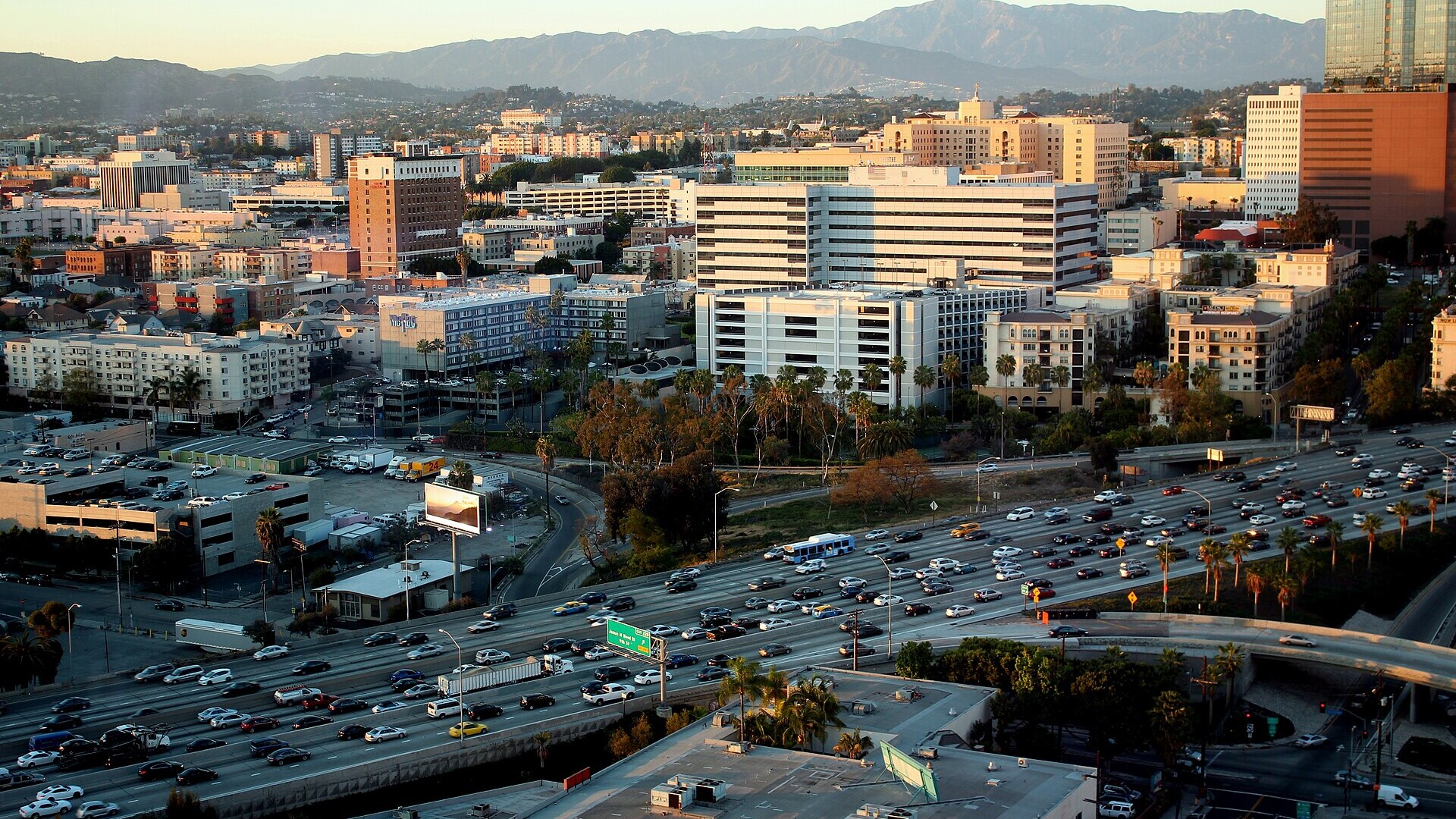
The 110 Freeway at rush hour in downtown Los Angeles. Photo: <a href="https://commons.wikimedia.org/wiki/File:110_Freeway_%40_Rush_Hour_(18322206624).jpg">Prayitno via Wikimedia Commons</a>, <a href="https://creativecommons.org/licenses/by/2.0/">CC BY 2.0</a>
A motorcyclist in the northbound express lanes of Interstate 110 in Los Angeles hit the back of a Tesla at about 7:21 a.m. on Oct. 29, and the crash set him and his bike on fire. He got up and walked away from the wreck with flames still on him.
The California Highway Patrol’s South Los Angeles office posted the civilian dashcam video on its Facebook page this week. The caption says the motorcycle “was splitting lanes in heavy traffic” and that the crash happened as a Tesla in the No. 2 lane moved one lane to the left. Overhead signs in the video show the cars approaching the express-lane exits for 39th Street and Adams Boulevard, near Exposition Park.
CHP told FOX Television Stations that the rider was taken for treatment of moderate, non-life-threatening injuries. A CHP spokesperson told TMZ the investigation was nearly complete and that the Tesla made an unsafe lane change, though the agency could not say whether the move was intentional. CHP has not named the rider or the Tesla driver, and its post doesn’t say whether anyone was cited.
That gives the public two official descriptions of the same crash: a rider splitting lanes, and a driver who changed lanes unsafely. One of the top comments under CHP’s post asks how the bike could be splitting lanes when it appears to be alone in its lane. Under California law, the second description carries more weight, though the rider’s speed could still cost him money.
What the 110 Freeway dashcam video shows
The camera car is creeping along behind the Tesla in heavy morning traffic. The Tesla pulls left into the lane beside the concrete median, the motorcycle comes up from behind and strikes its rear, and fire spreads across the pavement. ABC7 Los Angeles reported that gasoline spilled from the bike’s tank and ignited. On most motorcycles the tank sits directly in front of the rider’s lap, so a split tank or fuel line douses the rider as well as the road. The rider rises out of the fire, walks off and gets most of the flames out. A Florida rider’s bike caught fire at the end of an FHP chase this summer; this one burned in commuter traffic at walking pace.
California’s lane-splitting law and the lane-change rule
California has never banned lane splitting, and the Legislature didn’t define it until Vehicle Code section 21658.1 took effect Jan. 1, 2017, under Assembly Bill 51. The section describes lane splitting as riding a two-wheeled motorcycle between rows of stopped or moving vehicles in the same lane, and it lets CHP write educational guidelines in consultation with the DMV, Caltrans, the Office of Traffic Safety and a motorcycle safety group. It sets no speed limit for the practice. CHP’s motorcyclist safety page tells drivers that lane splitting is legal and that deliberately blocking or impeding a rider in a way that could hurt them is illegal.
The rule that applies to the Tesla driver is much older. Vehicle Code section 22107, on the books since 1959, bars any driver from moving right or left on a roadway “until such movement can be made with reasonable safety,” and requires a signal when another vehicle may be affected. The statute makes no exception for a motorcycle traveling between or beside the lanes. California’s civil jury instruction on section 22107 treats it as a duty of reasonable care. It cites a 1958 state Supreme Court case holding that a driver doesn’t have to know a lane change is safe, only to use reasonable care before making it, and that whether the driver did is normally a question of fact.
Speed differential is the number CHP and the Berkeley data focus on
Most of CHP’s caption comes from the lane-splitting tips the agency published in 2018, including the line that danger increases at higher speed differentials, meaning how much faster the bike is going than the cars around it. Those tips grew out of a 2015 UC Berkeley SafeTREC study of 5,969 motorcyclists involved in California crashes from June 2012 through August 2013, 997 of whom were lane splitting. The researchers found lane splitting relatively safe when traffic moved at 50 mph or less and the rider went no more than 15 mph faster than the vehicles around him. Above a 15 mph gap, the risk of injury rose significantly.
Lead author Thomas Rice told UC Berkeley’s news office that the most common lane-splitting collision involved “a rider traveling too fast when a motorist attempts to change lanes.” The 110 Freeway video shows the second half of that sentence. CHP hasn’t released either vehicle’s speed, so the footage can’t settle whether this rider was inside or outside the 15 mph range.
How California divides fault and the insurance bill
California doesn’t treat fault as all or nothing. In Li v. Yellow Cab Co. in 1975, the state Supreme Court adopted pure comparative negligence: an injured person’s damages are reduced by his own share of the blame, but partial fault doesn’t bar recovery. If an insurer or a jury decided this rider was closing too fast, a claim against the Tesla driver’s liability coverage would shrink by that percentage. It wouldn’t vanish.
The Tesla driver’s exposure turns on a different number. Under Title 10, section 2632.13 of the California Code of Regulations, an insurer can’t rate a driver as principally at fault for a crash unless that driver’s actions or omissions were at least 51% of its legal cause. A principally-at-fault injury accident goes on the driver’s safety record for rating and can cost the Good Driver Discount, which Proposition 103 requires to be at least 20% below the rate the driver would otherwise pay. CHP’s unsafe-lane-change finding is evidence an insurer will weigh. It is not a court ruling or a conviction.
Motorcycle deaths nationally and in California
NHTSA’s newest motorcycle fact sheet, dated July 2026, counts 6,228 motorcyclists killed in U.S. traffic crashes in 2024, down 2.2% from 6,366 in 2023. That 2023 figure is a revision; NHTSA first reported 6,335. The California Office of Traffic Safety puts the state’s 2023 toll at 583 riders killed, down 10.2% from 649 in 2022 but up nearly 19% from 491 in 2019.
What comes next for the 110 Freeway crash
CHP says its collision investigation is close to finished. The completed report will put the agency’s unsafe-lane-change finding in writing, and both insurers will start from it when they split the cost of the bike, the Tesla’s rear end and the rider’s medical bills. CHP’s post doesn’t say whether the Tesla driver will be cited under section 22107.
For drivers in the same spot, the statute and CHP’s guidance are specific: check mirrors and blind spots and signal before any lane change, and in slow freeway traffic expect a motorcycle beside or between the lanes. CHP also asks drivers in the far-left lane to move toward the left side of it to leave riders room. For riders, CHP advises against splitting next to big rigs, buses and motorhomes or lingering in a car’s blind spot, and the Berkeley data puts the risk line at a 15 mph speed gap.
When a car changes lanes into a motorcycle in stop-and-go traffic, should the driver who moved over carry most of the blame, or should the rider’s closing speed count just as heavily?
About the Author