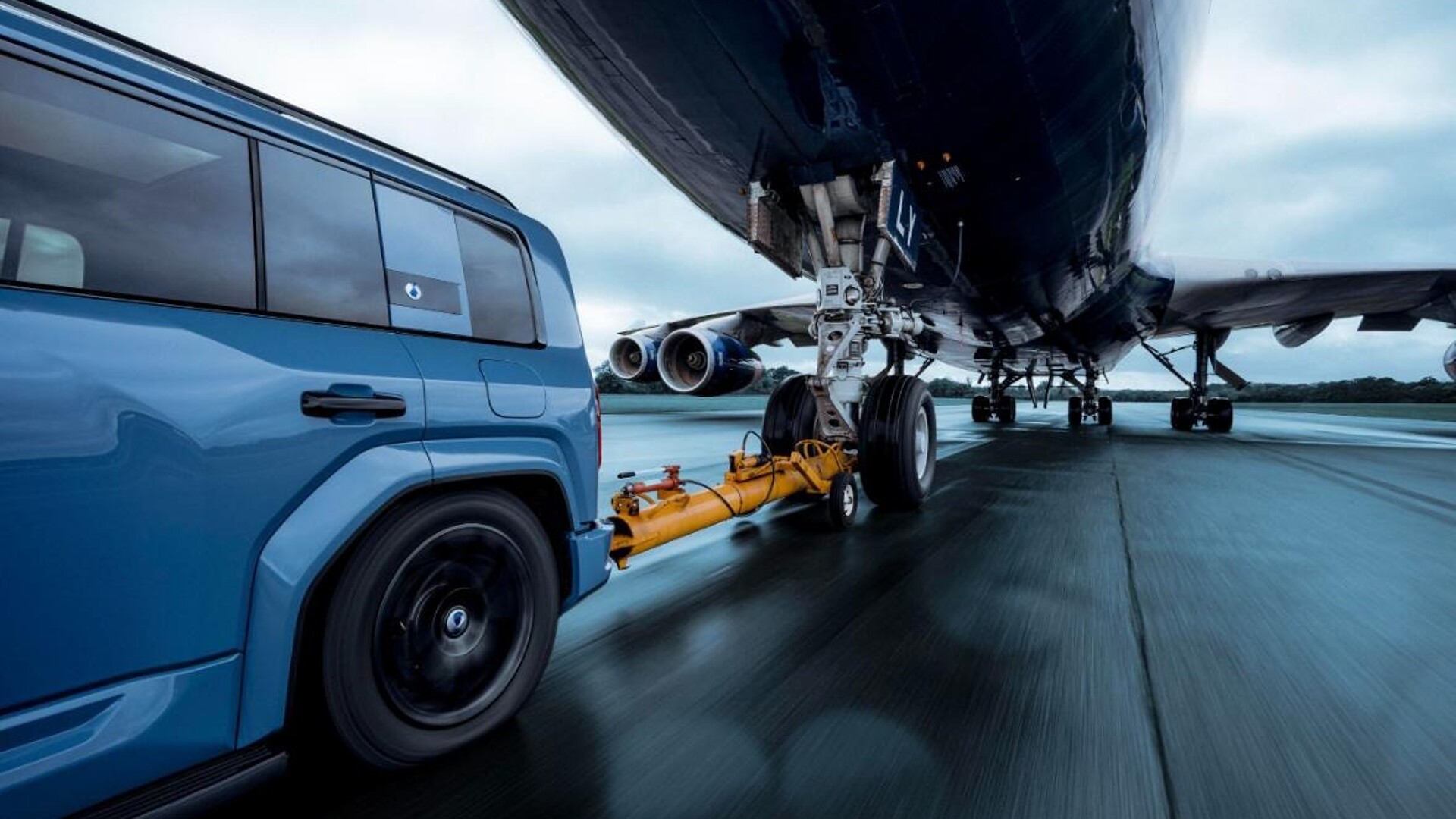
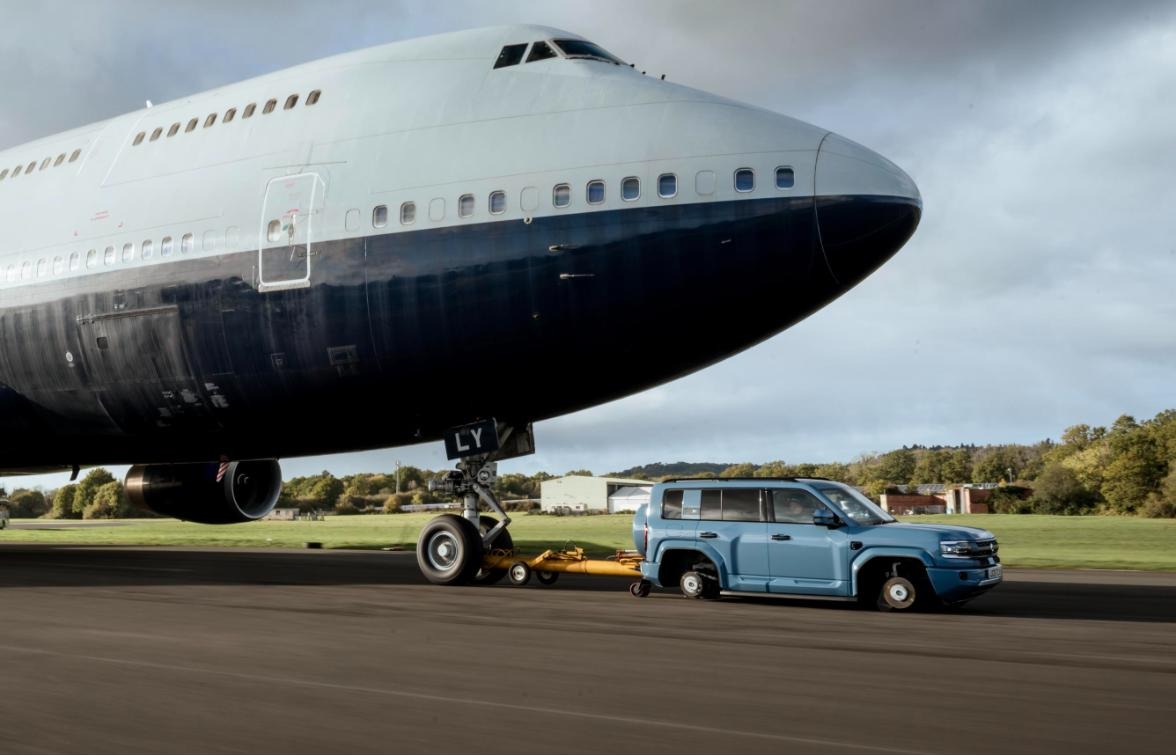
The BAO 5 hooked to the 747-400 nose gear at Dunsfold. Photo: DENZA UK (manufacturer press image)
Seventeen days after BYD sent a Yangwang U9 Xtreme to 312.65 mph on an Abu Dhabi highway, its premium brand Denza towed a 180-tonne Boeing 747-400 with a BAO 5 SUV that had both right-side wheels taken off.
Denza’s November 18 press release calls it the first time a production car has towed a plane on two wheels and the first time a 747 has been towed on electric power alone. Denza’s own photographs add a detail the claim leaves out. At each empty right-side hub, a small solid wheel sits in the arch and rolls on the runway.
The release describes these as small stabilisers “added to each axle to balance out the removal of the two driven wheels.” It doesn’t say whether they carried any of the car’s weight during the runs, or how much.
Why the ballast mattered
At walking pace, a tow like this is limited by grip, not horsepower. The SUV has to overcome the airliner’s rolling resistance through its tyres, and the force a tyre can put down depends on how hard it is pressed into the surface and how slippery that surface is. Denza removed the passenger seats and loaded 2,000kg of ballast for the three-wheel run and 4,500kg for the two-wheel run. The release gives no ballast figure for the four-wheel run.
The spec table attached to the same release lists a kerb weight of 3,035kg, so on the final run the BAO 5 weighed about 7,535kg, almost two and a half times its showroom figure. Whatever share of that rested on the stabiliser wheels did nothing for grip on the driven side. Denza doesn’t give the split.
Taking a wheel off a driven axle creates a second problem. An open differential sends torque to whichever side turns most easily, and a bare hub turns very easily. Denza’s UK model page says the BAO 5’s DMO platform has three differential locks, which would tie each remaining tyre to its empty hub. The release says the powertrain was “completely unchanged” without saying whether the locks were engaged or which drive mode was selected.
What the spec table says
The DMO system pairs a 1.5-litre turbo petrol engine (150PS, 240Nm) with a 272PS, 360Nm front motor and a 388PS, 400Nm rear motor, plus a third motor that works as a generator. Denza quotes 760Nm for the whole system. That is the two axle motors added together, with nothing from the engine.
It fits the electric-only claim. The release still doesn’t say which of the three runs were made with the engine off, or how much of the 31.8kWh battery they used.
Other figures are missing outright. The 1,600 metres Denza quotes is a combined distance for all three runs, including stops for filming and wheel removal, with no split by run and no speed. Post-run checks, Denza says, found no signs of stress on the powertrain, chassis or tyres; no data from them is published. The table rates the car to tow 2,500kg. The aircraft weighed 72 times that.
Torrential rain on the day of the final attempts meant waiting for the runway to dry enough for the tyres to find traction. The driver was BYD UK senior technician Mark Gallifant, whose previous best was a double-decker bus full of fare-paying passengers.
The aircraft
The release identifies the plane only as a 747-400 that left service in 2020 and still has its engines and full interior. In Denza’s photos the nose-gear door reads “LY” and the nose carries “NLY” above the cockpit windows. British Airways announced in December 2020 that G-BNLY, the 747-400 it had painted in its 1984 Landor livery, would become a permanent exhibit at Dunsfold. The jet in Denza’s shots wears navy and pale grey with no British Airways titles on the fuselage.
Dunsfold has done this before
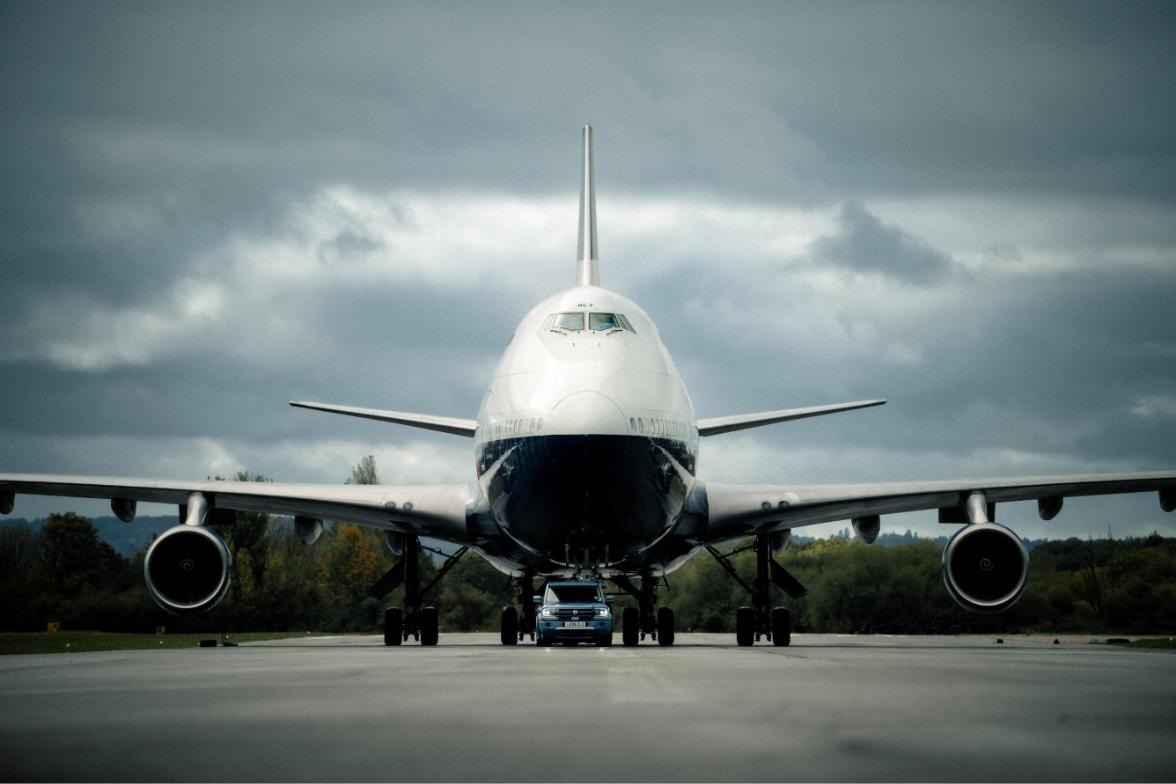
The Surrey airfield, better known as Top Gear’s test track, hosted a similar stunt in November 2006. Volkswagen’s newsroom account says a Touareg V10 TDI towed a 747 of about 155 tonnes there in heavy rain. VW added 4,345kg of steel balls and plates for a total of 7,030kg, fitted the shorter final drive from the Touareg V8 FSI, ran the Michelins at 4.5 bar and pulled the jet roughly 150 metres. The V10 made 750Nm.
The two efforts land close together: about 22 tonnes of aircraft per tonne of Touareg, about 24 per tonne of ballasted BAO 5, with 10Nm more torque on the Denza’s side. The Touareg kept all four tyres on the ground. Denza’s final run put a similar total weight on two driven tyres and two stabiliser wheels, a few weeks after BYD wrecked a U9 Xtreme in testing on the way to its own record.
Denza has posted the runs on YouTube. It has not published how far the two-wheel run went or how the 7.5 tonnes divided between tyres and stabilisers. Two driven tyres plus two small wheels on the tarmac: does that count as towing a 747 on two wheels, or not?
Sources: DENZA UK press release and specification table, 18 November 2026; DENZA UK BAO 5 model page; DENZA UK press images and video; Volkswagen Newsroom Touareg feature; British Airways Media Centre, 1 December 2020.
About the Author