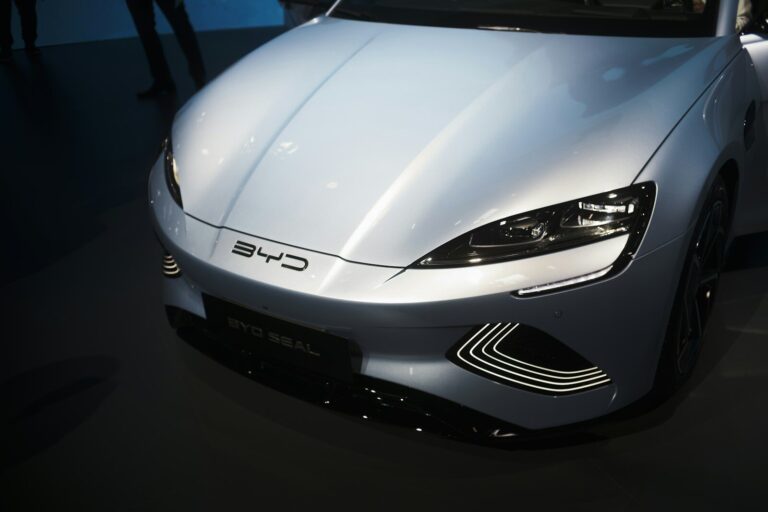
BYD’s luxury brand Yangwang has made an unusual choice about one of its own crashes. It didn’t bury the footage. It put it in a promo video.
On November 1, Yangwang sales boss Hu Xiaoqing announced on Weibo that the U9 Xtreme will make an open-road top-speed attempt in Abu Dhabi. The next day the brand released a teaser that admits the preparation was “并非一帆风顺,” roughly “not smooth sailing.” That’s putting it mildly. During a top-speed shakedown at a closed test facility in China, a U9 Xtreme went sideways on the straight, hit the barrier on one side, and spun across the track into the barrier on the other.
Most of the car was destroyed. The passenger cell held up, and the driver got out on his own.
What the footage shows
In the material Yangwang published, the front and rear of the car are wrecked, the bodywork is torn open, and one butterfly door is bent upward. The central tub, though, looks intact. No fire is visible, which matters a great deal with an 80-kWh battery pack on board. The driver is Jiang Wen, whom Yangwang introduced as a long-serving BYD test driver. After the crash he sits up and walks around the wreck like a man inspecting someone else’s fender-bender.
Related Articles
- Long Island Lamborghini Owner Says Montauk Valets Left the Windows Down in a July Downpour, Sues Gurney’s for $195,201.96
- Ex-Hendrick Employee Says His Supervisor Struck Workers in the Head and Neck for a Decade, and N.C. Appeals Court Lets His Lawsuit Proceed
Yangwang hasn’t released telemetry, an exact impact speed, a date, or a cause. In a behind-the-scenes clip Hu shared afterward, the team describes the impact as happening at roughly 360 km/h, about 224 mph. Until BYD publishes the data, treat that number as the company’s own account, not a measured figure.
Then the team kept testing. Yangwang says the program went on to hit 457.89 km/h on Chinese soil, which it calls a domestic record.
Why the tub survived
The horsepower makes the headline. The tub is the story. BYD has previously listed the U9 Xtreme’s specs as four 30,000-rpm motors, more than 3,000 PS combined, and a 1,200-volt architecture. All of that sits around a carbon-fiber monocoque.
A carbon tub doesn’t crumple. It stays rigid. The crash energy is supposed to go into the structures at each end, the subframes, crash boxes, and suspension, which tear, shatter, and break away so the cell in the middle doesn’t have to absorb it. When a car comes back looking like a deleted video game asset everywhere except the cabin, the structure did its job. Racing cars have worked this way for decades. Seeing it work on a road-legal production car at triple-digit speeds, twice in one crash, is rarer.
The battery chemistry probably helped too. Yangwang uses BYD’s lithium iron phosphate Blade cells instead of a nickel-rich pack. LFP gives up some energy density but is far more resistant to thermal runaway. A pack that survives two barrier hits without venting flames shows that trade-off paying for itself.
The repair bill nobody will pay
Practically speaking, that car is finished. Carbon monocoques aren’t straightened on a frame rack the way steel unibodies are. They get scanned with ultrasound and other non-destructive methods to look for delamination, and a tub that has taken a hit at that speed won’t be cleared to go back into service. Combine that with a 1,200-volt system that needs certified high-voltage technicians, and the car’s next stop is a teardown bay where engineers will treat it as a crash test BYD didn’t schedule.
The manufacturer is self-insured for a prototype on its own test program, so there’s no policy claim to process. Anyone who eventually buys one of the limited 30-car run should read their policy closely: most personal auto policies exclude damage from timed events or high-speed runs, and specialty track-day cover for a multimillion-dollar EV is a separate conversation.
Why Abu Dhabi is the harder problem
The car already holds BYD’s 496.22 km/h production-car top-speed claim, set at Germany’s ATP Papenburg facility. Going the remaining 3.78 km/h to 500 sounds trivial, but it isn’t. At that speed the car covers about 139 meters per second, so the braking zone alone is longer than many airport runways. A closed test facility has run-off areas, banking, and safety crews that have done this before. An open road has crosswinds, heat, sand, and surface variation that no tire engineer specified. Hu herself said the team approaches the attempt “充满期待,也始终保持敬畏,” which means “full of anticipation, and always with reverence.”
Related Articles
- Police Say a Stolen Car With Seven Teens Inside Ended Up in Maine’s Sabattus Pond, and the 16-Year-Old Driver Is Charged With Kidnapping
- Nissan Shoved the New Z’s Twin-Turbo V6 Into an Original S30, and It’s Headed to SEMA
Then there’s the regulatory side. An open-road record needs government sign-off on a full closure, an agreed definition of “production car” (an argument the hypercar world has never settled), and independently verified two-way timing if the number is going to survive scrutiny.
What BYD hasn’t said
Releasing crash footage before a record attempt is either confident marketing or honest engineering. Maybe both. BYD has turned a destroyed car into a public demonstration of its carbon cell and its battery chemistry. What it hasn’t explained is why the car lost control on a straight. Until it does, the impressive part of this story is the crash protection, not the speed.
Would you trust a 500 km/h claim from a company that hasn’t explained why its last test car went sideways?
About the Author