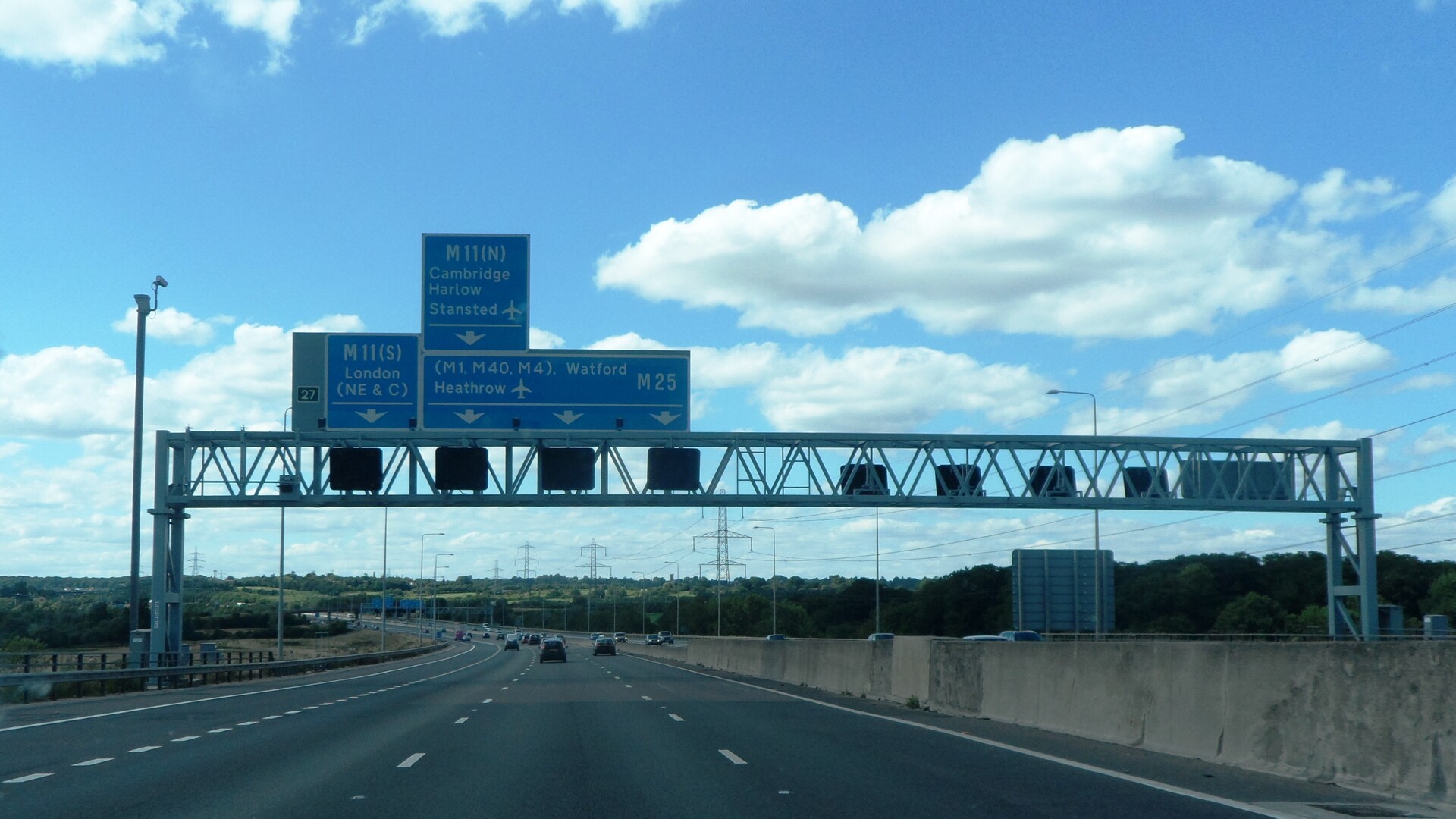
The M25 at Junction 27 in Essex. Photo by Anthony Parkes via Wikimedia Commons, CC BY-SA 2.0
The City TM crew had finished building the closure less than 30 minutes earlier. At about 11:51 p.m. on Sunday, March 15, 2026, a stolen black BMW X5 came through both lines of entrance barriers on the clockwise M25 near Junction 27 in Essex, England. According to City TM’s account of the incident, it was fleeing police at more than 80 mph. It missed all three workers standing inside, barely.
City TM, a traffic management company based in St Albans, released its camera footage this month ahead of Roadworker Safety Week, which runs Nov. 16 to 20. The crew had shut the clockwise carriageway between Junctions 27 and 28, near the M11 interchange, so contractor Tarmac could resurface it overnight. By the company’s telling, more than 45 workers and roughly 20 vehicles had just been let into the site, and the crew was putting the second line of entrance barriers back in place when the BMW arrived.
A dozen police cars followed the BMW in, and the crew got no warning
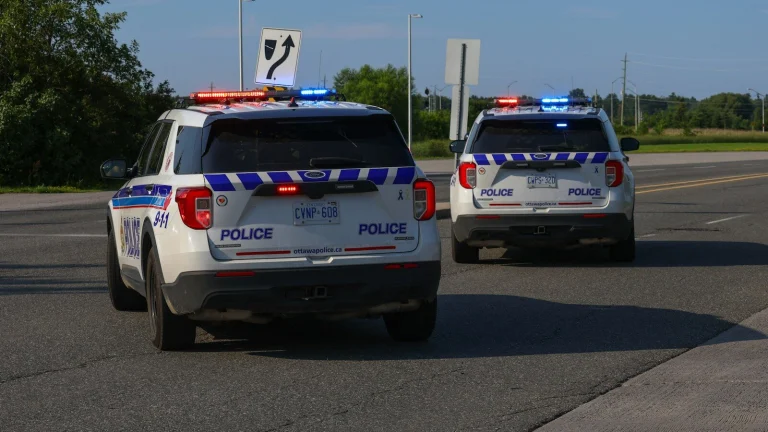
The car was heading from Hertfordshire into Essex. City TM says 12 police vehicles entered the closed section behind it, though not all of them appear in the footage, a count the company says Chris Whales of the Hertfordshire roads policing unit confirmed. The officers came in only after the crew had briefed them and cleared them to enter.
Nobody had told the crew a pursuit was coming their way. When City TM reported the breach to National Highways’ control centre, the company says, the control room replied that it had only just been told about it.
The BMW was later found abandoned in Romford, in east London. A man was arrested close to where it was found, but there was insufficient evidence to charge him with any offence, according to BBC Essex’s report as relayed by the trade site Highways News. I found no published police statement on the arrest, and none of the reports identifies who was driving.
The barriers were never meant to stop a full-size SUV
The closure was set up by the book. City TM says full Chapter 8 signing was in place, the Department for Transport’s standard for temporary traffic management. None of that is physical protection. The company’s own review says entrance barriers on a closure like this are designed to stop site vehicles or a confused driver, not to hold up against a forced breach by someone who has decided to drive through.
A motorway closure works because drivers obey the signs, and on a night shift the barrier line is the last thing standing between traffic and people on foot. Once a driver decides to ignore it, a crew has whatever distance it can get and whatever warning the control room sends. On March 15, by City TM’s account, the warning arrived after the car did.
Driving into a closed motorway carries a fine, and usually no points
Roadworks closures in England are normally backed by a temporary traffic order made under section 14 of the Road Traffic Regulation Act 1984, and section 16 of that act makes it an offence to drive in breach of one. The punishment is set in Schedule 2 of the Road Traffic Offenders Act 1988: the case is heard only in a magistrates’ court, the fine is capped at Level 3 on the standard scale, which is £1,000, and penalty points and a discretionary driving ban apply only when the breach involves a speed restriction. A driver who cuts through a closed carriageway to skip a queue, without speeding, faces no points for the closure itself.
Steal the car first, and the penalties jump. Section 12A of the Theft Act 1968, aggravated vehicle-taking, covers a taken vehicle that is driven dangerously, causes injury, damages property, or is itself damaged. It carries up to two years in prison, rising to 14 years if someone is killed. Dangerous driving is a separate charge with an obligatory ban, and UK courts do send people to prison for it, as a recent wrong-way crash case on the A55 in North Wales shows.
All of those charges need a driver the police can put behind the wheel. A camera clip of an SUV at night proves what the car did. It does not prove who was driving it, and according to the report, the evidence against the one man arrested fell short of a charge. The penalties were right there. Nobody could prove who had earned them.
England’s roadworks see about 30 incursions a week
City TM cites National Highways data recording 814 incursions into roadworks on England’s motorways and major A-roads from January through July 2026, about 30 a week. More than half, by that count, involved drivers trying to get around queues, closures, or diversions on purpose. Tony Carr, City TM’s general manager, wants far more of those drivers prosecuted, with penalties tough enough to make people think twice.
Police vehicles are part of the count too. The industry calls them blue-light incursions, when emergency vehicles enter a restricted work area while responding to a call, and National Highways published a case study in March 2026 on an awareness video Costain made for police drivers about the risk. On the M25 that night, by City TM’s account, officers stopped at the closure, got briefed, and waited to be cleared before following the BMW in.
The lead operative on the M25 that night has left the industry
No one was physically hurt. Work stopped, a roll call accounted for everyone, and the closure was inspected and rebuilt before the resurfacing resumed. Paul Frost, the lead traffic management operative on the shift, described the incursion as “the scariest thing to have happened to me.” City TM says he moved to daytime urban work afterward, still felt unsafe, and has since left the company and the industry. His brother Jamie Frost, also a lead operative, stayed on and has said he now feels more vulnerable and less confident working on the M25.
The No Excuse for Roadworker Abuse campaign, which organizes Roadworker Safety Week, says 60% of roadworkers experienced abuse from members of the public in the past 12 months. Neil Levett, one of the campaign’s organizers, told Highways News the industry is building a national database to record abuse and dangerous incursions, mapping the causes and the types of roads and works where they happen.
Prosecutions are on this week’s roadworker safety agenda
Prosecution is one of the five priorities for this year’s Roadworker Safety Week, alongside reporting, planning, technology, and worker wellbeing. City TM says it is sharing its review of the March incursion with clients, contractors, and industry safety groups. The open questions are practical ones: whether the control room’s warning gap gets fixed, and whether a database of incursions turns into cases a prosecutor can bring.
For anyone driving in England, a closed carriageway is a legal order, and breaking it is a criminal offence. Going through one costs up to £1,000 on its own, and if the way you drive through it counts as dangerous, the charge becomes one that carries a mandatory ban and possible jail time.
Ever sat in a roadworks queue and watched someone go around the cones? Did anything happen to them?
About the Author