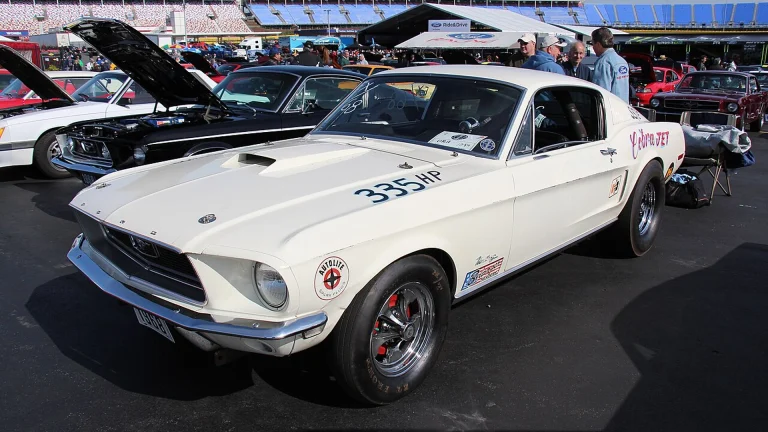
BBC director of entertainment Ed Havard didn’t bury the lede at this year’s Edinburgh TV Festival. Asked about the show’s fate on stage, he said flatly: “There has been a lot of speculation about this and we can confirm that Top Gear is coming back.” That’s the entire announcement. No press release, no teaser video, just a straight answer to a question that’s been hanging over BBC Studios for four years.
What Havard didn’t offer was almost as newsworthy as what he did. No hosts, no format details, no premiere date. When pressed on whether comedian Jimmy Carr, a frequent guest during the Flintoff-McGuinness-Harris era, would be stepping into a hosting chair, Havard gave the answer every publicist dreams of: “Jimmy would be a great host but I won’t be discussing that today.” Former Harlequins rugby player and Celebrity Traitors star Joe Marler is also reportedly in the mix. BBC Studios, which produces the show, isn’t confirming anything beyond the fact that it’s happening.
The more interesting question is why it took four years to get to “we can confirm.” On December 13, 2022, at Top Gear’s test track at Dunsfold Park Aerodrome in Surrey, presenter Andrew “Freddie” Flintoff was driving an open-topped, three-wheeled Morgan Super 3 when it overturned. The former England cricketer suffered serious facial and rib injuries and was dragged face-down under the car for roughly 50 meters. “I thought I was dead,” he said in a Disney+ documentary released last year. He has said he didn’t leave his house for six months afterward except for medical appointments.
The Morgan Super 3 isn’t built like anything else that regularly turns up on British television. It runs a two-front-wheel, one-rear-wheel layout, essentially a reverse trike, with a 1.5-liter three-cylinder Ford engine making 118 bhp sent straight to that single rear wheel, according to Morgan Motor Company’s own specifications. Dry weight is just 635 kg, roughly a third of a typical hot hatch, which makes for a fantastic power-to-weight ratio and a genuinely thin margin for error. Three-wheelers don’t behave like cars when a front wheel unloads mid-corner. A four-wheeled car with one tire losing grip under lateral load still has three other contact patches managing the chassis; a trike loses a huge chunk of its stability triangle the instant that happens, and adding throttle at that exact moment, which is what court filings describe, turns a wheel-lift into a rollover almost immediately.
That sequence is now on the record in unusually specific detail because of an ongoing lawsuit. Paul Rees, a 41-year-old racing and stunt driver, was riding in the passenger seat giving Flintoff real-time instruction, a detail the public didn’t know until Rees filed a claim against BBC Studios in December 2025 seeking up to £150,000 in personal injury damages. According to BBC Studios’ own defense filings, in-car microphones caught Flintoff voicing concern the first time the Morgan’s front wheel lifted mid-corner, only for Rees to reassure him the car couldn’t roll. Approaching the same corner again, Rees can be heard telling him to “turn right… now full power, full power.” The filing states the front wheel lifted again and, because Flintoff kept applying power on Rees’ instruction, the car flipped. BBC Studios disputes the claim entirely, arguing Rees gave “faulty instructions” and never reported an injury at the time or afterward. Rees has not responded publicly to the claim.
It’s a messy dispute partly because Rees wasn’t cast or crew in the traditional sense. He was a specialist adviser feeding real-time driving instruction from the passenger seat, which raises questions about how production insurance and duty-of-care obligations are supposed to apply to that role versus an on-camera presenter. Top Gear has run into this kind of gray area before. James May found himself dealing with his own legal headache over an uninsured classic motorcycle earlier this year, a reminder that the show’s relationship with paperwork has never quite matched its relationship with horsepower.
Flintoff’s own compensation, separate from the Rees lawsuit, was settled back in 2023. The BBC apologized and reached a deal reportedly worth around £9 million, reflecting roughly two years of lost earnings. That figure matters for a reason casual viewers might miss: it was paid by BBC Studios, the BBC’s commercial production arm, not out of the license-fee-funded public service budget. BBC Studios operates as a for-profit subsidiary that sells shows and formats commercially around the world, which is also why Havard was fielding hosting questions at a TV industry festival rather than in a government-funded press briefing. The financial exposure from a bad on-set accident lands on the commercial side of the ledger, not the taxpayer side.
Top Gear has survived worse than a scheduling gap. The show began in 1977 as a straightforward consumer motoring program, then became a global phenomenon in the 2000s once Jeremy Clarkson, Richard Hammond, and James May turned it into something closer to a buddy comedy with cars attached. The Chris Evans and Matt LeBlanc pairing that followed never found that chemistry, and Flintoff, McGuinness, and Harris were still building their own version of it when the Morgan Super 3 ended the conversation. Rollovers involving inherently tippy vehicles aren’t unique to Top Gear, either. Stone Cold Steve Austin found that out the hard way rolling a race rig of his own in the Nevada desert, a good reminder that horsepower-to-weight bragging rights and rollover resistance are two very different spec sheets.
Confirming a comeback from a festival stage is the easy part. It costs nothing and generates headlines. The harder part is what happens before cameras roll again: who signs off on stunts involving amateur-driven vehicles with professional passengers coaching from the seat next to them, what insurance actually covers when the person hurt isn’t the presenter, and whether the new hosts get a format that lets them do genuinely dangerous-looking things without doing genuinely dangerous things. BBC Studios says there will be “more information on Top Gear shortly.” Whether that information includes a rewritten safety playbook, and not just a hosting lineup, is the detail worth waiting for.
About the Author