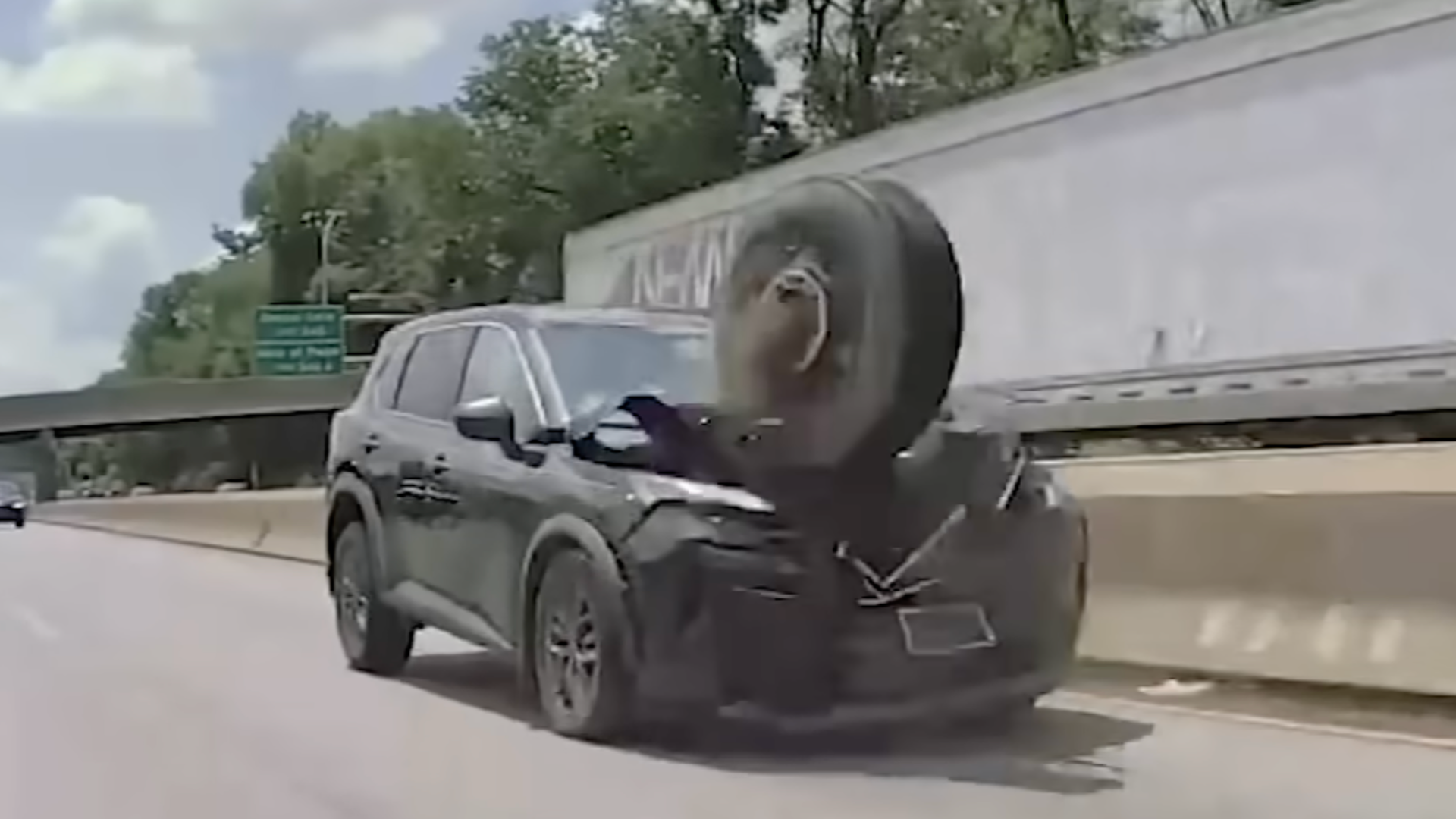
Last Wednesday afternoon on the westbound Schuylkill Expressway near the Girard Avenue exit in Philadelphia, a wheel that had no business being anywhere but bolted to a car bounced off the concrete median and drove itself straight into the front end of a Nissan Rogue. The Rogue’s driver had no time to do anything about it, and neither did anyone else on that stretch of I-76. The only reason anyone can reconstruct exactly what happened is that a Tesla traveling nearby had its cameras rolling the whole time. And yes, we noticed a wandering wheel found the one crossover in its segment with “Rogue” stamped on the tailgate before anyone in the comments could beat us to it.
What Actually Happened on I-76
The incident happened around 12:30 p.m. on Wednesday, July 29, according to the Tesla owner who shared his footage with Philadelphia’s Action News. He was driving westbound on the Schuylkill Expressway when his car’s external cameras caught a tire bouncing over the median before it slammed into the Nissan Rogue traveling behind him. He told the station he heard the impact in real time but didn’t realize what had actually happened until he went back and reviewed his own dashcam clips, a detail that says as much about how routine this kind of camera coverage has become as it does about the crash itself. Nobody has said publicly where the tire came from, whether it was ever traced to a specific vehicle, or whether that driver even knows a wheel is missing.
Why a Loose Wheel Hits Like a Wrecking Ball
A wheel and tire that separates from a moving car doesn’t behave like typical road debris. A shredded truck tire or a dropped bumper cover tumbles end over end and bleeds off speed almost immediately because it’s an unbalanced, irregular shape. A whole wheel assembly is round, balanced, and already spinning on its own axis, so it behaves more like a gyroscope than a piece of trash. It wants to stay upright and keep rolling at close to whatever speed the car was doing the instant it broke free. That’s the difference between something that skids to a stop in the breakdown lane and something that clears a concrete median, crosses multiple lanes of traffic, and still carries enough energy to cave in a hood, a bumper, and a radiator support on impact.
How a Wheel Actually Comes Loose
Runaway wheels are rarely a mystery to a mechanic, even when the public never learns the cause. The most common culprit is lug nuts that were never torqued to the manufacturer’s spec after a tire rotation, repair, or wheel swap. Under-tightened nuts work themselves loose within the first few dozen miles, while over-tightened ones stretch and weaken the studs until they shear off entirely, sometimes weeks later. Corroded studs, a failed wheel bearing, or aftermarket wheels and spacers that don’t properly center on the hub can all produce the same result. Backfire has covered this exact failure mode before: Tesla’s own Cybertruck lineup was recalled over wheels that could separate from the truck, and a different Cybertruck lost a wheel entirely during a promotional off-road outing. Wheel separation doesn’t discriminate by badge, price, or how new the vehicle is. It comes down to fasteners and torque specs every time.
The Insurance and Legal Reality
For the Rogue’s owner, this is likely a comprehensive claim rather than a collision claim in most states. Being struck by an object you never had a chance to avoid typically falls under comprehensive coverage rather than triggering a collision deductible, though the exact classification varies by carrier and policy, so it’s worth a call to an agent rather than an assumption. If investigators ever identify the vehicle the wheel came from, the Rogue owner’s insurer could pursue that driver’s liability coverage through subrogation, but proving which of thousands of cars on a Philadelphia interstate shed a wheel is genuinely difficult without a witness, paint transfer, or the source driver reporting it themselves. And because Pennsylvania’s hit-and-run statutes hinge on knowingly leaving the scene of a crash, a driver who has no idea their wheel came off is looking at a civil negligence problem rather than a criminal one, at least until someone can prove they knew.
The Owner Takeaway
There’s genuinely nothing a driver can do to dodge a tire that clears a median a few car lengths ahead. Reaction time and physics simply aren’t on your side at highway speed. The more useful lesson is preventive: any time your wheels come off for a rotation, repair, or seasonal swap, get them re-torqued within the next 50 to 100 miles, and don’t assume an impact gun set to a guessed number is the same as a torque wrench set to spec. It’s a five-minute habit that costs nothing and prevents exactly this kind of failure. Nissan, for what it’s worth, has had a rough stretch on the recall front lately too. The brand recalled more than 168,000 full-size SUVs this summer over a tire information sticker with the wrong number printed on it, a reminder that wheel-and-tire paperwork problems come in more than one flavor.
As of Action News’ last update, nobody had confirmed whether anyone involved was hurt, and no source vehicle had been named. What’s left is a badly dented Rogue, a viral clip nobody asked to star in, and one more data point for why the growing fleet of camera-covered EVs on the road keeps turning into accidental witnesses to things no one could have scripted.
About the Author