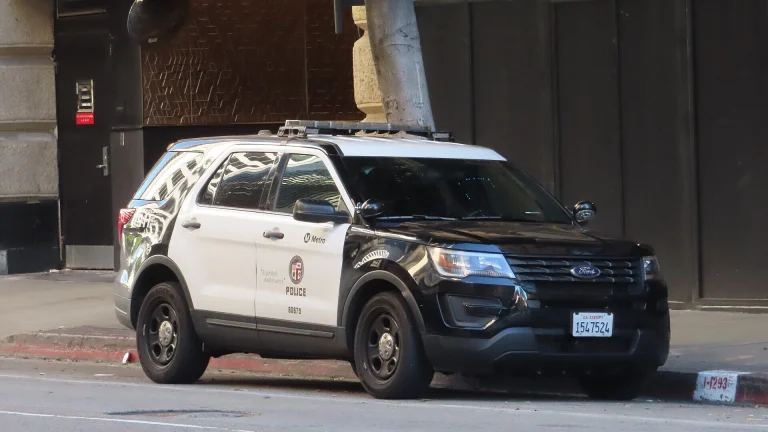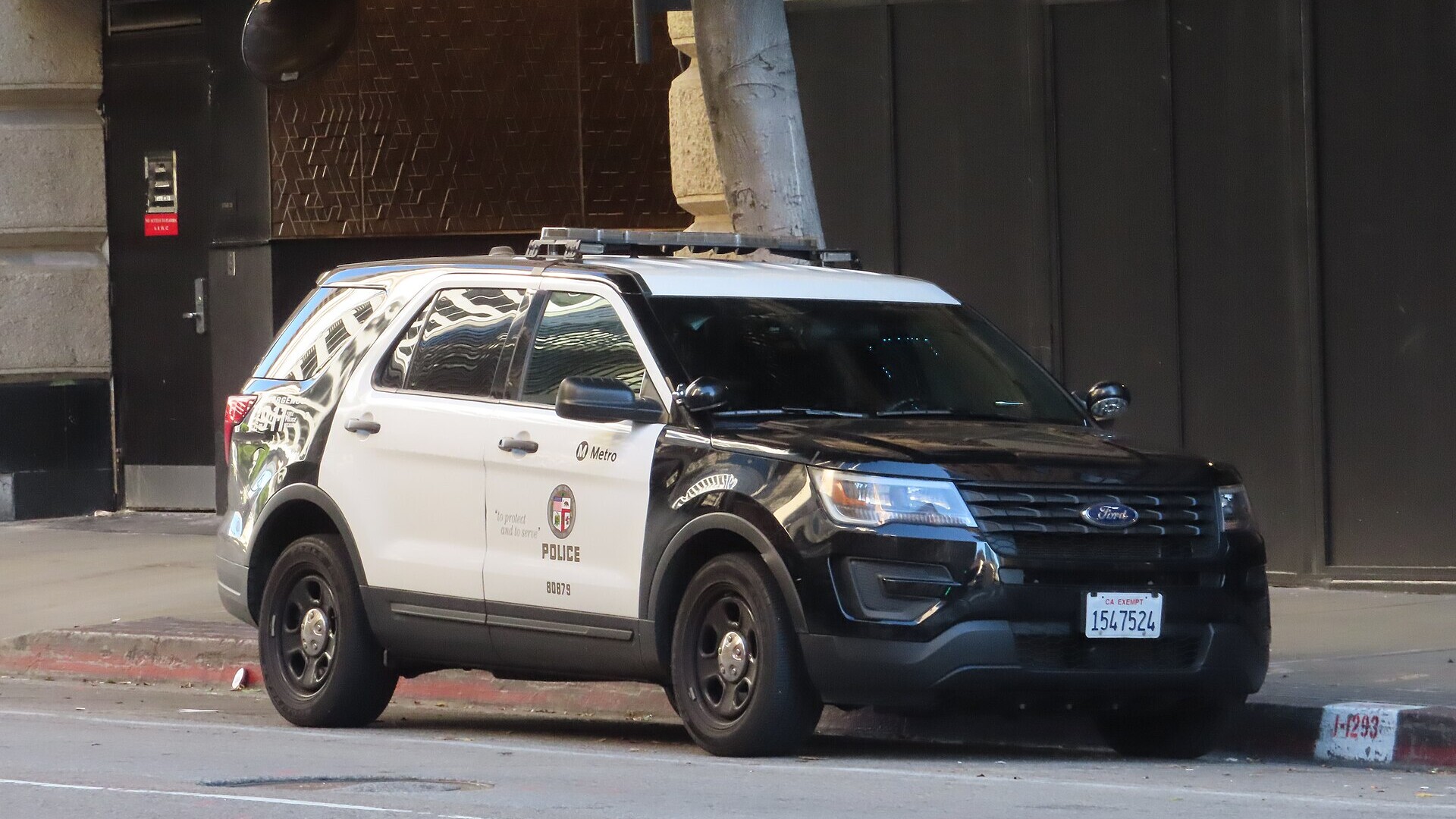
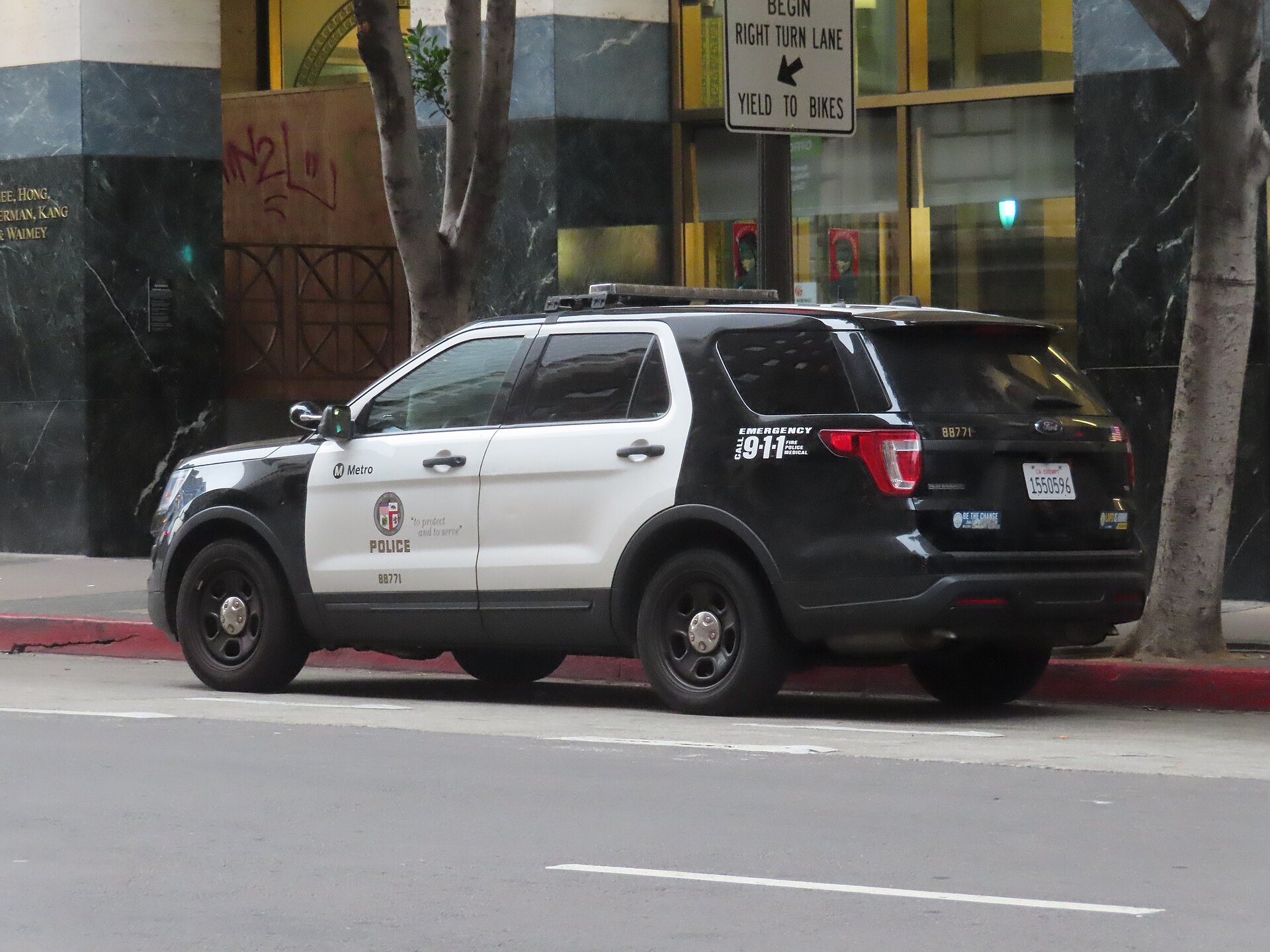
File photo of an LAPD Ford Police Interceptor Utility; not the vehicle in the crash. Photo: Jason Lawrence / Wikimedia Commons (CC BY 2.0)
A Los Angeles Police Department patrol vehicle answering a party call hit and killed a 32-year-old woman on Woodman Avenue near Bessemer Street in the San Fernando Valley section of Los Angeles, California, on Halloween night, according to reports from FOX 11, NBC Los Angeles and CBS Los Angeles. FOX 11 called the neighborhood Valley Village, while CBS Los Angeles called it Valley Glen. CBS Los Angeles reported that firefighters pronounced her dead at the scene and that her family describes her as a mother of two young girls.
Three facts decide how California law treats a crash like this one, and none of them is in the public record yet: whether the call was an emergency, whether the officer had a siren and red lights going, and how fast the vehicle was moving. None of the three local reports carried an LAPD statement on any of them. The LAPD newsroom listing I could reach ended in August, and I could not find a department release on the crash.
What the first reports say
The reports do not agree on the call. NBC Los Angeles said officers were responding to reports of a shooting at a Halloween party attended by hundreds of people, and wrote that there was no evidence of a shooting. FOX 11 said the officer was heading to a party that was drawing 911 calls for being rowdy. CBS Los Angeles said the officer was going to a fight at a large party about a mile away. They also differ on the time: NBC Los Angeles and FOX 11 said about 11:30 p.m., and CBS Los Angeles said about 10:30 p.m.
Where the woman was standing is also unsettled. NBC Los Angeles said she was crossing in a crosswalk, while CBS Los Angeles said it is still unclear whether she was in the street or in a crosswalk. FOX 11 said slick roads from that day’s rain might have played a part but that it is unknown whether they did. Her father told CBS Los Angeles he lives near the crash site and sees vehicles speeding there, some without their lights on, and that officers should be more careful. That is his observation; nothing released so far says what this officer’s vehicle was doing.
What California law gives an officer on a call
The emergency-driving exemption comes with two conditions. Vehicle Code Section 21055 frees the driver of an authorized emergency vehicle from many rules of the road, speed limits included, when responding to an emergency call, but only if the driver sounds a siren as reasonably necessary and the vehicle shows a lighted red lamp visible from the front. A patrol car speeding without both is outside the statute’s protection.
The exemption does not cover carelessness. Section 21056 says it does not relieve the driver of the duty to drive with due regard for the safety of all persons on the road, and it does not protect a driver from the consequences of arbitrarily using the privileges the exemption grants. Civil liability runs on a separate track. Section 17004 shields a public employee from civil damages for injury or death caused while operating an emergency vehicle in the line of duty when responding to an emergency call, and Section 17001 makes a public entity liable for deaths and injuries proximately caused by an employee’s negligent operation of a motor vehicle within the scope of employment. How the two apply together in a given case is for lawyers and a judge to argue, but Section 17004 is written around an emergency call, which makes the nature of this call a fact that matters.
What LAPD’s own rules require
LAPD’s Department Manual, Volume 4, Section 120.40 lets an officer start a Code Three response for an emergency, with examples that include a serious crime in progress and preservation of life, and says the officer should notify Communications Division. An officer who does not start a Code Three response has to obey all traffic laws. The manual repeats the due-regard duty and says officers who arbitrarily misuse the policy can face discipline, civil liability and criminal prosecution. Supervisors are told to assess whether Code Three requests are appropriate.
A reported shooting or a fight with injuries fits those examples more easily than a noise complaint, and the reports describe three different calls. An LAPD roll call training outline from the Emergency Vehicle Operations Course, titled “Code-3 Response: Clearing Intersections,” tells officers to slow down, be ready to stop and clear each lane in turn, even on a green light. It says eye contact with a pedestrian in a crosswalk does not by itself make an intersection safe, and it describes slowing to about 5 mph while clearing lane by lane as safe and slowing to 20 mph while making eye contact with a pedestrian as improper.
Earlier LAPD cases and what comes next
LAPD has handled this kind of case before. In a December 2023 release, the department said an officer in a marked vehicle with emergency equipment activated struck a pedestrian who was crossing Century Boulevard in Los Angeles away from the marked crosswalk, and the pedestrian later died. The Multi-Disciplinary Collision Investigation Team took the case to present to the District Attorney’s Office for filing considerations, and Internal Affairs opened its own investigation. Chief Michel Moore said, “I have very serious concerns regarding the officer’s driving leading up to the collision.”
NBC4 reported in January 2024 that the man’s family filed a claim against the city, that LAPD said the officer was not responding to an emergency call, and that the District Attorney’s review was open with no charges announced at that time. The family’s attorney said the officer had her lights and sirens on without an emergency call. I did not find a later announcement. In September 2025, ABC7 reported that police said a patrol SUV with its lights and sirens on, passing traffic in the median on Figueroa Street in Highland Park, killed a 30-year-old skateboarder, and that the officer was not driving at an excessive speed. Police said the investigation would determine the actual speed.
If the Halloween crash follows the path LAPD described in 2023, speed, lights and siren go to collision investigators, then to prosecutors. The nature of the call is what a civil claim would test. The family has said it wants answers. No claim or lawsuit has been reported, and I found no LAPD announcement on who is investigating. LAPD has not said what the dispatcher told the officer, whether the siren and red lights were on, or how fast the vehicle was going, and those are the facts Section 21055 turns on.
Should an officer answering a party disturbance call be allowed to run lights and siren through a residential street at night, or should anything short of a confirmed life-threatening emergency be driven at the posted limit?
About the Author