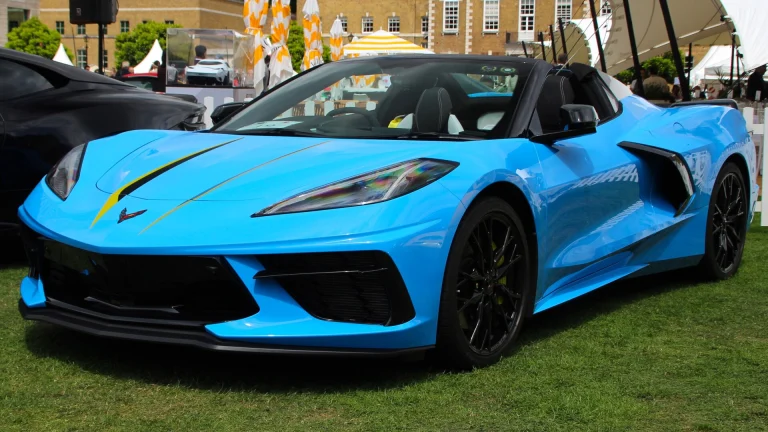

File photo: MrWalkr / Wikimedia Commons (CC BY-SA 4.0)
Federal prosecutors in Washington say a D.C. man, Jomaar Taylor, reprogrammed key fobs on Corvettes sitting on Maryland dealership lots and drove them into the District without buying them. On Nov. 9, an assistant U.S. attorney filed a two-count felony information against him in U.S. District Court for the District of Columbia: conspiracy to transport stolen vehicles across state lines, and possession of a firearm and ammunition by a person with a prior felony conviction. He was ordered held without bond after his March 9 arrest, and the docket I reviewed shows no release.
The charges are allegations. Taylor has not been convicted in this case.
A diplomatic tag that was not on file
The case began with a license plate, not a theft report. On Dec. 1, 2025, a U.S. Secret Service Uniformed Division sergeant noticed a parked black 2025 GMC pickup in Washington wearing diplomatic plates whose letter-and-number sequence looked wrong, according to the affidavit Sgt. Zachary Webster swore in support of the March 2 criminal complaint. The tag did not turn up in the databases he checked. When a sergeant called the Frederick, Md., dealership the truck was registered to, the dealership did not know the truck had been stolen, WUSA9 reported.
A second sergeant matched the same tag to a black Dodge Charger with three orange stripes. The affidavit says the Charger was reported stolen from a dealership in Manheim, Pa., on Nov. 13, 2025. It was later towed for illegal parking in D.C. and released to a man who handed over Taylor’s driver’s license, the affidavit says. A Harford County, Md., detective then linked the GMC to two Corvettes taken on Dec. 7: a white one from Jones Junction Auto and a red one from Bob Bell Chevrolet of Bel Air.
Cellphone data from a phone investigators described as a burner led Secret Service agents to a 2019 black Corvette wearing a fake plate, with its VIN partly covered. Investigators said it came from Waldorf Toyota in Maryland. Garage surveillance described in the affidavit shows two men carrying a device between cars, which the affiant identified as an Autel IM508-type programmer. The affidavit names a second man whom the affiant believes was with Taylor during at least one theft; that man is not charged in the complaint.
The charges narrowed, and a gun count arrived
The March complaint cited three federal statutes: 18 U.S.C. § 2312 (transporting stolen vehicles), § 2313 (receiving or selling them) and § 371 (conspiracy). Prosecutors amended it on March 9. The Nov. 9 information is narrower on cars and wider on weapons. Count Two alleges that from November 2025 through Dec. 12, 2025, Taylor and a co-conspirator agreed to violate § 2312, with overt acts on Dec. 7, when a fob was allegedly reprogrammed on a white Corvette at a dealership, and on Dec. 12, when the same was allegedly done to a black Corvette at a Waldorf dealership. Count One alleges that on March 6, 2026, in D.C., Taylor possessed an AR-style rifle and 20 rounds of 5.56 mm ammunition after a prior felony case in Prince George’s County, Md.
The forfeiture allegation lists what prosecutors want if he is convicted: that rifle, a Glock 43X pistol, two diplomat license plates, programming and diagnostic tools, a drill, a grinder, and cash in two amounts, $9,700 and $6,051.
Why a dealer-lot theft becomes a federal case
A Corvette stolen from a Bel Air lot and kept in Maryland is a state crime. It becomes a federal one when it crosses a line. Section 2312 covers anyone who transports a stolen motor vehicle in interstate commerce knowing it was stolen, and carries up to 10 years. Conspiracy under § 371 tops out at five. The felon-in-possession count carries up to 15 years under § 924(a)(8). Those are statutory maximums; the sentencing guidelines and a judge set the real number.
Knowledge is the hinge. A driver who buys a stolen car in good faith has not violated § 2312. A man who allegedly reprogrammed a fob on the lot and drove off without buying anything has a harder time claiming he didn’t know, and that is how the government pleads it.
A tool sold to repair shops
The device in the affidavit is a commercial product. Autel’s product page for the IM508 pitches it to workshops and technicians and lists key generation, PIN-code reading and all-keys-lost functions; I found no buyer restrictions on it. The documents I reviewed do not say which function was used on the Corvettes. Backfire News has covered the other end of this problem, including a North Carolina man accused of using a cloned key on a Charger and a stolen C8 Corvette that unraveled a $1.3 million theft ring. The cost can land on owners too, as in a Maryland case that left an owner with a $2,398 MVA insurance penalty.
What the docket doesn’t say
The new case is 1:26-cr-00265. A docket entry on Nov. 10 resets hearings, but I could not see its text. A felony can proceed by information only if the defendant waives indictment in open court under Federal Rule of Criminal Procedure 7(b), and the entries available to me do not say whether that happened. The docket listed Diane Shrewsbury as Taylor’s defense attorney at the March hearings, and it shows he conceded to detention for reasons stated on the record. I found no public statement from the defense on the allegations.
Should key-programming tools like the one in this case be sold only to licensed locksmiths and repair shops, or would a registration rule burden the technicians who need them more than it slows down thieves?
About the Author