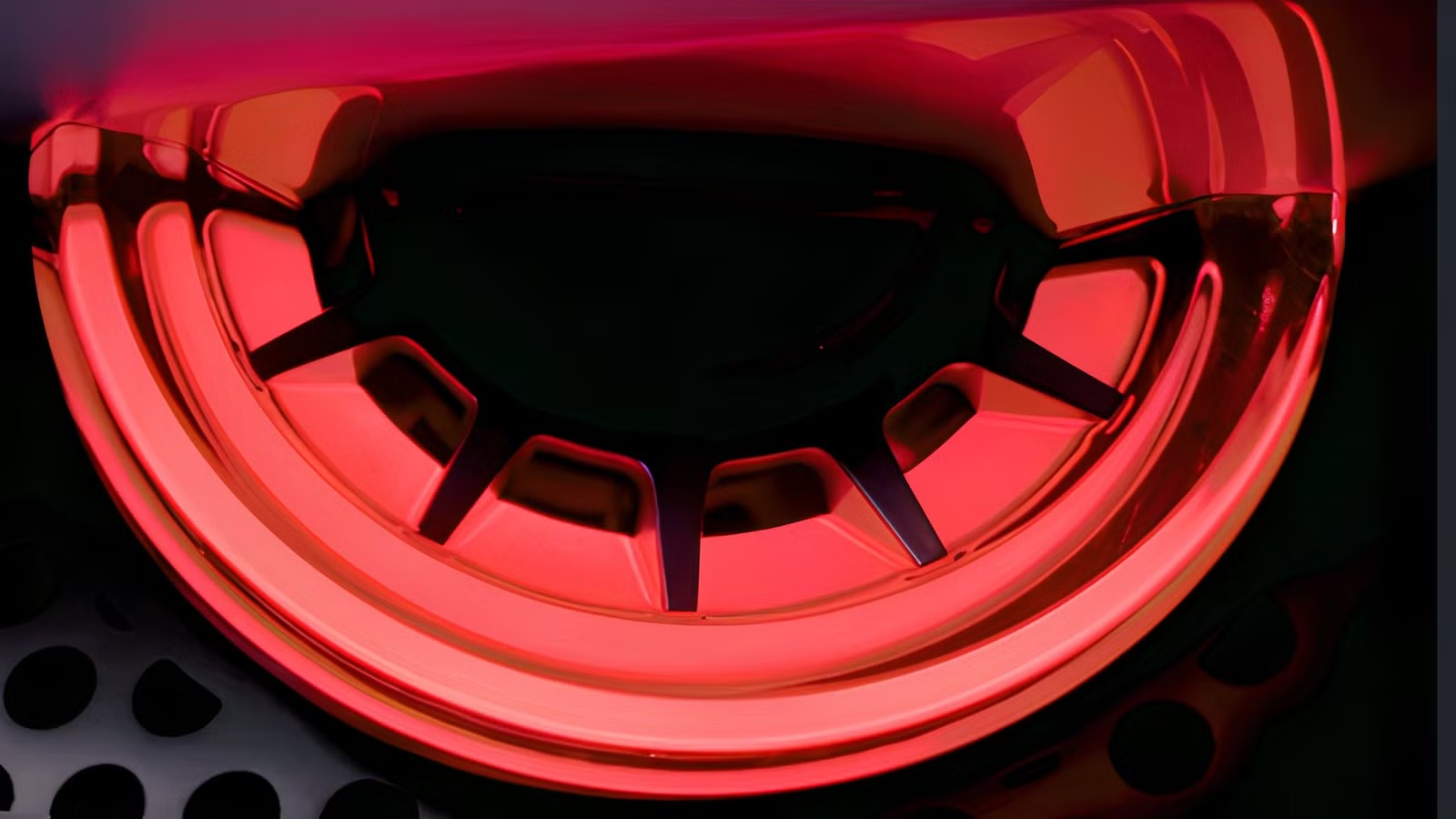
Hennessey Performance just released the second teaser for the car everyone inside the company still calls “Project Overlord,” and unlike every hype cycle that’s come out of Sealy, Texas before it, this one isn’t selling top speed. The new image, posted to Hennessey’s official Instagram account, shows the car’s front-end lighting signature: four individual LED pods tucked into a blade-shaped housing beneath a thin, eyebrow-style running light. The caption is short, “The next icon awakens,” and it locks in a reveal date of August 3, 2026. A week earlier, the first teaser showed a diamond-cut, red-glowing element from the rear of the car, captioned “The mission defines the machine,” alongside hashtags referencing full afterburner and, oddly enough, diamonds are forever.
Four Days Before Monterey, On Purpose
That August 3 date is worth sitting with for a second. Monterey Car Week, the industry’s biggest stage for exactly this kind of reveal, doesn’t officially begin until August 7 this year and runs through August 16. Hennessey is choosing to show its hand four days before the circus arrives, which means either the company wants a clean news cycle without a dozen other manufacturers competing for headlines, or the timing is dictated by production or event logistics we’re not privy to. Either way, it’s a deliberate choice not to simply piggyback on Pebble Beach.
A Pivot Two Years in the Making
The more interesting part of this story predates both teaser images by more than two years. Back in March 2024, Hennessey’s director of design, Nathan Malinick, told an interviewer that the company had quietly shelved Project Deep Space, an electric, six-wheeled, four-seat hyper-GT, to redirect resources toward a different car entirely. The reason, per Malinick, came straight from the customer base: they wanted something manual, high-revving, naturally aspirated, and engaging, not another entry in the horsepower arms race. Founder John Hennessey reportedly began describing the project internally as an American successor to the Porsche Carrera GT, a reference point that says plenty about the target here. The original Carrera GT wasn’t remarkable because of its numbers, 604 horsepower is practically quaint by 2026 hypercar standards, it mattered because of a screaming, Formula 1-derived V10 and a chassis that punished sloppy inputs instead of correcting for them.
Why Naturally Aspirated Is the Hard Way to Get There
That’s a real departure for a brand built on record chasing. Hennessey made its name with the Venom GT’s top-speed runs and the Venom F5’s 300-mph ambitions, so hearing that the new car is not about setting records, it’s about engagement and enjoyment, is a genuine shift in company messaging. Translating that into engineering is where it gets difficult. Turbocharging is the easy path to hypercar-level horsepower; strip it away and you’re left chasing output through displacement, compression, and redline instead, all of which drive up cost, heat management complexity, and the risk of something expensive breaking at high RPM. Hennessey already has a proven turbocharged 6.6-liter Fury V8 in production, but as of the 2024 interview, the company hadn’t settled on an architecture for this car, weighing a V10, a V8, or something else entirely. Given the naturally aspirated requirement customers apparently demanded, don’t expect a de-turboed Fury under the new bodywork, this sounds like a clean-sheet engine.
Hennessey Has Already Proven It Can Build a Manual Hypercar
None of this is happening in a vacuum. Hennessey’s Maverick division, its custom one-off arm, already built the Venom F5 LF, a manual-transmission hypercar making over 2,000 horsepower from that same twin-turbo Fury V8. And the production Venom F5-M Roadster, which Hennessey calls the most powerful manual transmission vehicle ever built, just had its own moment at Goodwood Festival of Speed in early July, pairing 2,031 bhp with a six-speed gated shifter. Both prove Hennessey can keep a clutch pedal alive at absurd power levels. Project Overlord appears to be aiming somewhere else on the spec sheet entirely: lower output, higher revs, and an engine note that no amount of turbocharging can fake. It’s less about beating the F5’s numbers and more about giving Hennessey a second flagship built around a completely different kind of experience.
Hennessey Isn’t the Only One Betting on Analog
It’s also not an isolated bet. Fernando Alonso just took delivery of a one-off manual Pagani Zonda built around a naturally aspirated V12, and Gordon Murray Automotive rolled four naturally aspirated hypercars into this year’s Goodwood specifically because that’s what its buyers keep asking for. If Project Overlord lands anywhere near that company on August 3, Hennessey will have pulled off something nobody expected from the brand that built its reputation chasing top-speed records instead of feel.
Whether the finished car actually earns the Carrera GT comparison John Hennessey has been making for two years is a question nobody can answer from a headlight teaser. We’ll find out on August 3.
About the Author