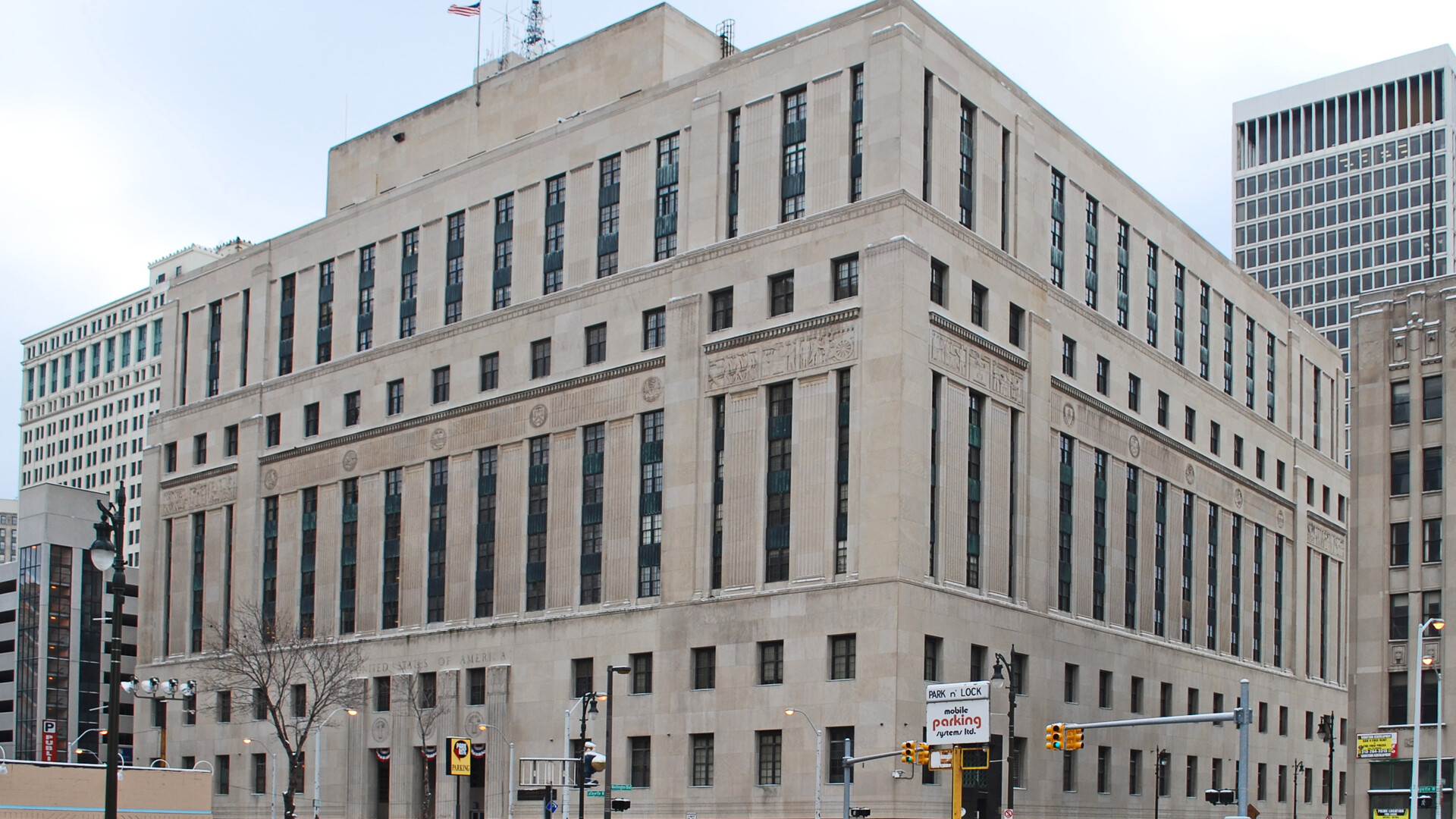
The Theodore Levin United States Courthouse in Detroit. Photo: Andrew Jameson / Wikimedia Commons, CC BY-SA 3.0
Kevin Adell, the Detroit broadcaster who runs The Word Network, filed for Chapter 11 bankruptcy protection on October 23, 2026, days after a federal jury in Detroit ordered him to pay $62.2 million to a Black pastor who had hosted a show on his network, Deadline Detroit reported.
The pastor, Bishop George Bloomer, is among Adell’s 20 largest creditors, who together hold claims of more than $101.8 million, according to the filing as Deadline Detroit described it. The Detroit News reported Thursday that the verdict and the bankruptcy have put the fate of Adell’s personal car collection in question, including the 1949 Buick Roadmaster from Rain Man and the Ferrari 250 GT California replica from Ferris Bueller’s Day Off.
The verdict and what the judge said before trial
Bloomer sued in October 2022 in the U.S. District Court for the Eastern District of Michigan, in Bloomer v. The Word Network Operating Company, No. 2:22-cv-12433, naming the network, Church of the Word and Adell individually. After a five-day trial and one day of deliberation, WDIV reported, the jury found for Bloomer on race discrimination, hostile work environment and retaliation under 42 U.S.C. § 1981. It awarded $9.2 million in compensatory damages, $51 million in punitive damages and $2 million for unjust enrichment.
The claims center on September 2019. In a June 4, 2025 opinion that sent most of the case to trial, Judge Nancy G. Edmunds described Adell showing Bloomer a digitally altered image that Bloomer considered racist, then continuing to call him by a TV character’s name and sending another altered photo after Bloomer objected. Viewing the evidence in Bloomer’s favor, the court said, a jury could treat that conduct as direct evidence of racial animus. The opinion also notes that Adell disputes parts of Bloomer’s account and that he apologized to Bloomer on November 4, 2019.
Adell’s attorneys argued that Bloomer left voluntarily and that race played no part, according to EURweb. A spokesperson told WDIV that Adell had no comment on the case at that time.
Punitive damages under Section 1981 have no statutory cap
Discrimination verdicts under Title VII are limited by statute: combined compensatory and punitive damages top out between $50,000 and $300,000, depending on the size of the employer (42 U.S.C. § 1981a(b)(3)). Section 1981 claims are not covered by that limit, which is how one plaintiff’s case can carry $51 million in punitive damages. The check on the number is the Constitution. In State Farm v. Campbell (2003), the Supreme Court said few awards that exceed a single-digit ratio of punitive to compensatory damages will satisfy due process.
Backfire News’s math puts this award at about 5.5 to 1, inside that range, so any effort to cut it would likely start with the compensatory figure or the evidence. The reports I read mention no appeal plans, and I did not find post-trial motions in the records I could reach.
What the bankruptcy filing does to the judgment
The filing freezes collection. A petition triggers the automatic stay in 11 U.S.C. § 362(a), which stops creditors, including a plaintiff holding a fresh judgment, from seizing or selling property while the case proceeds. A defendant outside bankruptcy who appeals generally has to post a bond or other security to hold off enforcement (Fed. R. Civ. P. 62(b)), and on a $62.2 million judgment that is an expensive requirement.
The stay delays collection and leaves the debt in place. A Chapter 11 plan has to give each unsecured creditor at least what it would receive in a liquidation (11 U.S.C. § 1129(a)(7)), and for an individual that value includes non-exempt property, which is where a car collection comes in. Exemptions that shield a vehicle are measured in thousands of dollars, so a car bought for $350,000 is worth far more to creditors than the law lets a debtor protect.
Bloomer’s side could also ask the bankruptcy court to rule the debt non-dischargeable. An individual’s Chapter 11 discharge does not cover debts excepted by 11 U.S.C. § 523, which includes injury that is willful and malicious. Whether a jury’s discrimination findings meet that test is a question for the bankruptcy judge. I have not seen Adell’s asset schedules, so which cars he holds personally and which sit inside a company is unconfirmed.
The two cars
The Buick is a 1949 Roadmaster convertible. Fox 2 Detroit reported that Adell paid $350,000 for it at auction and agreed to lend it to an Autos for Autism benefit in New Baltimore, Michigan. He told the station the film made him aware of autism.
The Ferris Bueller car was never a Ferrari. The film used replicas of the 250 GT California, and Entrepreneur reported in 2022 that three were commissioned for the production and that one had recently sold at auction for $337,500. That report does not say whether it was the car now in Adell’s collection, and I could not confirm what his car is worth. For where other screen cars ended up, see our rundown of famous TV and movie cars and where they are now.
What happens next
The bankruptcy court sets the deadlines for Adell’s asset schedules and for creditors to challenge discharge. The first things to check are whether either car appears on those schedules under his name, and whether Judge Edmunds’ judgment stands against him after any post-trial motions.
Should a judge trim a jury’s $51 million punitive award to leave more for a debtor’s other creditors, or should the verdict stand even if collector cars have to be sold to pay it?
About the Author