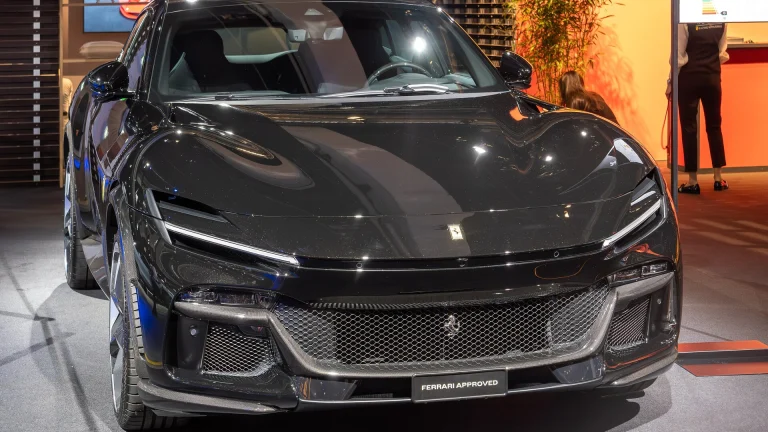
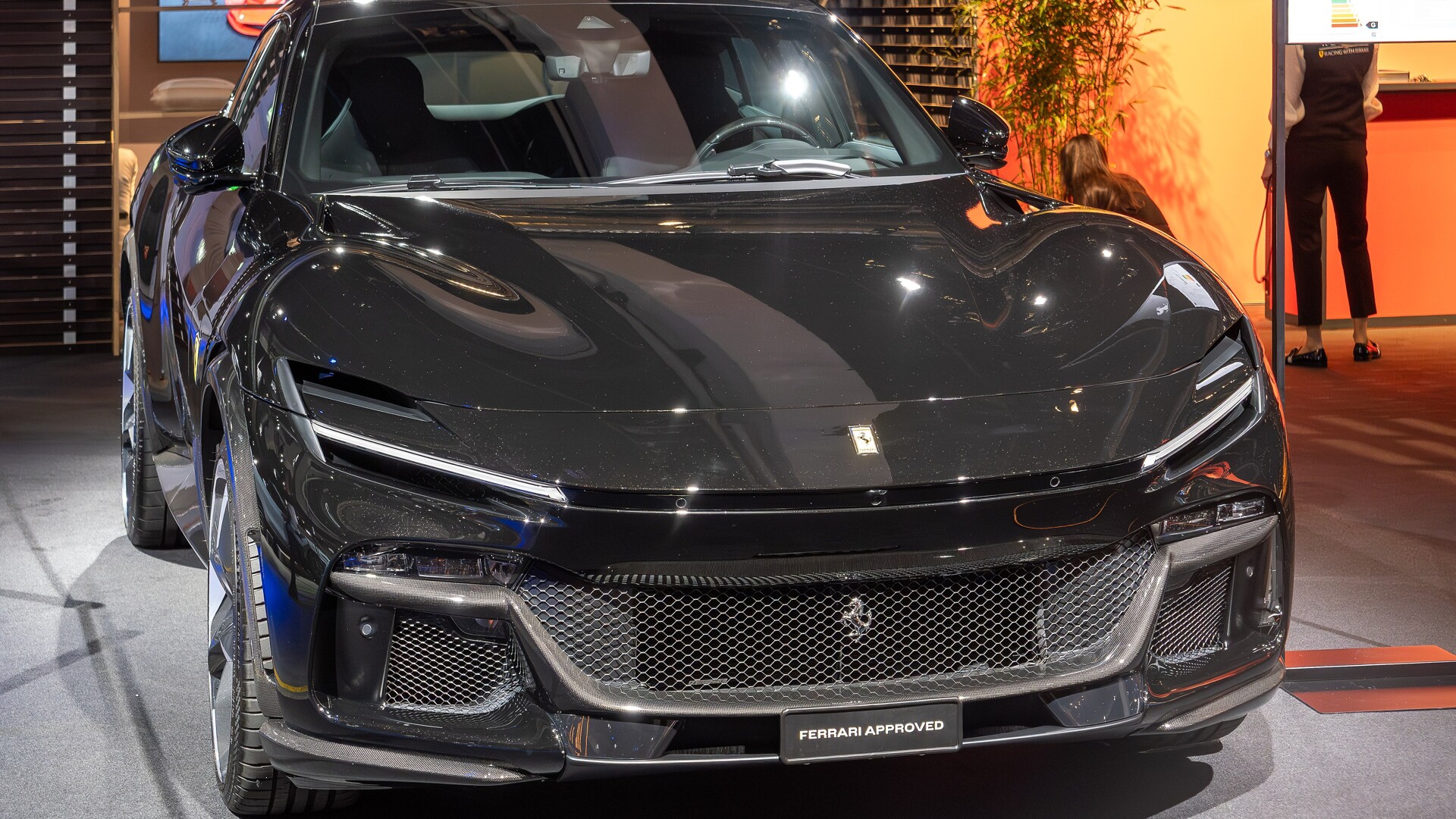
A Ferrari Purosangue on display at Auto Zürich 2025. This is not the Beverly Hills police car. Photo: Matti Blume, CC BY-SA 4.0, via Wikimedia Commons.
Beverly Hills, California, spent early November passing around dashcam video of a Ferrari driver clocked at 52 mph in a 25 zone who tried the police chief’s name on the officer. On Nov. 20, the Beverly Hills Police Department showed up with a Ferrari of its own: a V12 Purosangue in black-and-white police livery, introduced in a joint Instagram post from Ferrari Beverly Hills, the department and Master Protection Films, a Los Angeles paint-protection-film shop.
The dealership’s caption calls the four-seat SUV the department’s “newest fleet vehicle” and says Ferrari Beverly Hills and BHPD “have joined forces to keep the streets of Beverly Hills safe.” It tells followers to catch the car at the LA Auto Show “and on road for a limited time,” then links to JoinBHPD.org, the department’s hiring site. BHPD’s account added a comment under the post: “Thank you @ferraribeverlyhills! We love working with our local businesses.”
Neither the caption nor the department’s reply says who holds title to the car, whether the city paid anything for it, how long “a limited time” lasts, or whether it carries the red light and siren a police vehicle needs to chase anyone. Under the California Vehicle Code, the answer to the first question settles most of the others. Whose name is on the title decides whether this Purosangue can work as a police car or only dress as one.
View this post by Ferrari Beverly Hills, Master Protection Films and the Beverly Hills Police Department on Instagram
Video: Ferrari Beverly Hills, the Beverly Hills Police Department and Master Protection Films, via Instagram.
What the Ferrari Beverly Hills video shows
The clip opens on a car under a red Ferrari cover in Master Protection Films’ studio. When the cover comes off, the front doors read Beverly Hills Police, and the rear glass carries the dealership’s Instagram handle, @FERRARIBEVERLYHILLS, in white capitals above the Ferrari script. Patrol cars don’t usually carry a business’s social media handle.
The hardware is the stock Purosangue. Ferrari rates its naturally aspirated 6.5-liter V12 at 725 cv, about 715 hp, and quotes 0 to 100 km/h in 3.3 seconds. On the price side, Ferrari’s own pre-owned site lists a 2024 Purosangue at Ferrari Beverly Hills with 2,265 miles for $599,000. That is a used one.
California’s police-paint law exempts car dealers
California regulates what a traffic-enforcement car looks like because a ticket can depend on it. Vehicle Code Section 40800 says an officer on duty “for the exclusive or main purpose” of enforcing the rules of the road must wear a full distinctive uniform, and any car the officer uses “shall be a distinctive color specified by the commissioner” of the California Highway Patrol. The CHP’s color rule allows several schemes, including a black body with white front doors, with the agency’s name readable in daylight from 50 feet.
The enforcement teeth sit in Section 40804(b). An officer on traffic duty who makes a speeding arrest while “using a motor vehicle not painted the distinctive color” is “incompetent as a witness” in that case. The rule does not reach officers assigned only to vehicle theft, hit-and-run, felony or warrant work.
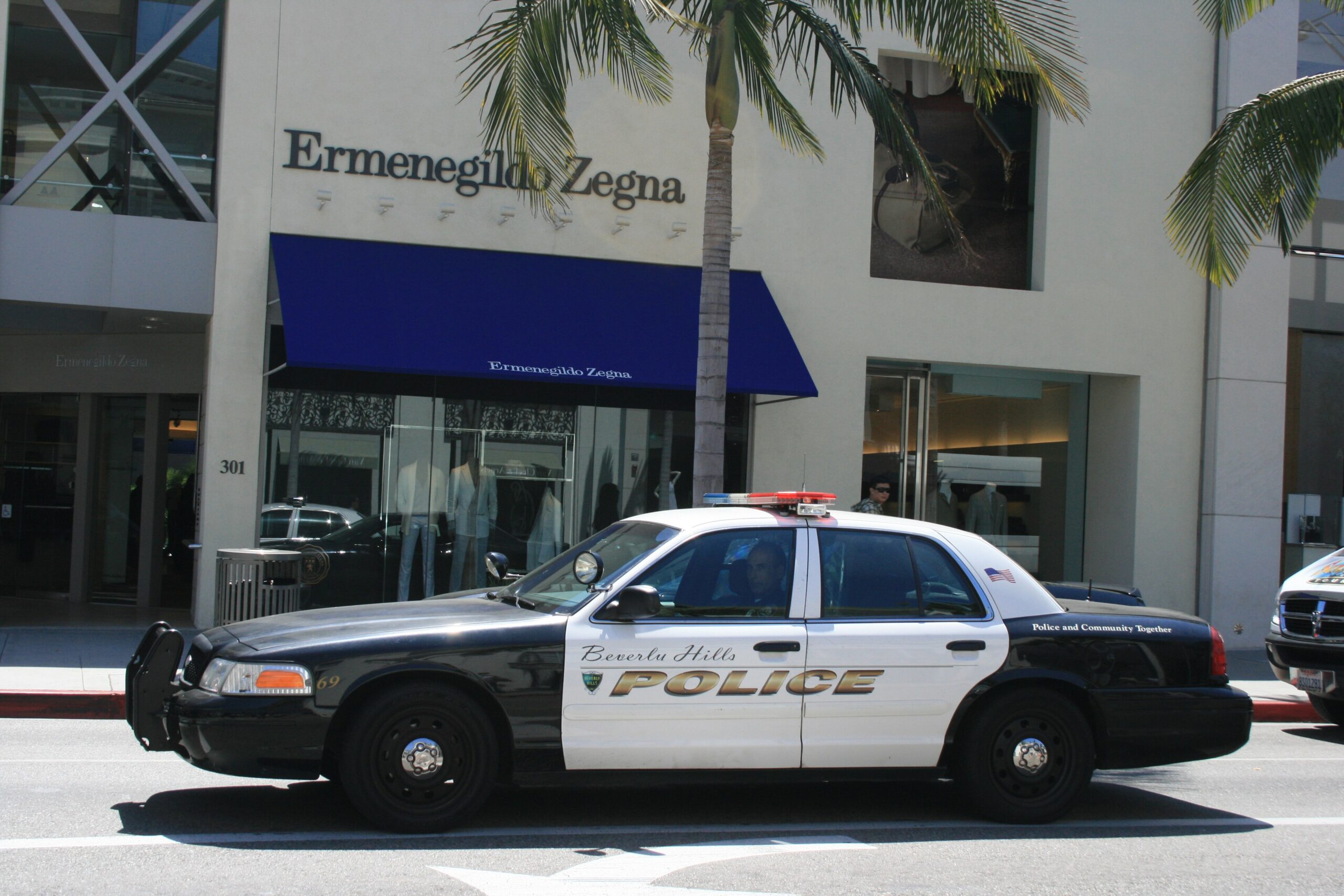
The same colors are off-limits to the public. Section 27605 bars anyone from owning or operating a car painted to resemble a traffic-enforcement vehicle, then lists who is excused. Cars used by police agencies for traffic enforcement are excused. So is a vehicle “owned by vehicle manufacturers or dealers.” Under that line, Ferrari Beverly Hills can keep a black-and-white Purosangue on its showroom floor indefinitely. A customer who bought the same car could not legally drive it home in that paint, unless it fits another exemption such as a solid color or a pre-1979 registration. A separate section, 27606, applies the same ban to roof light bars and fake light bars, without the dealer exemption.
A police paint job doesn’t make an emergency vehicle
Running red lights and exceeding the limit during a chase is legal in California only for an “authorized emergency vehicle,” and only when Section 21055 is satisfied: the car is responding to an emergency or pursuing a suspected violator, the siren is sounding as needed, and a red light is showing to the front.
Section 165 defines who qualifies. For police, it covers “any publicly owned vehicle” operated by an agency that employs peace officers, for use in their duties. A privately owned car gets there only through subdivision (f), which covers a vehicle with an authorized emergency vehicle permit issued by the CHP commissioner. If the dealership still holds title to the Purosangue, the badge on the door does not make it an emergency vehicle. It would need a CHP permit, or the city would need to own it. The posts don’t say which, if either, applies.
The caption uses both descriptions. A “fleet vehicle” is one a department runs, “on road for a limited time” reads like a loan, and the posts don’t say which this is.
Los Angeles police have borrowed exotics before, and Dubai buys them
Beverly Hills is not the first Los Angeles-area department to wear someone else’s supercar. In March 2014, the Associated Press reported that the LAPD was getting a Lamborghini. LAPD Officer Sally Madera said the car was “privately owned” and would be loaned to the department for “charity events and recruitment.”
Dubai runs the opposite model. Its police force added a Mansory-modified Purosangue in late 2025 to mark 12 years of its luxury patrol fleet, Gulf News reported, describing it as one of seven such cars in the world and assigning it to tourist areas including Burj Khalifa and JBR. The paper put the fleet at 56 vehicles. Backfire News has followed that program from its Mansory Ferrari 812 to a Lamborghini Temerario, and in Dubai the cars are assigned to tourist patrol. The Beverly Hills post promises an auto show weekend and an undefined stretch on the street.
The recruiting math behind the BHPD Ferrari
The link at the end of the caption explains who the car is for. JoinBHPD.org advertises a $111,285 annual base salary for entry-level trainees, paid while they attend the academy, plus a $35,000 signing bonus. Experienced officers from other departments are offered $118,118 to $146,749 and a $45,000 bonus. By Backfire News’s math, the $599,000 asking price on that used Purosangue would cover the base pay of five new trainees, $556,425, with money left over. If the car is on loan, the department pays none of that.
Not every reader of the post was sold. One commenter argued the car’s value could pay for more officers and pointed out that the car can’t be used for PIT maneuvers.
Where the Purosangue goes after the LA Auto Show
The LA Auto Show runs through Nov. 29 at the Los Angeles Convention Center, so anyone who wants to see the car up close has until then. After that, the caption’s “limited time” on Beverly Hills streets begins, with no end date published.
For drivers in Beverly Hills, the practical points come straight from the code. A traffic officer whose main job that day is enforcement has to be in a car in the CHP-approved colors, and the Purosangue’s black body and white doors appear to fit that pattern. Whether it can legally run lights and siren behind you depends on ownership or a CHP permit, which nobody has disclosed. When the loan ends, California law lets the dealership keep the police paint on the car, and it does not let the next owner drive it that way.
If the city doesn’t own it, it’s a recruiting poster on wheels with @FERRARIBEVERLYHILLS across the back glass. Would you want your department’s badge on a car a dealer can take back?
About the Author