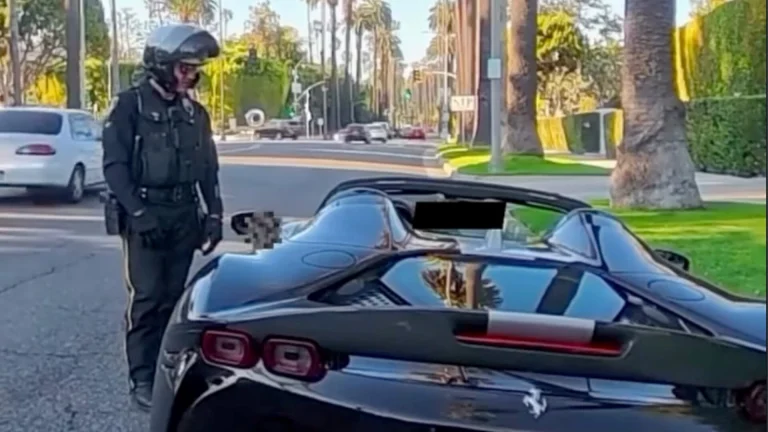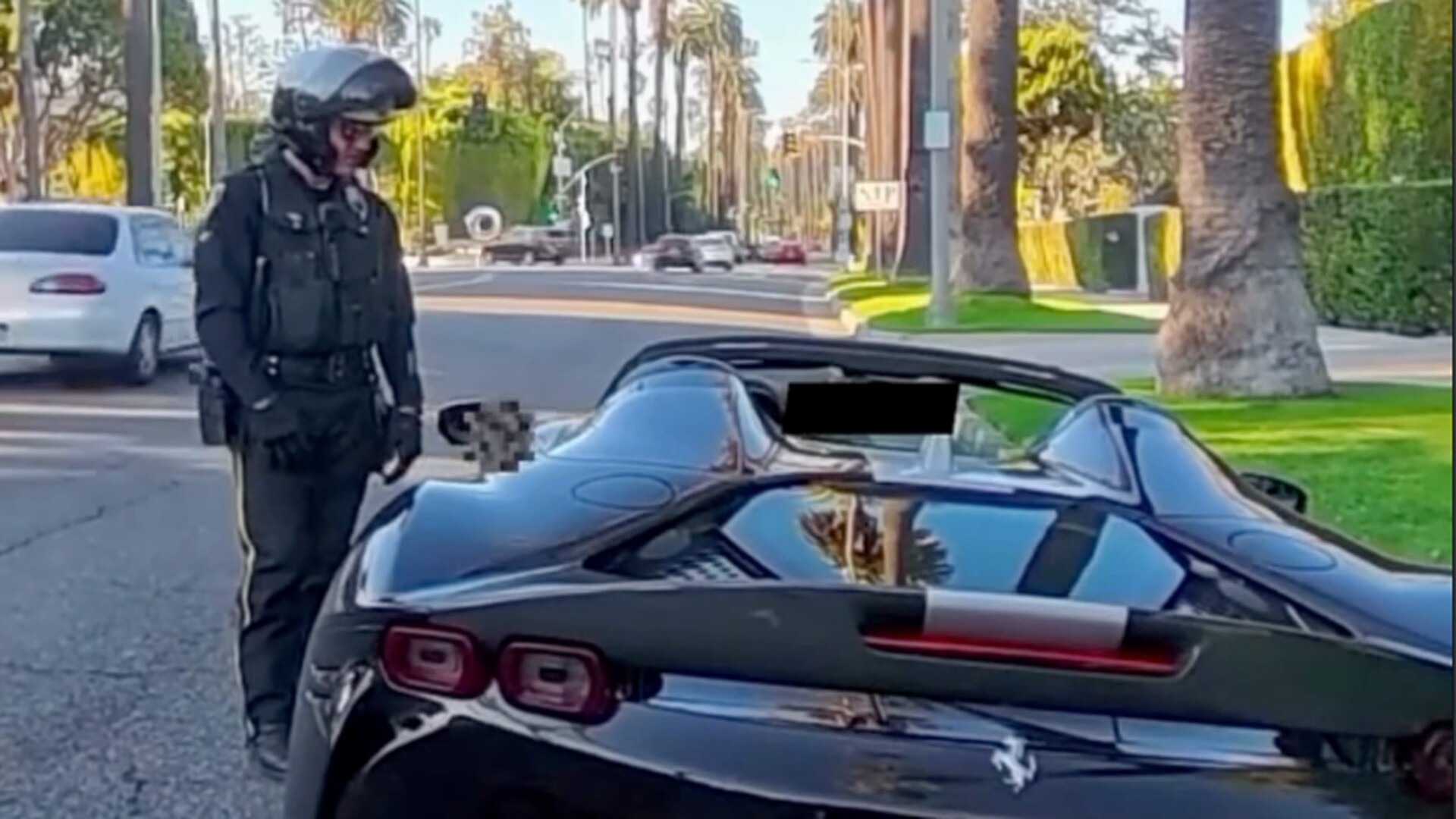
Frame from Beverly Hills Police dashcam video shared by Mayor Sharona Nazarian. Credit: KTLA 5 News via Instagram
A Ferrari driver stopped for speeding in Beverly Hills, California, asked the officer, in the words of a caption on the dashcam video, “do you know Mark Stainbrook,” the police chief at the time. According to KTLA, the officer had clocked the black Ferrari at 52 mph in a 25 mph zone. Beverly Hills Mayor Sharona Nazarian posted the officer’s dashboard-camera footage to Instagram over the weekend, and KTLA reported on it Monday.
Video: KTLA 5 News on Instagram, using Beverly Hills Police dashcam footage shared by Mayor Sharona Nazarian.
What the officer heard before the chief’s name came up
KTLA reports the driver opened by saying he did not know how fast he was going. The officer answered, “I don’t believe you,” and then, “You had some fun, and you got caught.” The driver next said he was rushing to get treatment for an infection; a caption in the video has him saying he was trying “to treat an infection that I have.” When that did not work either, KTLA reports, he brought up Stainbrook, and the officer stayed unmoved.
Later in the video, a caption has the officer telling him, “okay I need you to sign here in the yellow box.” KTLA’s report does not say whether the driver was cited, and it does not name him. The stop apparently happened early this year, according to KTLA, so the chief he named has since left: the city announced on May 8, 2026 that Stainbrook would retire effective June 26, 2026.
Fifty-two in a 25 is more than double the limit
The arithmetic is 27 mph over, or 2.08 times the posted speed. California Vehicle Code section 22352(b)(1) sets 25 mph on any highway in a business or residence district unless local authority or the state transportation department sets a different speed, and that limit is “prima facie,” meaning the statute treats it as the default that applies unless changed as the code allows. A separate law, the basic speed law in section 22350, bars driving faster than is reasonable or prudent for conditions and never at a speed that endangers people or property. KTLA does not say which section the officer used; pairing these two with the stated speed is Backfire News’s reading.
The cost depends on the Judicial Council’s 2026 Uniform Bail and Penalty Schedule, adopted December 12, 2025. It places speeding offenses in Category 4 and sends them to a separate Speed Chart instead of listing one flat fine, so the total for 27 over turns on that chart plus the add-ons the state and county stack on top. Next door in Los Angeles, a speed camera pilot is set to fine drivers $50 at 11 mph over, and a camera has no use for a police chief’s name.
What the signature in the yellow box does
Under Vehicle Code section 40504(a), a driver given a notice to appear signs a written promise to appear in court, and the officer hands the driver a copy. It is the point where a roadside conversation becomes a case file. What came after the signature, whether the driver paid, contested the ticket, or did something else, is not in KTLA’s report or the clips.
Why a chief’s name is a weak card to play
A name-drop asks the officer to treat his own chief as a favor to be cashed. An officer who lets a 52 in a 25 go on a stranger’s word takes the risk on himself, with his own dashcam recording the decision and, as the mayor’s post shows, with the city able to play it back months later. That is Backfire News’s reading of the video, not a statement from the department. KTLA’s report does not say why the mayor chose to post the clip now, and nothing in it points to a court date or other next step for the driver; the open question is whether Beverly Hills police or the mayor’s office will say what became of the stop.
Should an officer who clocks a driver at more than double the limit always write the ticket, or should a warning stay on the table?
About the Author