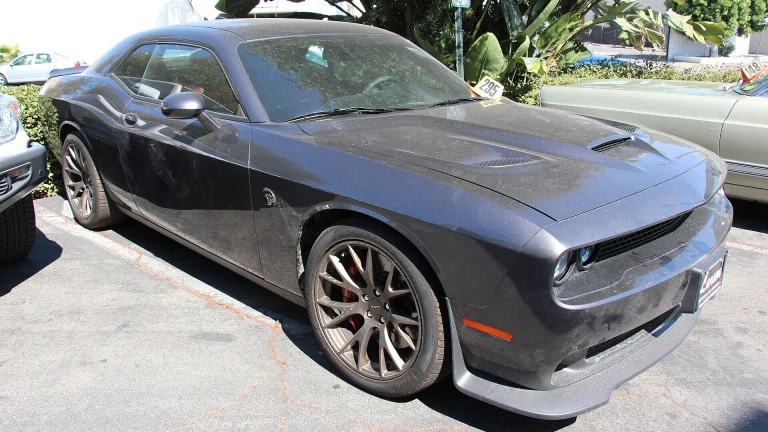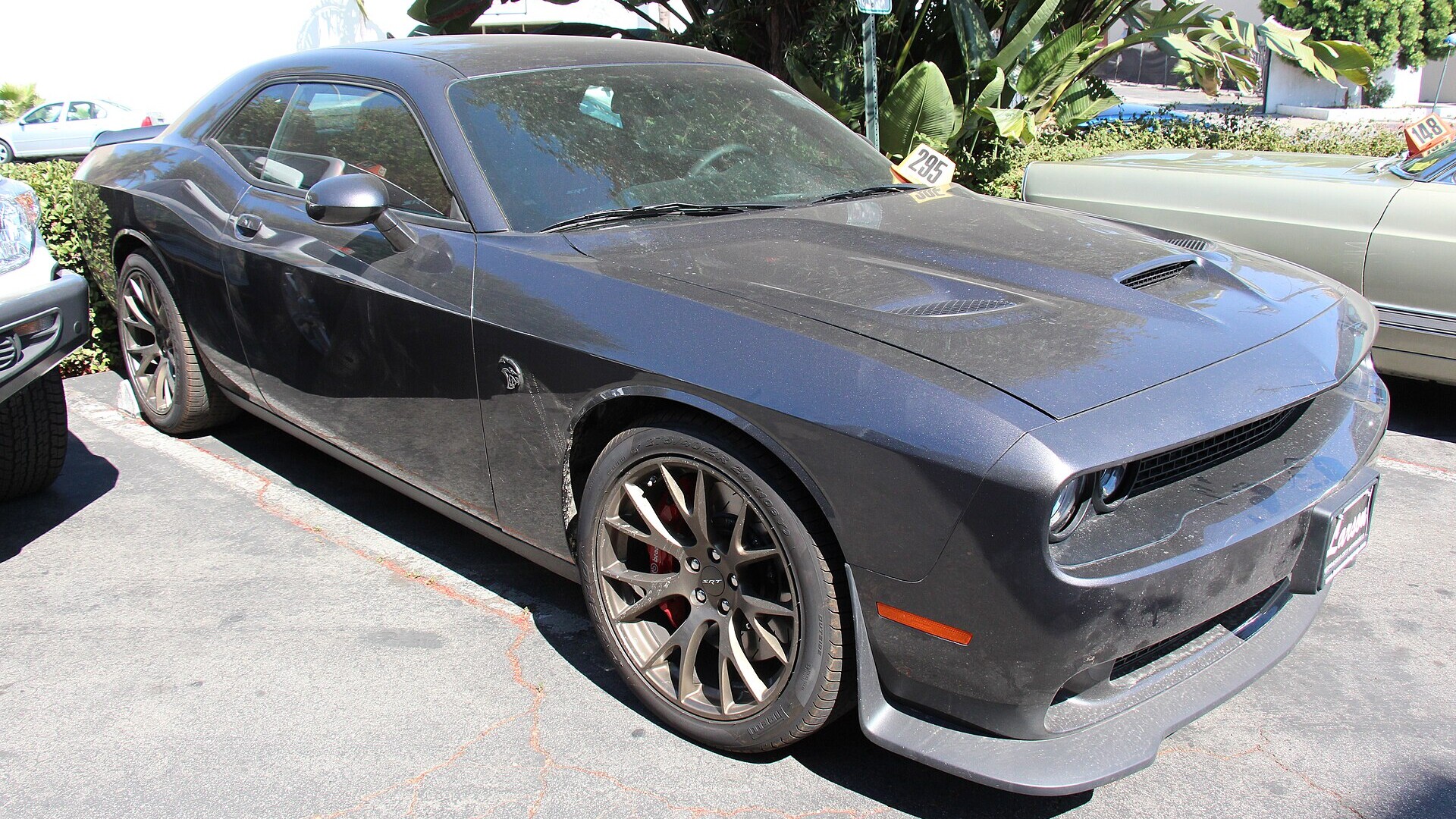
File photo of a 2015 Dodge Challenger SRT Hellcat, not a vehicle named in the case. Photo: Sicnag, via Wikimedia Commons (CC BY 2.0).
A clerk at the Houston County tag office in Perry, Georgia, told a sheriff’s deputy in July 2024 that a title Patrick Narh-Martey had brought in looked fake. On Wednesday, 13WMAZ reported that a grand jury has now indicted the Warner Robins surgeon on 40 felony counts, up from the 19 he faced after his arrest in April, and that four other people are charged alongside him. Prosecutors say the cars he rented out through his side business were stolen. None of it has been proven in court.
A Florida title, a missing VIN and a $44,500 Hellcat
According to the Houston County incident report as WGXA described it in April, the title was for a 2019 Dodge Challenger Hellcat that Narh-Martey said he bought for $44,500 a few weeks earlier. The clerk told the deputy the VIN was not in the national database and began with the letter L, which the clerk said does not show up on Georgia vehicles. The deputy ran the number and found it in no state’s records. The title, which was from Florida, was registered to a 2021 Challenger, not the 2019 model Narh-Martey described.
Narh-Martey told investigators he found the car on Facebook Marketplace, and WGXA reported he said the seller mailed him the title. The report listed him as a victim, and he was not charged. WGXA dates that contact to July 2024; 13WMAZ’s new story says July 2021, and the indictment puts his possession of the vehicles in August 2024, so 2024 looks right, but I have not seen the report itself.
The check that started this is one anyone can run. NHTSA says a VIN is a 17-character number that encodes details about the vehicle, and its decoder lists the build plant and country of manufacture. A number that does not decode, or decodes to a different car than the one on the lot, is the kind of mismatch that stands out at a tag counter.
From 19 counts to 40
Narh-Martey was arrested April 10. District Attorney Eric Edwards said then that prosecutors believe he knowingly bought stolen vehicles and altered their VINs to disguise them for his rental company, Amanor Enterprise, LLC, as 13WMAZ spells it. The first charges were 10 counts of theft by receiving stolen property and nine counts of possessing a vehicle with an altered VIN. Edwards said at least 13 vehicles were involved, taken from places ranging from Charlotte to Chicago.
The grand jury’s indictment, as 13WMAZ summarized it, lists 13 counts of theft by receiving stolen property, 10 of buying and selling, four of forgery, five of false statements or writings, four of altering, forging or counterfeiting a motor vehicle title, three of owning, operating or conducting a chop shop, and one of possessing tools for committing a crime. It says that in August 2024 he unlawfully possessed multiple vehicles, each valued between $5,000 and $25,000.
Four other people are charged in the same indictment. Prosecutors accuse two of them of removing vehicle identification and of theft by receiving, and the other two of operating the chop shop. The tools count rests on what prosecutors call a “vin kit”: fraudulent VIN decals, door stickers, vehicle titles, electronic devices, OBD2 cables and uncut vehicle keys.
13WMAZ’s photo caption calls Narh-Martey a surgeon at Emory Hospital Warner Robins. In April, Emory Healthcare told WGXA he is a private practice physician and is not working at its Warner Robins or Perry hospitals. Neither report I read includes a statement from Narh-Martey or an attorney for him.
What Georgia law asks of a buyer
The theft-by-receiving counts turn on a lower bar than most people assume. O.C.G.A. § 16-8-7 covers a person who receives, disposes of or retains property “which he knows or should know was stolen,” and the thief does not have to be convicted first. Punishment follows value under § 16-8-12: property worth $5,000 to under $25,000 carries one to 10 years, which a judge may reduce to a misdemeanor, and anything above $24,999.99 carries two to 20.
The chop shop counts are different because they require knowledge. Section 16-8-82 defines a chop shop as a place where people knowingly take apart, rebuild, alter or store a vehicle or part they know was obtained by theft, fraud or conspiracy, in order to hide or change its identifying numbers or to sell it. In the version of § 16-8-83 I read, knowingly owning or operating one is a felony punishable by three to 10 years and a fine of up to $100,000, and altering a VIN is one to 10 years. That text also tells courts to order restitution to victims and their insurers absent extraordinary circumstances.
Backfire News’s arithmetic, not the state’s: if a jury put each of the 13 receiving counts in the $5,000-to-$25,000 band the indictment describes, the ceiling is 10 years per count, or 130 years on paper, before a judge decides whether sentences run together. Narh-Martey’s account is that he bought a car from a Marketplace seller. Whether he knew or should have known is the question a jury would answer on those counts.
What comes next
Neither report gives an arraignment or trial date, and I found no plea entered by Narh-Martey or the four co-defendants. The open questions are whether any of them contests the charges, and what restitution looks like for the owners and insurers of the 13 vehicles if there is a conviction.
Should a buyer who “should have known” a car was stolen face the same felony as one who knew, or should Georgia prosecutors have to prove the buyer actually knew?
About the Author