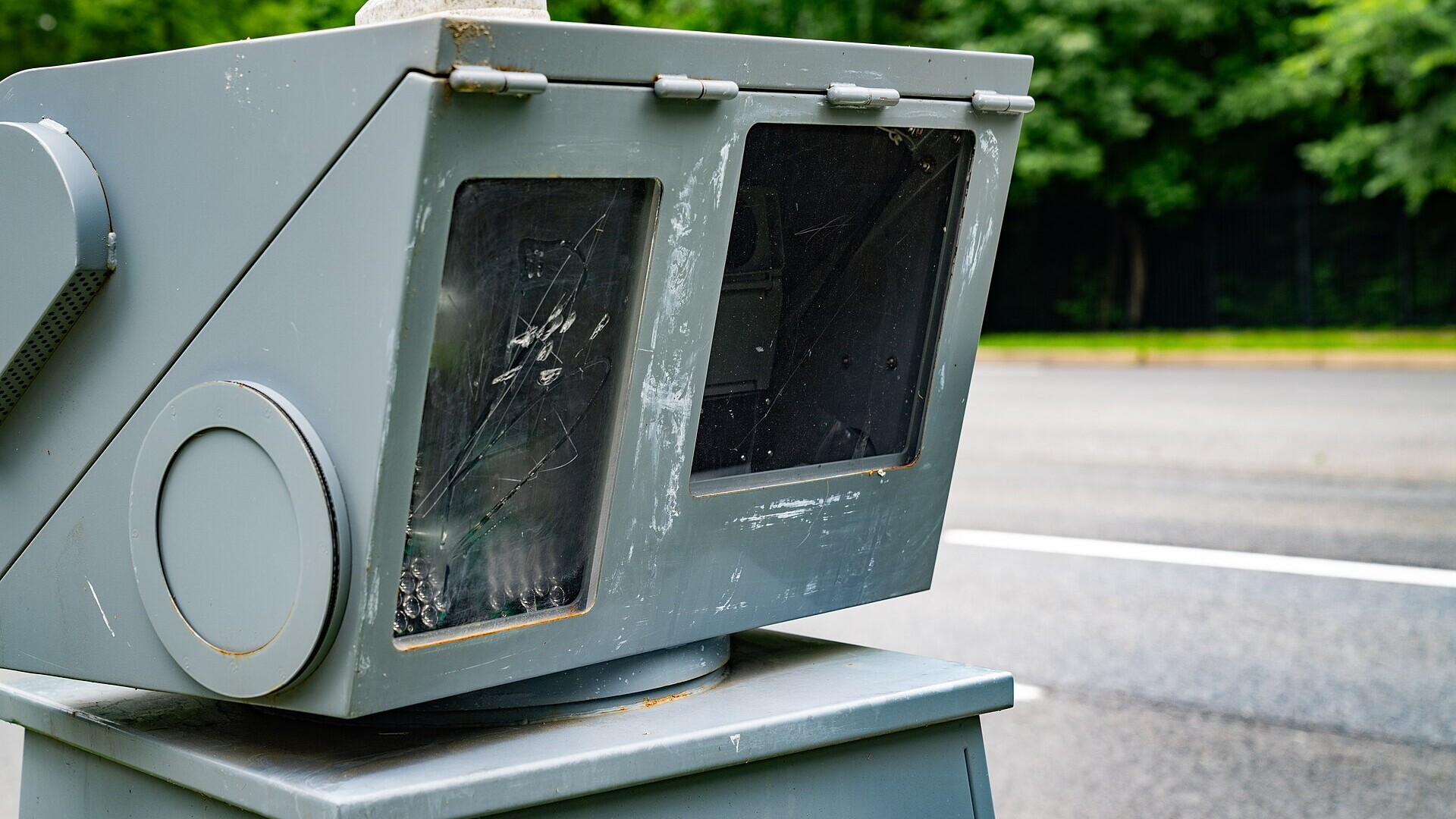
A speed enforcement camera on Wisconsin Avenue in Bethesda, Maryland. Photo: Tony Webster / Wikimedia Commons, CC BY 2.0
Los Angeles turned on its first speed cameras Oct. 26. For 60 days you get a $0 warning in the mail, then $50 and up. The part worth reading is the city’s own impact report: the pilot is expected to cost $7.95 million a year across 125 locations, and citation revenue goes first to cover it.
Eleven miles over is the line, and $50 is the floor
LADOT says the cameras, authorized by California’s AB 645, flag vehicles traveling at least 11 mph over the posted limit. After the warning period, the civil penalty in the impact report is $50 for 11 to 15 mph over, $100 for 16 to 25, $200 for 26 or more, and $500 at 100 mph or higher. The warning clock restarts at each location: LADOT’s program page says a 60-day warning period applies at launch and whenever systems activate on new streets.
FOX 11 Los Angeles reported that about 20 cameras went live on day one, including La Brea Avenue at 1st Street, Fairfax Avenue at Clinton Street, Melrose Avenue at Hayworth Avenue and La Cienega Boulevard at Pico Boulevard, with all 125 expected by Dec. 31. LADOT’s page says only that it anticipates all systems will be active by the end of 2026.
What $7.95 million a year means in tickets
The impact report puts the expected cost at $7,950,000 per year for all 125 locations, with a separate one-time $500,000 line in its cost table. It does not estimate how many tickets that takes. Backfire News’s math: at the $50 tier, $7.95 million is 159,000 tickets a year, or 1,272 per camera, a little under 3.5 a day at every site. Higher tiers lower that count. Fine reductions raise it, and so does every notice that goes unpaid.
LADOT’s program page says revenue goes back into department programs meant to make streets safer, and its March memo to the Council says revenue beyond cost recovery will go to traffic calming. If the cameras work and drivers slow down, the ticket count falls, and the money that covers the program’s costs falls with it. I read the report and the use policy, and neither says who covers a shortfall.
The city’s launch notice points to Oakland’s reported 70% reduction in excessive speeding at camera locations and San Francisco’s reported 84%. Those are the other cities’ own figures, not an audit.
The notice goes to the registered owner, and the clock is 30 days
Notices are mailed to the registered vehicle owner only, based on rear license plate images, according to the use policy. The city says the cameras capture plate information, not drivers’ faces. The policy also says the violations add no points to a DMV record and generally do not affect insurance.
An owner has 30 calendar days from the mailing date to request an initial review, and the impact report says results are due within 60 days. An owner who is still unsatisfied can contest the violation in an administrative hearing within 21 calendar days of the review decision, per the use policy. Neither document says what comes after the hearing.
Fines can be cut for low-income owners. Those below the federal poverty level may have fines reduced by up to 80%, and owners with incomes up to 250% of the poverty level by up to 50%, the policy says. It also lists community service in lieu of payment and says the city may offer a monthly payment plan. The language is “up to” and “may,” and I did not find the reduced dollar amounts in either document.
Where the 125 cameras go, and who objected
Each of the 15 council districts gets at least eight systems, and five get nine, the LADOT memo says. The impact report places 59 of the 125 locations, or 47%, in equity areas, and says fewer than half of the recommended segments fall in the top quintile of its Equity Index. Placement follows crash data: the report says 16% of all fatal and severe crashes from 2017 to 2021 were due to unsafe speeds, and unsafe speed was the primary violation in 40% of fatal motor-vehicle-only collisions.
Of 193 public communications, LADOT counted 127 in support (66%) and 63 (33%) raising concerns. The concerns centered on the risk of disproportionately affecting people of color and on privacy and surveillance. LADOT recommended no changes, and the City Council adopted the program as amended on March 24, 2026, by a vote of 14-0 with one member absent, according to Council File 23-1168. The action became final March 27.
On data, the use policy requires images that do not result in a violation to be deleted within five days of capture, and lets LADOT keep a record that a vehicle was cited for up to three years. LADOT’s program page says no personally identifiable data is shared with local, state or federal law enforcement except as California law requires. Plate-camera data has caused trouble elsewhere: Backfire News has covered a Georgia investigator accused of misusing Flock cameras and Durango police rewriting how long their plate data is kept.
What happens after the warning period
The first fines, at the day-one sites, are about seven weeks away. Later cameras follow on a rolling schedule as each finishes its own 60 days. After the five-year pilot, LADOT reports to the state Legislature on safety and economic impact. The impact report says the evaluation must include a racial and economic equity analysis covering violations issued to indigent individuals and violations by zip code, plus the number of vehicles with two or more violations in a month or year.
Should a speed camera program have to live off its own tickets, or should the general fund pay so no budget depends on drivers speeding?
About the Author