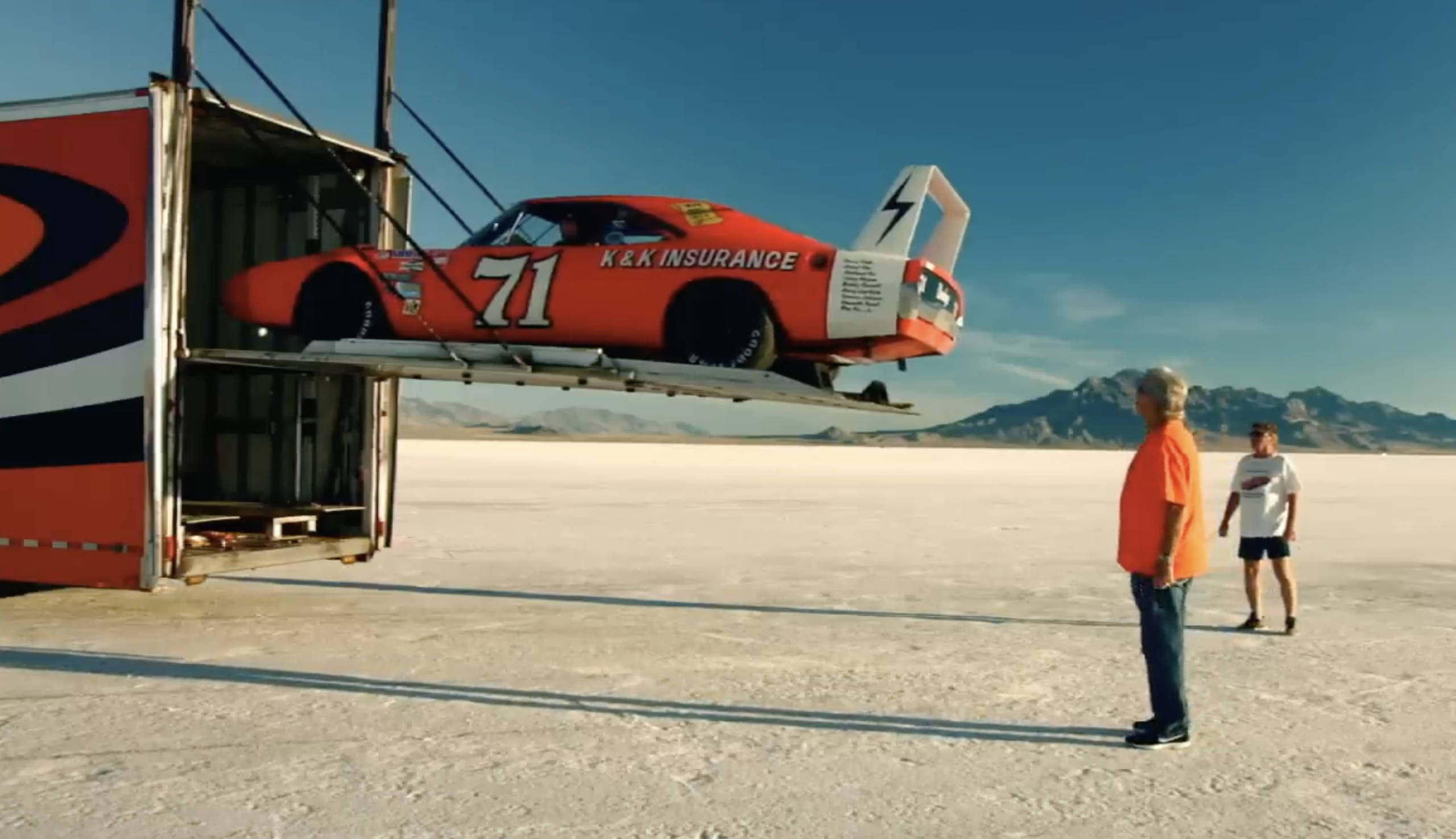
In the fall of 1971, a NASCAR team that had just been rule-booked out of a job loaded a winged Dodge onto a trailer and pointed it west toward Utah. What happened over the following days on the Bonneville Salt Flats turned the banned Dodge Daytona from a sanctioning-body casualty into one of the strangest footnotes in American speed record history — and Mopar people are still telling the story more than five decades later.
Chrysler Built a Wing Car, So NASCAR Wrote a Rule Around It
The Charger Daytona showed up in September 1969, with Plymouth’s Superbird following for the 1970 season, and both cars looked like a practical joke parked on pit road. A pointed nose cone grafted onto the front, a rear wing tall enough to walk under, and proportions that made a stock Charger look conservative. The shapes were not styling exercises. Chrysler had people with aerospace backgrounds working the problem, and the payoff showed up in trap speeds. In March 1970, Buddy Baker pushed a Charger Daytona past 200 mph on a closed course at Talladega, the first driver anywhere to manage it.
NASCAR’s answer for 1971 was never phrased as a ban, which is part of why the story still irritates Mopar fans. The sanctioning body capped aero-bodied cars at 305 cubic inches while conventional bodies kept their big-blocks. Nobody was going to line up at a superspeedway surrendering that much displacement, so the wing cars simply stopped appearing. The rule did the work of a ban without ever using the word. It’s worth reading alongside our earlier breakdown of Dodge’s NASCAR ban and the longer tail of that fight, which still helps explain why Dodge isn’t in NASCAR today.
Bobby Isaac Had Just Won a Championship in the Thing
The driver holding the short end of that rule was not some backmarker looking for an excuse. Bobby Isaac had clawed his way up from Carolina dirt tracks, and in 1970 he took the Grand National title with 11 wins in the No. 71 K&K Insurance Dodge, with Harry Hyde calling the shots on the box. Isaac was a qualifying savant, the kind of driver who could find a tenth in a corner that nobody else believed existed. The aero car amplified all of it.
Losing that package could easily have curdled into resentment. Hyde went a different direction. If NASCAR controlled the scoreboard, he reasoned, then the team would go find a scoreboard NASCAR had no say over.
Bonneville Didn’t Care What the Rulebook Said
The salt flats offered exactly what a shelved superspeedway car needed: timed, sanctioned class records with no competitors to block and no inspectors from Daytona Beach deciding what counted. In September 1971, the K&K crew set up shop on the salt and started running. The haul most often cited is 28 records, headlined by a flying mile in the neighborhood of 216.9 mph — numbers that had nothing to do with stock car racing and everything to do with proving a point.
It was not glamorous work. Salt chews at everything it touches, the surface shifts under a car that’s already twitchy above 200, and the visual references that let a driver place a race car simply don’t exist out there. Isaac had no draft to lean on, no traffic to read, and no banking to hold him. Just a white horizon, a tall-geared Hemi, and a body shape that had been designed for a very different kind of oval. A whole crew made those runs possible, but Isaac was the one strapped in.
Harry Hyde’s Other Legacy
Hyde’s career didn’t end on the salt. He spent decades as one of the sport’s sharpest crew chiefs and eventually became the template for Robert Duvall’s character in Days of Thunder, which is its own peculiar epilogue given that several of the movie’s actual cars were later found rotting in the woods. Isaac’s story ended far too early; he collapsed during a race in 1977 and died at 43.
The Wing Cars Got the Last Word Anyway
Whatever the rulebook said in 1971, the collector market has been rendering its own verdict ever since. Surviving wing cars trade in six and occasionally seven figures, and their provenance dramas make headlines on their own. One 1969 Charger Daytona has never been titled or registered. Don Tarr’s ex-racer failed to find a buyer on the block. Another spent a decade sitting in a Missouri junkyard as fraud evidence and still couldn’t clear $355,000 when it finally crossed.
That’s the part the 1971 rule never accounted for. A displacement cap can end a car’s racing career, but it can’t decide how the car is remembered. The banned Dodge Daytona left NASCAR as a problem to be solved and came back from Bonneville as a legend — which, for a team that had every reason to sulk, is about as complete a rebuttal as motorsports allows.
About the Author