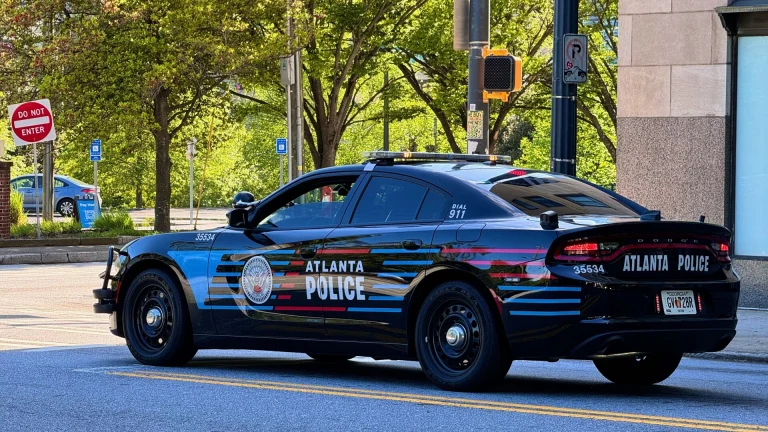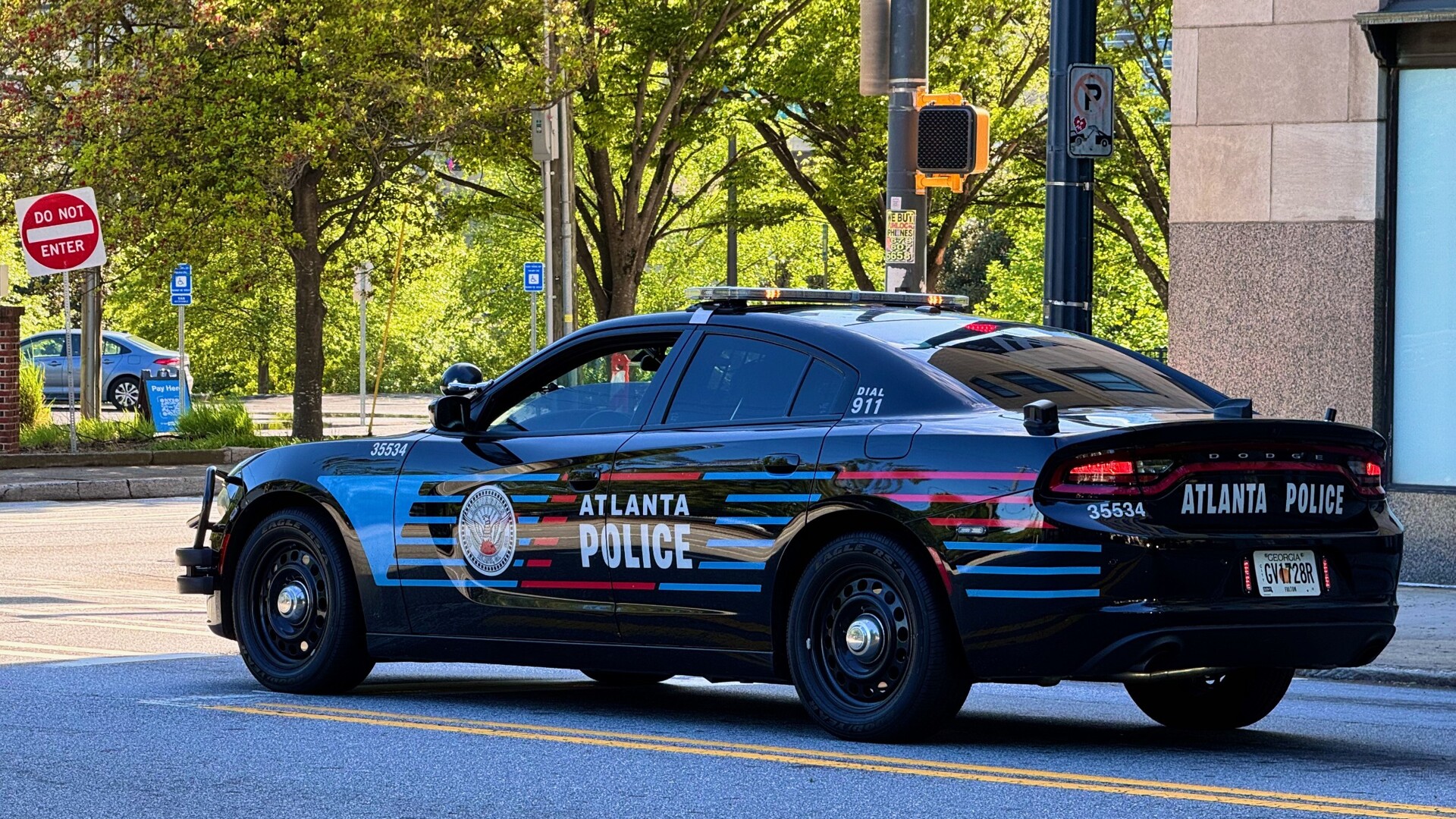
File photo of an Atlanta Police Department Dodge Charger Pursuit patrol car; not a vehicle involved in the I-95 chase. Photo: Harrison Keely / Wikimedia Commons (CC BY 4.0).
Deputies from five Georgia counties and the State Patrol spent nearly 65 miles on an I-95 chase of a Dodge Charger early Sunday that reached up to 140 mph and ended when the driver lost control on Belfast-Keller Road in Bryan County and went into a ditch, WJCL reported, citing preliminary Georgia Department of Public Safety details.
Photo: Harrison Keely / Wikimedia Commons (CC BY 4.0). File photo of an Atlanta Police Department Dodge Charger Pursuit patrol car; not a vehicle involved in this chase.
Troopers were dispatched at 12:53 a.m. on Nov. 15 to assist Camden County deputies, according to the WJCL report. Deputies from Glynn, McIntosh, Liberty and Bryan counties also took part as the Charger ran north from about mile marker 18 to mile marker 82. In Liberty County the deputies yielded and troopers took over. At Belfast-Keller Road the driver left the interstate, lost control, crossed the road and ended up in a ditch, where troopers and deputies took the driver into custody without further incident.
The report does not say why the chase began, who was driving, whether anyone was hurt or what charges, if any, the driver faces. A DPS spokesperson told WJCL more information would be released later. When Backfire News checked Tuesday, the newest item on the DPS press-release page was dated Oct. 30.
Georgia’s 2026 law counts the miles run from troopers
Georgia changed the price of a long chase on July 1, 2026, when House Bill 1161 took effect. The bill amended Code Section 40-6-395, the state’s fleeing-and-eluding statute, so that a person convicted of fleeing a vehicle or officer of the Uniform Division of the Department of Public Safety (the division State Patrol troopers work in), Capitol Police or Commercial Vehicle Enforcement is sentenced at 30 days for each mile the person actually traveled while fleeing. The result still has to fall inside the minimum and maximum the statute already sets.
The text builds in limits that make the handoff matter. The count starts only from the point the officer told the dispatcher the person was fleeing. A judge or jury must find the distance beyond a reasonable doubt, although distance is not an essential element of the offense. If the distance cannot be determined, the statute presumes it to be zero miles. As I read it, miles run from a deputy before troopers took over would not count, because they were not run from a Uniform Division officer.
No charges in this chase have been made public, so what follows is Backfire News’s arithmetic from the preliminary route, not a prosecutor’s theory. Mile marker 18 to mile marker 82 is 64 miles, and the report does not say where in Liberty County troopers took the lead. Aggravated fleeing, the statute’s felony tier, covers driving more than 20 mph over the posted limit and carries 12 months to 10 years and a fine of $5,000 to $10,000. At 30 days a mile, the formula would not rise above the 12-month minimum until a driver had run about 12 miles from troopers. If all 64 miles had been trooper-led, it would come to 1,920 days, a little over five years, well inside the 10-year ceiling.
The radio call matters as much as the speedometer. A prosecutor who wants the mileage count needs the dispatch record showing when a trooper reported the flight, plus the logs or video that place the Charger’s route after that call. Without them, the default is zero. Florida builds its penalty differently: a chase there carries a felony, a one-to-five-year license revocation and possible vehicle forfeiture, as Backfire News reported.
What DPS policy says about handing off a pursuit
DPS’s pursuit rule, Policy 17.02, governs troopers, not sheriff’s deputies. The version posted on the department’s website is marked revised May 15, 2019. It tells troopers to yield to a more familiar member when a pursuit enters another post or region, if possible (17.02.4(D)(2)(d)). It limits a pursuit to three patrol cars unless a supervisor approves more (17.02.4(D)(2)(e)) and tells troopers not to join another agency’s pursuit unless that agency asks (17.02.4(D)(9)). It also directs members to discontinue a pursuit when the risk of continuing outweighs the danger of letting the suspect escape (17.02.4(E)(1)(a)). Troopers being dispatched to assist Camden County is consistent with the request rule. The WJCL report does not say why the deputies yielded in Liberty County, and Backfire News did not review the policies of the five sheriff’s offices.
What to watch next
Watch for the DPS release WJCL says is coming and for any charging documents. If the driver is charged under Code Section 40-6-395(c), the incident report, the dispatch log and any dash or aerial video will decide how many miles count. Policy 17.02 requires an incident report within 24 hours when a pursuit ends without a death or serious injury (17.02.4(E)(5)(c)), and that report is the document to ask DPS for.
Georgia’s law adds 30 days for every mile a driver runs from troopers, counted only from the moment a trooper reports the flight. Does that punish the driver, or the handoff?
About the Author