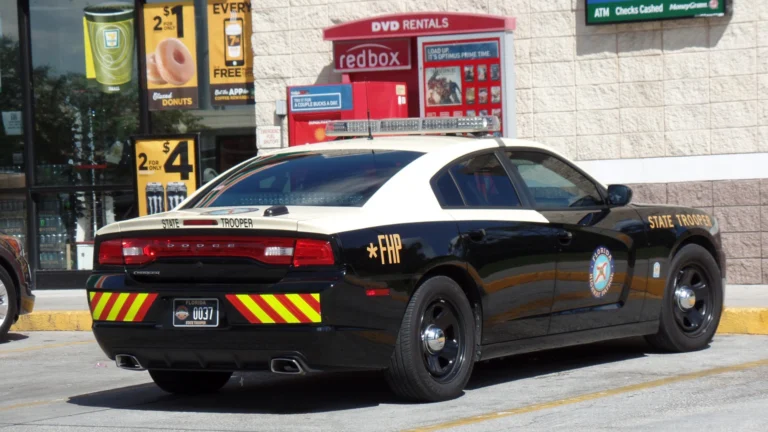
Most police pursuit policies spend their pages listing what officers can’t do. The Florida Highway Patrol’s pursuit policy, 17.05, rewritten in 2024 and revised again in March of that year, mostly lists what troopers can do. Its purpose section makes ending a chase “as soon as practical” the goal, and it names precision immobilization technique (PIT), intentional contact and aviation as ways to get there. It calls the PIT “the primary technique employed by the Division to terminate a pursuit.” It also treats the maneuver as “a use of control” instead of deadly force, and the indexed text sets no speed limit on it.
Then there’s the line that should make every Florida commuter look twice at their mirrors: “Members may drive on the wrong side of the roadway, in the wrong direction, or on the shoulder for the purpose of immobilizing an immediate threat to the public.”
A quick reversal
This is a big change from where FHP stood not long ago. An earlier policy version barred troopers from driving the wrong way to overtake or pursue anyone. It also told them to avoid PIT on large vehicles and high-center-of-gravity vehicles unless deadly force was justified. That older framework limited chases to felonies, reckless driving and DUI. The current one is built around ending the pursuit with contact.
What other state patrols say
Other state agencies draw much firmer lines. Georgia’s Department of Public Safety says a PIT by trained troopers “under reasonable and prudent circumstances” isn’t deadly force. It adds that in other circumstances it may be, and then it’s allowed only when the law permits deadly force. Wisconsin’s State Patrol procedure is blunter: PIT is a lower-level tactic at 35 mph or less and deadly force above that. The LA County Sheriff classifies a PIT on a motorcycle as deadly force. Georgia’s Clayton County police prohibit following a fleeing driver the wrong way on a divided highway.
Florida is the outlier because its policy treats the risk as the same regardless of speed.
Why speed is the whole story
A PIT is basic physics. The patrol car’s front corner pushes on the target’s rear quarter, starting a yaw the driver can’t catch. At 35 mph that usually ends with a spun car and a bent bumper. Kinetic energy rises with the square of speed, though, so a PIT at 70 mph puts four times as much energy into the spin as one at 35. That energy goes somewhere: into a utility pole, a median barrier or the side of a rolling SUV.
Related Articles
- Orange County Has Charged 12 Parents Over Kids’ E-Motos and Is Eyeing 50 More, and a Dead 13-Year-Old’s Parents Are in Court Nov. 12
- Hasselhoff’s K.I.T.T. Trans Am Was Stolen, Had Its Electronics Wrecked, Now It’s Heading to Auction
Vehicle type matters too. Pickups and crossovers have high centers of gravity, and they’re far more likely to trip and roll than to spin flat. That’s why FHP’s old policy listed them as vehicles to avoid. The current fleet on Florida roads is mostly exactly those vehicles.
Wrong-way pursuit compounds the problem. When a fleeing driver goes the wrong way, at least two vehicles are suddenly closing head-on with traffic at highway speed, and one of them has a siren. Florida’s emergency-vehicle statute, section 316.072, does let pursuing officers disregard movement and turning rules. It also keeps their duty to drive with “due regard for the safety of all persons.” In other words, agency policy can allow the tactic, but the officer is still legally responsible for how it’s used.
The money problem for bystanders
If you’re the uninvolved driver who gets hit, Florida’s sovereign immunity law, section 768.28, caps what the state pays at $200,000 per person and $300,000 per incident. A jury can award more, but anything above the cap needs a separate act of the Legislature to pay. In a multi-car crash, $300,000 gets used up quickly by medical bills, and your own insurer will likely cover the rest. That means your uninsured/underinsured motorist coverage and personal injury protection (PIP) limits matter more than most Floridians realize.
Related Articles
- BYD Put Footage of Its Wrecked U9 Xtreme in a Promo Video, and the Driver Walked Away Before an Abu Dhabi Speed Run
- Spire Parked Carson Hocevar for the Homestead Finale After NASCAR Fined Him $100,000 and Docked 25 Points
Your insurer may also try to recover what it paid from whoever caused the crash. If that’s a fleeing driver with minimum coverage, there won’t be much to recover.
The deterrence argument
FHP’s position is that every driver who runs knows a PIT is coming, and that this should discourage people from running at all. Florida’s fleeing statute already makes it a felony to flee a marked patrol car with its lights and siren on. The penalties get steeper for high speed or reckless disregard, and steeper again if someone is seriously hurt or killed. The policy is betting that ending chases fast and physically makes Florida roads safer than letting them go on. That’s an empirical claim, and FHP’s own pursuit and crash data are the only way to test it.
What to do if you see a chase coming
- Move right and stop when you can, even on a divided highway. A wrong-way pursuit can come from either direction.
- Keep your distance from any car being chased. If it gets PIT’d, it can spin across several lanes.
- Review your UM and PIP limits before you need them, not after.
- If your stolen car is recovered after a PIT, comprehensive coverage normally handles theft-related damage. Call your insurer before you sign any tow or storage paperwork.
The bottom line is that Florida made the PIT its default way to end a chase, removed any speed ceiling and allowed troopers to drive the wrong way. Whether that’s sound strategy or an expensive gamble, the policy itself doesn’t hide what it permits.
Images Via: wikipedia
About the Author