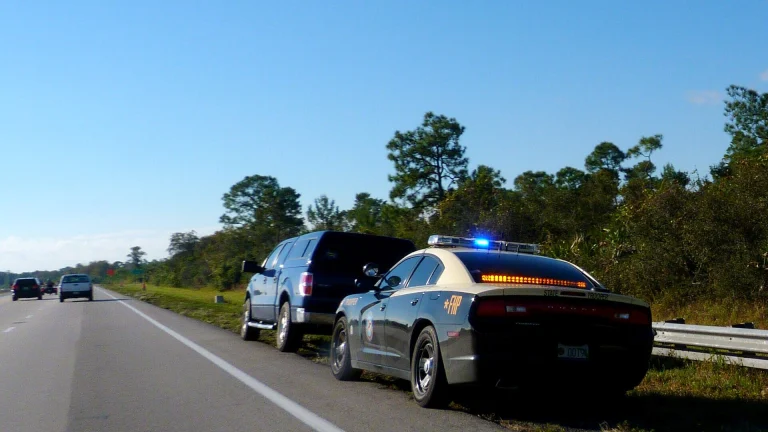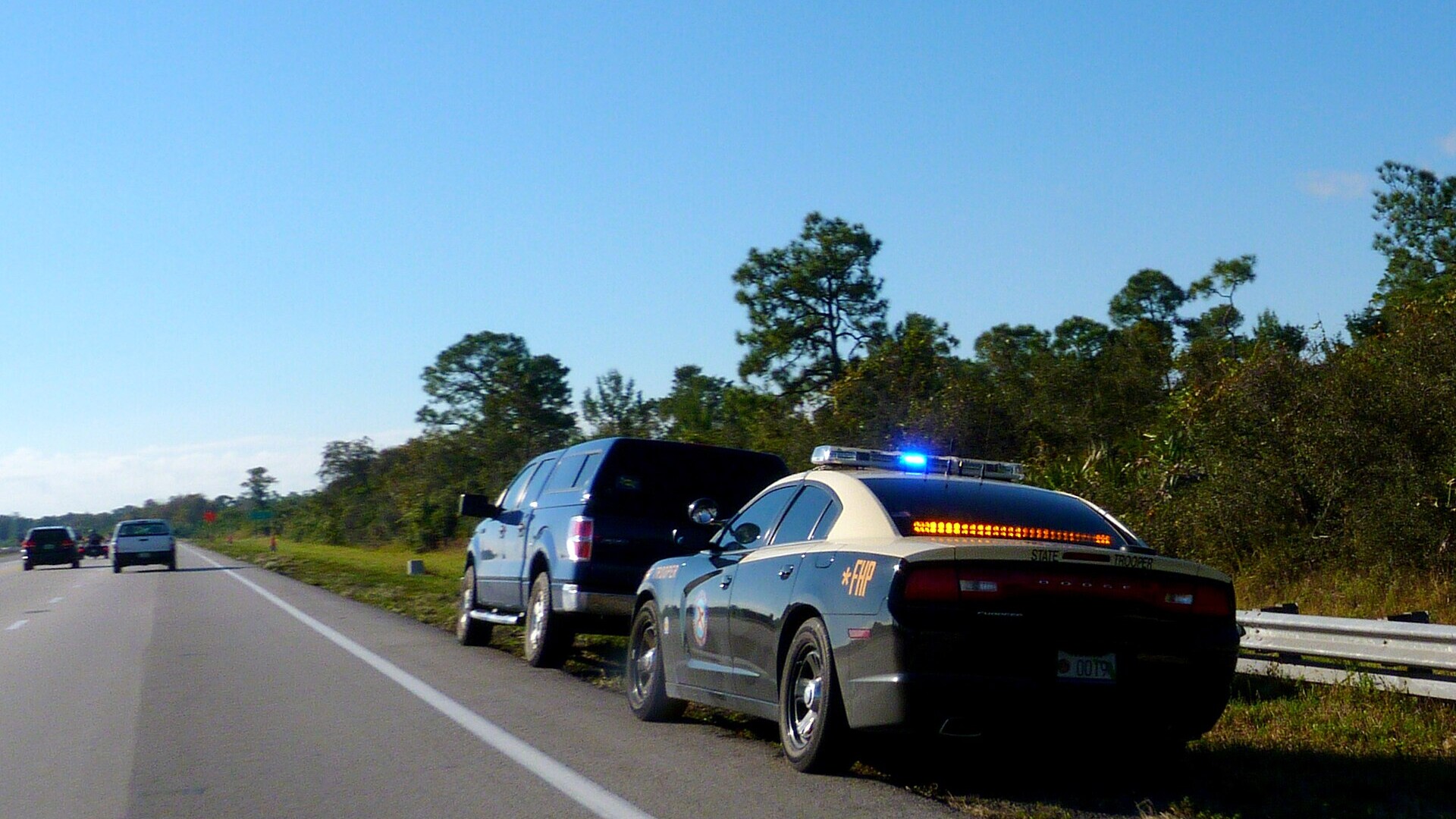
A Florida Highway Patrol Dodge Charger on a roadside traffic stop. Representative image, not from any incident described here. Photo: Rusty Clark ~ 100K Photos / <a href="https://commons.wikimedia.org/wiki/File:Florida_Highway_Patrol_on_Trafffic_Stop.jpg" target="_blank" rel="noopener">Wikimedia Commons</a>, CC BY 2.0
Rockstar Games’ page for GTA VI gives a Nov. 19 release date, says pre-loading starts Nov. 10, and places a criminal conspiracy across the state of Leonida, which it calls “the sunniest place in America.”
The page text we could read says nothing about police, pursuits or vehicles, and it does not name Florida. So this follows a chase through the Florida documents that would apply to one, in the order it happens: how it starts, what the driver is charged with, and how it ends. The car side of the crossover is in our story on eBay’s video game-inspired cars at SEMA.
How a chase starts
Florida Highway Patrol Policy 17.05 allows a pursuit when a trooper reasonably believes the driver committed a felony, reckless driving or DUI, and says all other pursuits are prohibited. The copy posted on FHP’s website carries an Oct. 11, 2022 revision date, which predates the rewrite we covered in our look at what FHP’s policy says about the PIT and wrong-way driving.
Pursuits across the country start more often with a lesser offense. The Bureau of Justice Statistics’ 2012–2013 pursuit report studied 5,568 pursuits from 115 agencies, a database it says is not nationally representative. Sixty-nine percent began with a traffic violation, and 12% with a suspected nonviolent felony.
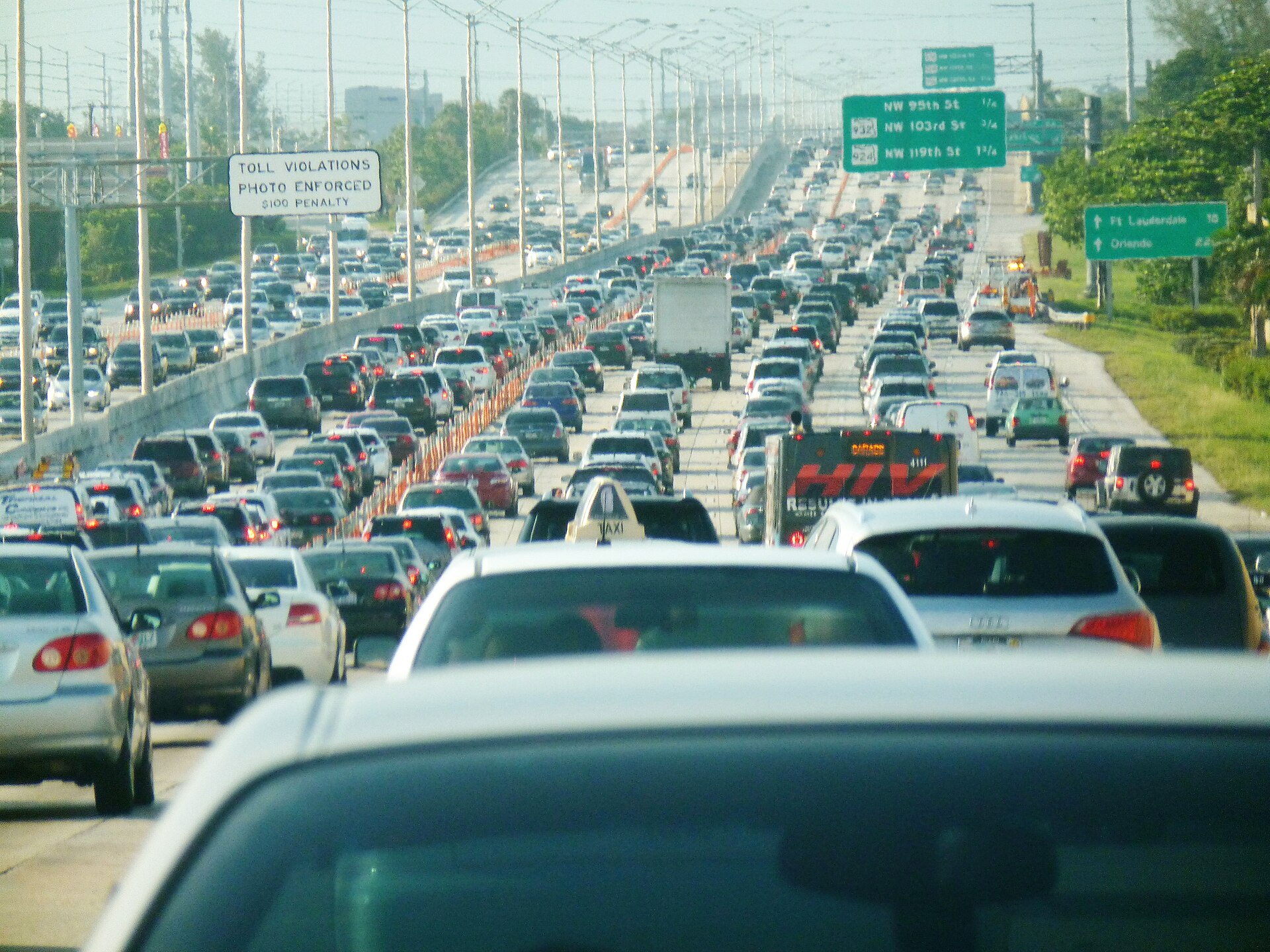
An Oct. 15 chase in Palm Beach County began the same way. A deputy clocked a Kia at 84 mph in a 45 zone on Forest Hill Boulevard in West Palm Beach, according to the probable cause affidavit as reported by CBS12, and the car ran a red light at South Congress Avenue. The chase that followed peaked at 102 mph in a 35 zone. The Kia slowed merging onto southbound I-95, where deputies stopped it.
What the driver is charged with
Rafael Soto Ross, 30, is charged with DUI, reckless driving, excessive speeding, driving with a suspended license and possession of a controlled substance with intent to deliver. Fleeing or eluding is not among the charges as reported. He is presumed innocent, and none of the charges has been tested in court. The statutes behind each charge are in our full story.
Fleeing is a separate offense. Florida’s section 316.1935 makes it a third-degree felony to willfully refuse an officer’s order to stop, and a separate subsection makes fleeing a marked patrol car with lights and siren on a third-degree felony too. Neither sets a speed threshold. Driving at high speed or with wanton disregard for safety during the flight raises it to a second-degree felony. If that driving causes serious bodily injury or death, it is a first-degree felony with a mandatory minimum of three years.
A conviction under subsections (1) through (4) requires the court to revoke the driver license for at least one year and not more than five. Courts cannot suspend, defer or withhold adjudication or sentence. The vehicle is deemed contraband and can be seized and forfeited under sections 932.701 through 932.704.
How a chase ends
In the same BJS database, 29% of pursuits ended when the fleeing driver stopped voluntarily, 25% when an officer or supervisor called it off, and 15% in a collision. About one in six ended with the driver getting away, and 57% lasted three minutes or less. The report estimates about 68,000 pursuits in 2012 and 351 pursuit-related deaths. It gives no figures for PIT maneuvers or spike strips, so it cannot say how often either one ended a chase.
FHP’s policy covers the tools. It says aerial assistance will be used if available, calls for a PIT maneuver “at speeds consistent with training” with no number attached, and refers to tire-puncturing devices as Pursuit Termination Devices instead of spike strips. A district commander must be notified when a pursuit lasts longer than five minutes. The posted version sets no numeric speed cap for pursuits either: it lets members exceed speed limits as long as life or property is not endangered.
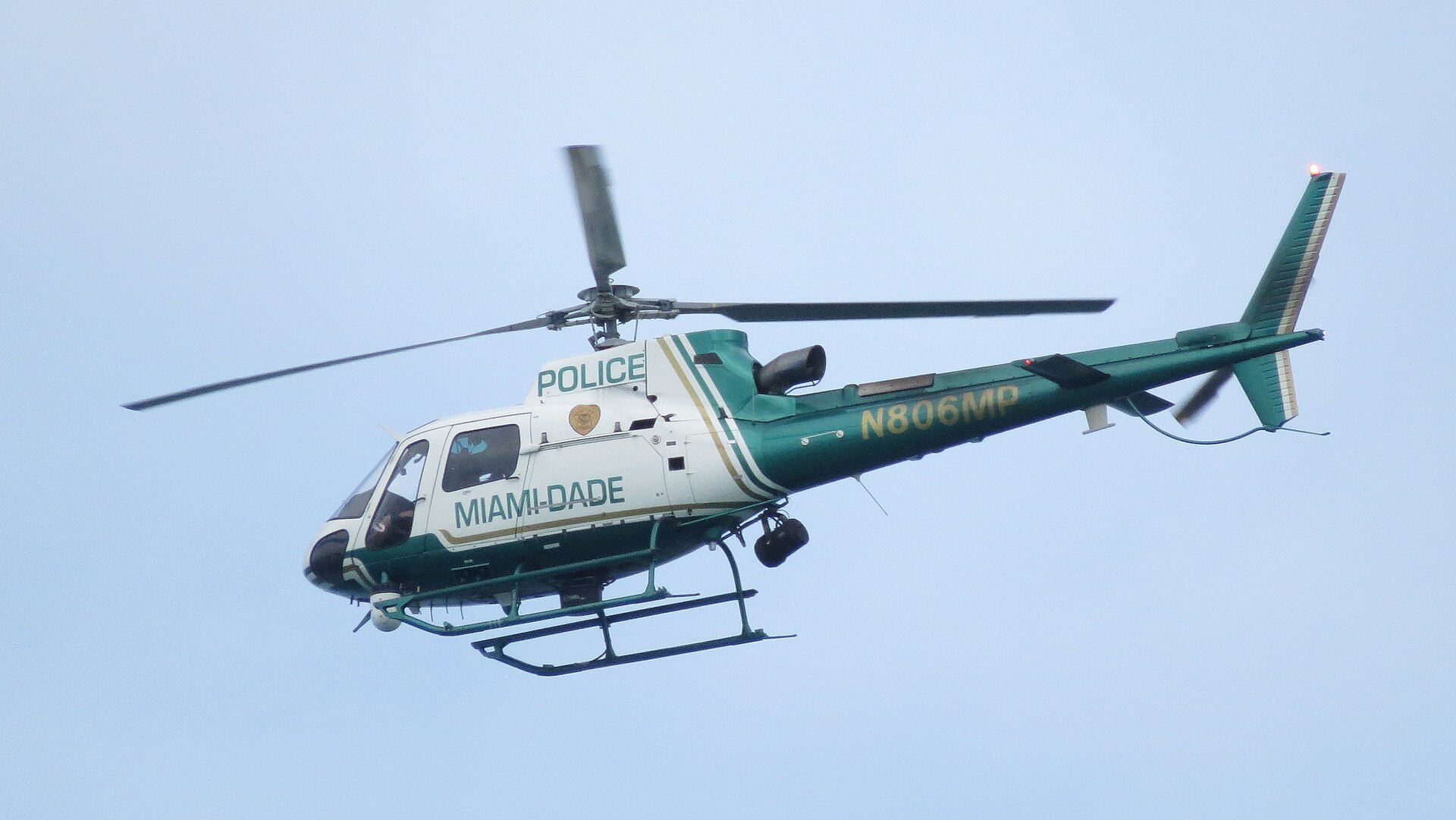
A PIT ended a Pasco County chase on July 26. At about 3:45 a.m. on State Road 54 in New Port Richey, a trooper saw a Chevrolet Traverse doing 74 mph in a 45 zone, according to FHP as reported by the Tampa Bay Times. The 15-year-old driver, who held a learner’s permit, did not stop, FHP says, and reached up to 115 mph before the trooper used the maneuver. The SUV hit a utility pole and a tree. The driver’s 15-year-old passenger died and the driver was seriously injured. As we reported, no prosecutor has announced charges.
Pre-loading opens Nov. 10 and the game launches Nov. 19. Should FHP put a speed limit on the PIT maneuver, or leave it to a trooper’s training and judgment?
Sources: Rockstar Games, GTA VI page; Florida Highway Patrol Policy 17.05 (FLHSMV); Bureau of Justice Statistics, Police Vehicle Pursuits, 2012–2013; Fla. Stat. § 316.1935.
About the Author