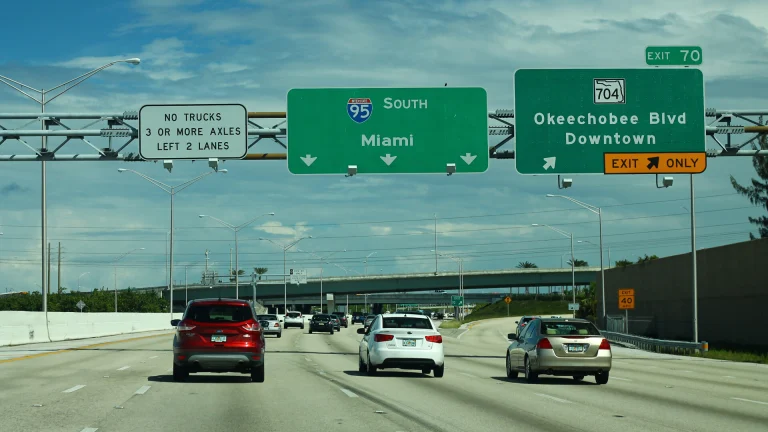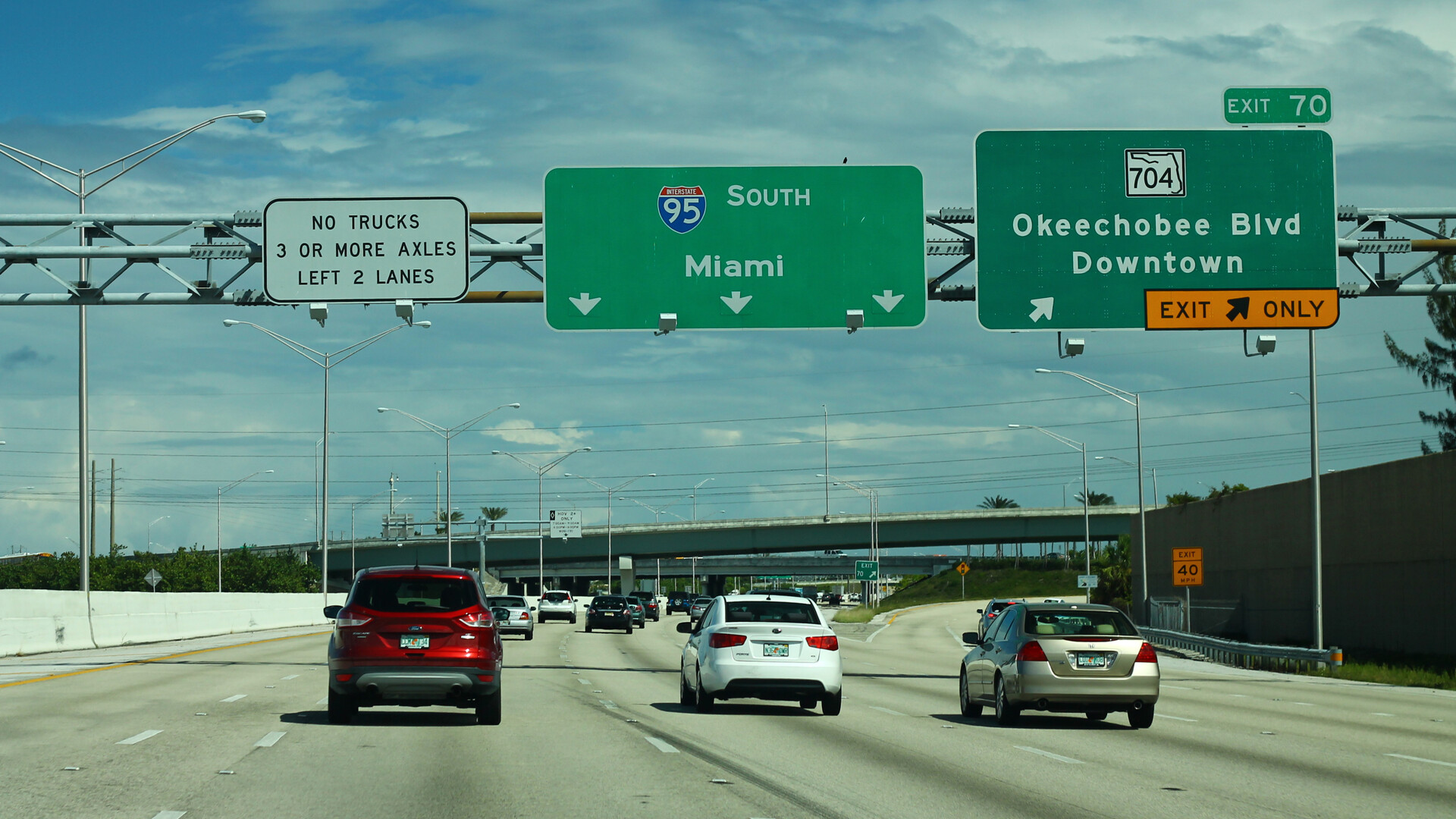
I-95 southbound at the Okeechobee Boulevard exit in West Palm Beach. Photo: formulanone / Wikimedia Commons (CC BY-SA 2.0)
Rafael Soto Ross, a 30-year-old Boca Raton chef, was arrested early Thursday, Oct. 15, after what the Palm Beach County Sheriff’s Office describes as a 102 mph chase on Forest Hill Boulevard in West Palm Beach, according to the probable cause affidavit as reported by CBS12. He faces charges of DUI, reckless driving, excessive speeding, driving with a suspended license and possession of a controlled substance with intent to deliver, none of which has been tested in court.
What deputies say happened on Forest Hill Boulevard
A deputy clocked a black Kia at 84 mph in a 45 zone, and the car then went through a red light at South Congress Avenue, the sheriff’s office said. The chase that followed peaked at 102 mph in a 35 mph zone, according to the affidavit. That is 67 mph over the limit, nearly three times it. The Kia slowed as it merged onto southbound I-95, where deputies made the stop.
Deputies noted a strong odor of alcohol, bloodshot eyes and that Soto Ross was driving without shoes. They also reported finding about 7.58 grams of marijuana and a red cooler holding 129 dissolvable strips of buprenorphine and naloxone, the generic version of Suboxone, with the prescription labels ripped off. Soto Ross first refused a breath test, CBS12 reported, then submitted to testing that recorded 0.146 twice. Records showed his driver’s license was canceled in 2024, with earlier suspensions.
A 0.146 reading falls 0.004 short of Florida’s enhanced DUI penalties
Florida makes it a crime to drive with a blood or breath alcohol level of 0.08 or more under section 316.193(1)(b). The reported 0.146 is about 1.8 times that. It sits 0.004 below 0.15, the level at which subsection (4) of the same statute raises the penalties for a first conviction: the fine goes from $500 to $1,000 up to $1,000 to $2,000, and the maximum jail term goes from six months to nine.
A first DUI conviction also brings a court-ordered license revocation of at least 180 days and no more than one year under section 322.28(2)(a)1. Those ranges assume this would be a first DUI conviction. CBS12’s report mentions earlier license suspensions but no earlier DUI, and I have not seen his full record.
The Suboxone strips carry the felony charge
Buprenorphine is a Schedule III controlled substance in Florida, listed in section 893.03(3)(a)3. Possessing a Schedule III drug with intent to sell or deliver it is a third-degree felony under section 893.13(1)(a)2, punishable by up to five years in prison under section 775.082(3)(e). Reckless driving carries up to 90 days in jail on a first conviction under section 316.192(2), and the DUI tops out at six months. The speed and the alcohol reading draw the attention, but the cooler is the only item on the charge list with a maximum measured in years instead of months.
The labels matter. Florida’s simple-possession statute, section 893.13(6)(a), applies unless the substance was lawfully obtained, including under a valid prescription, and a pharmacy label is how a patient shows that. Suboxone is a prescription medication used to treat opioid dependence, so a cooler of strips with the labels torn off looks different to deputies than one with a patient’s name on it. CBS12’s account does not say what else, if anything, backs the intent-to-deliver charge, such as packaging, messages or cash.
The license charge, and a fleeing charge no one has reported
The charge list says driving with a suspended license, while the records CBS12 cites describe a license canceled in 2024. Under section 322.34, cancellation, suspension and revocation are treated alike. Driving on a canceled license without knowing about it is a noncriminal moving violation. Doing it knowingly is a second-degree misdemeanor on a first offense, with a 60-day maximum. The statute says knowledge is met if the driver was previously cited, admits knowing, or received the notice the law requires on a suspension or cancellation order.
The list also does not include fleeing or attempting to elude. Under section 316.1935, willfully fleeing a law enforcement officer in a marked patrol car with lights and siren on is a third-degree felony, and doing it at high speed or with wanton disregard for safety is a second-degree felony. A conviction brings a license revocation of at least one year. CBS12’s account does not say whether deputies had their lights and siren on or whether prosecutors will add the count, and I have not seen the charging document.
Florida had a busy October. Backfire News covered a driver accused of DUI after a 135 mph work-zone run on Oct. 23, and an arrest log that put felony fleeing, DUI and a breath-test refusal on one driver on U.S. 1 four days later.
What happens next
The Oct. 18 CBS12 report is the latest public account I found. It describes the charges at arrest. Prosecutors decide what is formally filed in Palm Beach County court, and I found no filing, plea or statement from Soto Ross or a lawyer for him. No filing, no plea, no statement from Soto Ross or a lawyer for him. Until a judge rules, it’s all allegation: 60 days at the low end, five years at the high end.
Four thousandths of a point separate his 0.146 from Florida’s heavier DUI penalties. Is a hard line at 0.15 fair, or should 0.146 get the same treatment?
About the Author