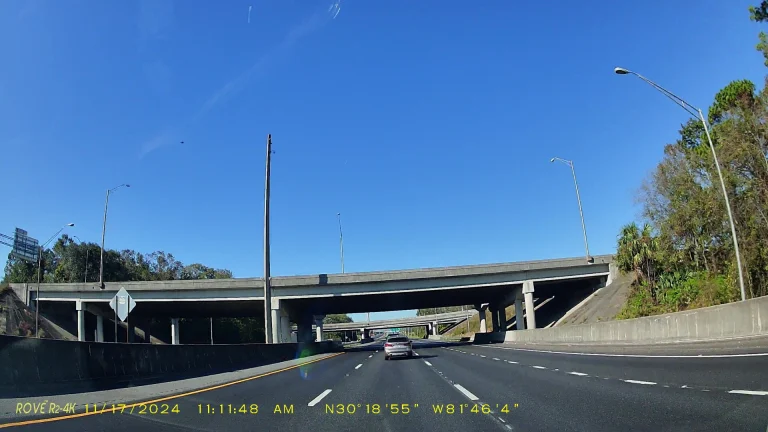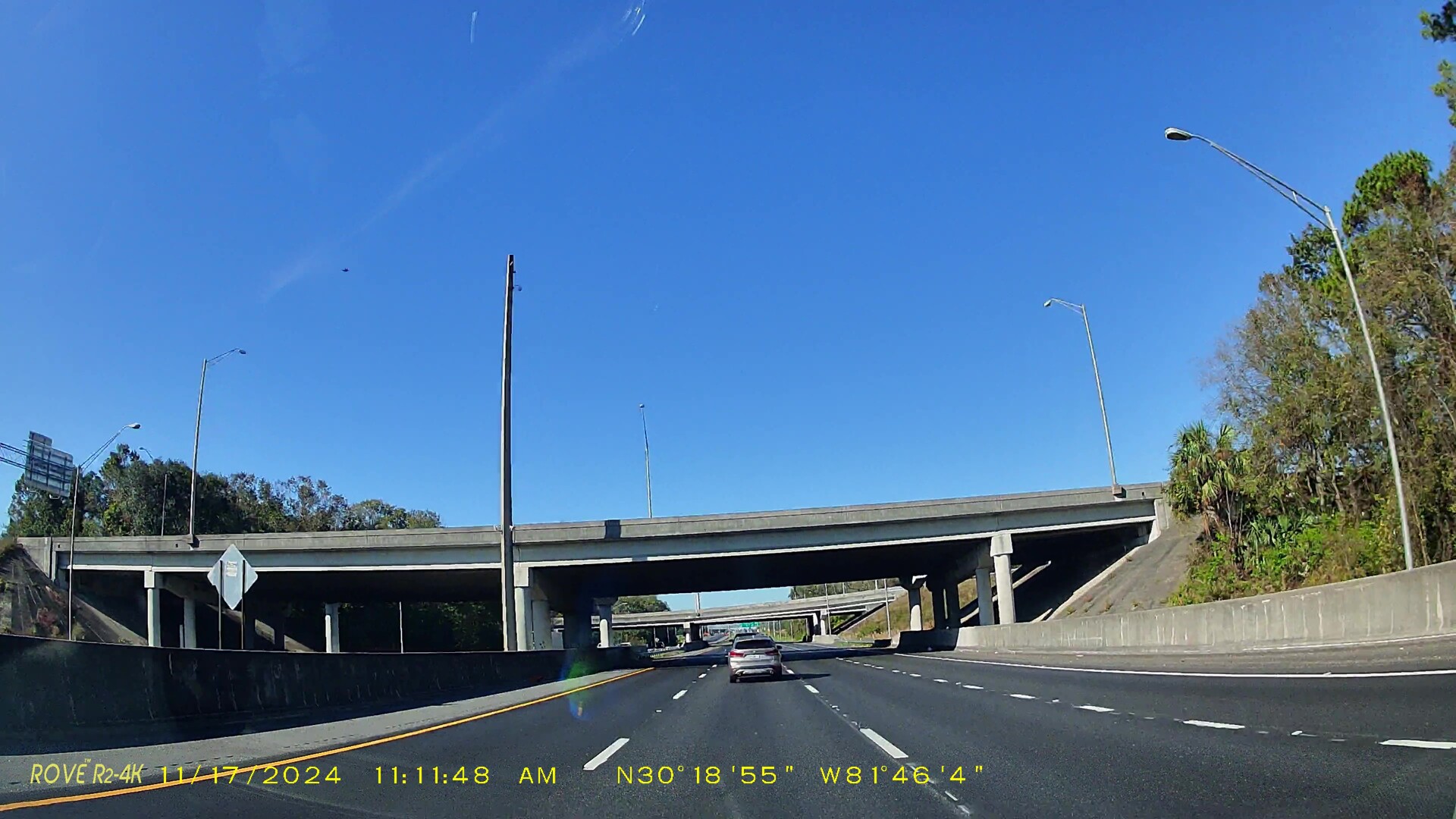
Westbound I-10 at the I-295 overpass in Jacksonville. Photo: Michael Rivera via Wikimedia Commons (CC0)
A 22-year-old Jacksonville man, Zyon Jackson, told a Jacksonville Sheriff’s Office traffic officer he was just “enjoying his night,” according to the sheriff’s office, after the officer stopped a car the agency says was doing 135 mph on the city’s interstates. The dashcam clock on the video JSO released reads just after 1 a.m. on Sept. 9, 2026, and the agency says part of that run went through an active construction zone with workers present.
Officer Nicholas Whisman, of JSO’s Specialized Traffic Enforcement Unit, was driving on I-95 when a dark car “raced, and we mean raced, by,” the agency wrote. The stop stretched from I-95 onto I-10, and the driver pulled over just short of the I-295 ramps and got out of the car. Jackson now faces three misdemeanors in Duval County Court, one of them a speeding crime Florida didn’t have until July 2025.
The clip JSO posted on Oct. 12 is short. An on-screen label shows parts of the pursuit playing at four times normal speed, and the final shot shows the driver getting down on the pavement beside his car as the officer walks up. The video shows no radar or pacing readout, so the 135 mph figure is the sheriff’s office’s. The clerk’s file includes a 17-page arrest and booking report that isn’t posted online; the clerk lists it as viewable on request, and Backfire News hasn’t seen it. No breath or blood alcohol result appears in any public filing.
Five counts and three bond decisions in Duval County Court
The Duval County clerk’s docket for case 16-2026-CT-009422-AXXX-MA lists five counts, all dated Sept. 9:
- DUI, under section 316.193
- Dangerous excessive speeding, under section 316.1922(1)(b), the part of the law covering 100 mph or more
- Reckless driving, under section 316.192
- Exceeding the posted speed in a work zone, under section 316.183(6)
- Possession of an open container by a driver, under section 316.1936
The docket lists the first three as misdemeanors. The work-zone and open-container counts are civil infractions, which end in fines rather than jail.
The bonds set on Sept. 9 show how the court weighed them. The DUI count drew a $2,503 bond and reckless driving drew $1,503. The dangerous-excessive-speeding count, the one built on the 135 mph number in the video, carried no money bond; Jackson was released on his own recognizance on that count. Both money bonds were posted through Palmetto Surety Corporation, according to filings entered Sept. 15, and his release conditions on the docket include no driving and no alcohol.
Judge Shayla Lee signed a finding of probable cause to detain him on Sept. 9, and the court declared him indigent and appointed the public defender’s office. The defense filed a notice of discovery, the routine demand for the state’s evidence, on Sept. 15. No plea appears on the docket. His Oct. 1 arraignment was reset after the docket noted he was not present; at the Oct. 14 setting, the docket notes his appearance was waived, and the arraignment moved to Nov. 12. Every count is an accusation, and Jackson has not been convicted of anything.

Florida’s 100 mph crime has a condition attached
Before July 1, 2025, 135 mph on a Florida interstate was, by itself, a civil infraction. The top speeding tier in section 318.18 is a $250 fine for 30 mph or more over the limit. Turning speed into reckless driving took more than speed: the Florida House staff analysis of the bill that changed the law cites Harris v. State, 318 So. 3d 645 (Fla. 2d DCA 2021), in which the appeals court required evidence of circumstances beyond the speeding that showed the driver acted with conscious and intentional indifference to the consequences.
House Bill 351 made “dangerous excessive speeding” a crime. The House passed it 75-38, Gov. Ron DeSantis signed it May 22, 2025, and it took effect July 1, 2025. The statute gives two ways to commit the offense: driving 50 mph or more over the limit, or driving at 100 mph or more “in a manner that threatens the safety of other persons or property or interferes with the operation of any vehicle.” A first conviction carries up to 30 days in jail, a $500 fine, or both. A second within five years of a prior conviction brings a license revocation of 180 days to a year.
The 50-over route has no condition. Florida’s highest legal limit is 70 mph under section 316.187, so a car doing 135 anywhere in the state is at least 65 over. Jackson’s charge, as filed, uses the 100 mph route instead, which means the state has to show the speed endangered people or property, the same kind of extra fact Harris demands for reckless driving.
JSO’s post supplies that fact. Jackson was “speeding that fast through an active construction zone,” the agency wrote. “There were workers present, and Jackson’s speeding put their lives in danger. Not cool.” Those workers figure in three of the five counts. They are the threat in the 100 mph charge, the danger in the reckless driving charge, and the reason the work-zone ticket costs what it does.
Under section 318.18(3)(e), a speeding fine in a posted construction zone doubles only when construction personnel are present or operating equipment on or right next to the road, and the signs have to say fines are doubled. At 30 or more over, that turns the $250 base into $500. Section 318.19 also requires anyone cited at 30 mph or more over the limit to appear at a hearing instead of simply paying the ticket.
A DUI conviction costs more than the speeding crime
On paper, the new speeding crime is the lightest of Jackson’s three misdemeanors. A first DUI conviction under section 316.193, without aggravating factors such as a blood alcohol level of 0.15 or higher, carries a fine of $500 to $1,000, up to six months in jail, at least 50 hours of community service, and a 10-day impoundment or immobilization of the vehicle. Section 322.28 adds a license revocation of at least 180 days and up to a year. A first reckless driving conviction allows up to 90 days in jail and a fine of $25 to $500. The open container is a noncriminal moving violation.
The insurance requirement outlasts all of it. Under section 324.023, a driver convicted of DUI in Florida has to carry liability coverage of $100,000 per person and $300,000 per crash for injuries, plus $50,000 for property damage, for at least three years after the license is reinstated. The ordinary Florida minimum under section 324.022 is $10,000 in property damage liability, with no standalone bodily injury requirement. A driver moving from that floor to 100/300/50 coverage, with a DUI on the record, pays for the difference at every renewal for those three years.
Florida agencies keep posting triple-digit stops
JSO is one of several Florida agencies putting these stops on social media since the law changed. In July, the Orange County Sheriff’s Office posted a 137 mph Lamborghini stop under a “Super Speeder” label, and another Florida case turned 96 mph in a 45 zone into a criminal charge because it cleared the 50-over line by a single mph.
The Federal Highway Administration’s 2026 National Work Zone Awareness Week fact sheet counts 850 people killed in U.S. work zones in 2024. Speeding was involved in 34% of fatal work zone crashes that year, 262 of them, up from 29% in 2023, and more than half of the fatal crashes happened at night. Jackson’s stop was around 1 a.m.
Next date: Nov. 12 arraignment in Courtroom 512
Jackson’s arraignment is set for 9:30 a.m. Nov. 12 in Courtroom 512 of the Duval County Courthouse, with Judge Lee presiding. The arrest report will have to answer the questions the video can’t: how the 135 mph was measured, where the construction zone began and ended, how many workers were on the road at 1 a.m., and what the alcohol evidence shows. If the state can’t put workers in that zone at that hour, the work-zone fine doesn’t double and the 100 mph charge loses the fact it leans on, though prosecutors, who file their own charging document, could switch to the 50-over route.
For Florida drivers, the statutes draw a clear line between the two. A first dangerous-excessive-speeding conviction doesn’t take the license by itself; a second within five years does. A DUI conviction takes it the first time and brings three years of high-limit insurance with it.
Should Florida treat 100 mph as a crime on its own, no matter who else is on the road, or is the law right to make prosecutors prove the driver put someone in danger?
About the Author