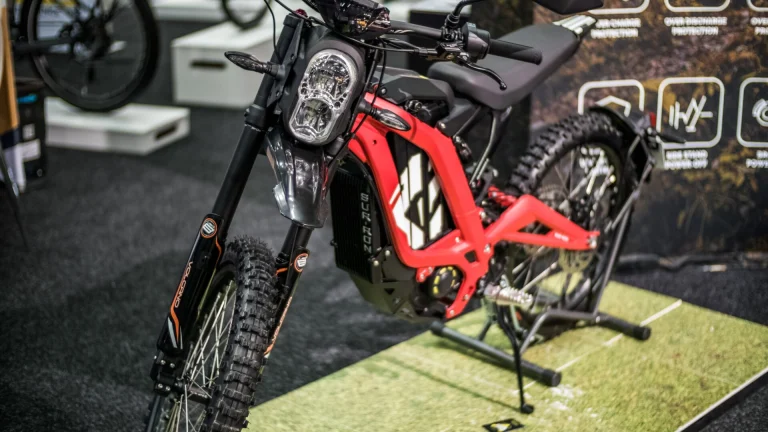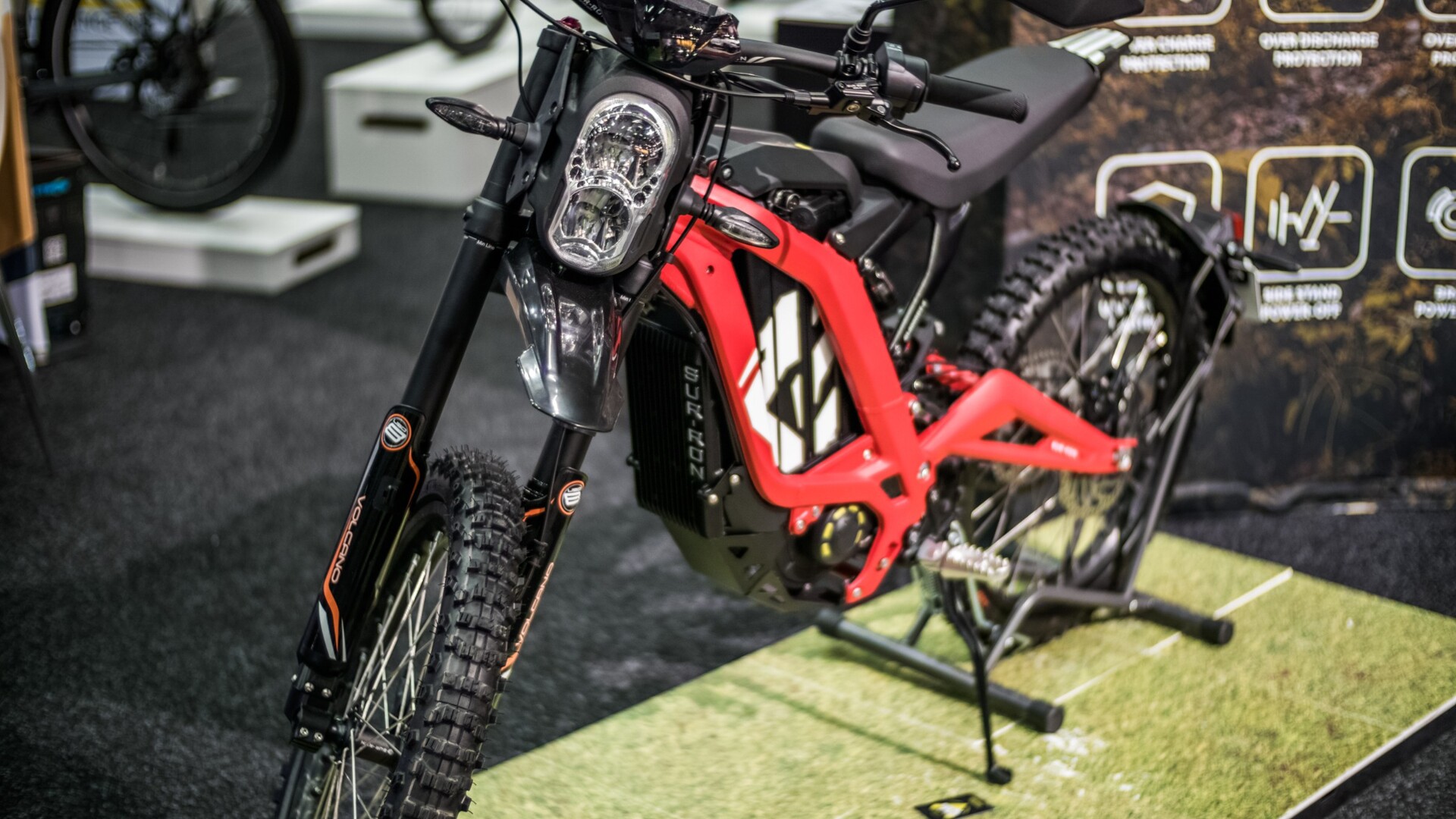
A Sur-Ron electric dirt bike, a brand named in several of the Orange County cases. The Garden Grove crash involved a different model. Photo: <a href="https://commons.wikimedia.org/wiki/File:Sur-Ron_Electric_Dirt_Bike_1a.jpg">Ivan Radic</a>, <a href="https://creativecommons.org/licenses/by/2.0/">CC BY 2.0</a>, via Wikimedia Commons
Vu Thanh Nguyen, 56, of Santa Ana, is charged with felony child endangerment because, Orange County prosecutors say, he bought his 13-year-old son a faster and more powerful electric motorcycle, the kind California calls an e-moto, after the boy had already broken his leg riding a different electric vehicle. Just before 10 p.m. on May 7, the boy lost control of that bike on Magnolia Street near Larson Avenue in Garden Grove, California, hit a concrete light pole, and died.
The Orange County District Attorney’s Office announced the charges on Oct. 20. The father also faces a misdemeanor count of contributing to the delinquency of a minor, and up to six years in state prison if he is convicted on both counts. The boy’s mother, Hong Cuc Thi Nguyen, 49, also of Santa Ana, is charged with one misdemeanor count of child endangerment, which carries up to a year in county jail. The charges are accusations, and neither parent has been convicted. The DA’s announcement lists no arraignment date and no defense attorney, and Backfire News found no public statement from either parent.
The case is part of a strategy Orange County District Attorney Todd Spitzer has pursued all year: when a child is hurt or killed on an illegal e-moto, the parent who allowed it can be the defendant. Whether that strategy holds up here will depend less on the crash than on what the father knew before he paid for the second bike.
Prosecutors’ account of the crash on Magnolia Street
According to the DA’s release, the boy was seen speeding, running red lights, and doing wheelies on an E-Ride Pro SS 2.0 shortly before the crash. He hit the raised center divider, was thrown off the bike, and struck the light pole. He was taken to UCI Medical Center, where he died, three days before Mother’s Day.
The speed figure comes from the boy’s own Life360 app, the location-sharing service families install so parents can see where their kids are. It showed the bike at 43 mph when he lost control. Prosecutors say the E-Ride Pro SS 2.0 tops out at 40 mph in its “Eco” mode and 62 mph in “Sport.” They also point to videos the boy posted on TikTok and Instagram of himself doing wheelies and leg switches on the bike.
Garden Grove police told ABC7 Los Angeles the bike was not street legal and was not an e-bike, since it has no pedals; they compared it to an off-road dirt bike.

Why a bike with no plates counts as a motorcycle in California
California’s e-bike rules turn on three things: motor power, motor-only speed, and pedals. Class 1 and Class 2 e-bikes have no age limit, and Class 3 riders must be 16 or older. A bike whose motor exceeds 750 watts, that can go faster than 20 mph on motor power alone, or that lacks fully operable pedals is, in the DA’s words, an E-Moto, and so is an e-bike modified past those limits. Prosecutors say the bike in this case is either a motor-driven cycle under Vehicle Code section 405 or a motorcycle under section 400. Either way, riding it on a public street takes a motorcycle license, DMV registration, a plate, insurance, and full motorcycle equipment. Without those, the DA says, the only legal places to ride it are private property and designated off-highway vehicle areas. A 13-year-old cannot get the license, so he could not legally ride it on Magnolia Street at all.
The statute prosecutors are leaning on was written for gasoline. Section 405 currently defines a motor-driven cycle as a motorcycle with a motor that “displaces less than 150 cubic centimeters,” which is engine-displacement language that says nothing about watts. The Legislature is fixing that. Senate Bill 1167, by Sen. Catherine Blakespear, was signed on Sept. 30 as Chapter 846 of the Statutes of 2026. It rewrites the definition to cover electric motors producing 5 gross brake horsepower (3,750 watts) or less, but only for bikes designed for highway use that meet federal safety standards and carry a 17-digit VIN. It also expands the ban on selling mopeds and motor-driven cycles labeled as e-bikes and requires certification labels from their makers. The law takes effect Jan. 1, 2027, which means the retail side of this problem gets new rules only after a year in which Orange County charged a dozen parents.
How California decides a parent’s choice is a crime
Both parents are charged under Penal Code section 273a. Its felony-capable subsection covers anyone who, “under circumstances or conditions likely to produce great bodily harm or death,” willfully causes or permits a child in their care to be placed where the child’s health is endangered. Prosecutors can file that as a misdemeanor, with up to a year in county jail, or as a felony, with two, four, or six years in state prison. That range explains why the same statute puts the father in front of a possible prison term and the mother in front of a possible jail term: prosecutors chose to file her count as a misdemeanor and his as a felony.
“Willfully” does not mean the parents wanted their son hurt. In People v. Valdez, decided in 2002, the California Supreme Court held that the mental state for felony child endangerment is criminal negligence: conduct that is a gross departure from what an ordinarily careful person would do. The test is objective. A jury asks whether a reasonable parent in the same position would have recognized the risk, not whether this parent did.
That is why the DA’s release is built around a sequence: warnings about reckless riding, repeated injuries, a broken leg six months before the crash, and then the purchase of a faster bike. Prosecutors will offer each step as evidence that the danger was obvious. The release does not say who gave those warnings, when, or whether any of them came from police, and that gap is where a defense would likely push.
The father’s second count, under Penal Code section 272, is broader still. It reaches any act or omission that “causes or tends to cause or encourage” a minor to break the law, and it carries a fine of up to $2,500, jail time, or both. Prosecutors’ theory is that buying a 13-year-old a motorcycle he could not legally ride on the street does that.
Spitzer framed the case around that choice. “When parents refuse to hold their children accountable and that refusal to parent results in unspeakable tragedy, then I have no choice but to hold parents accountable,” he said in the release, adding that “grief does not erase the need for accountability.”
Twelve Orange County parents charged since January
The count moved while this story was being reported. The Oct. 20 release said the office had charged 10 parents since January. A day later, a second release announced six more cases and put the total at 12. The cases run through the office’s RIDE SAFELY unit, which Spitzer created in May, and Senior Deputy District Attorney Noor Hasan is prosecuting this one.
The details in those filings show how much of this enforcement rests on prior warnings. In Lake Forest, deputies warned an Aliso Viejo mother in June 2025 that she could face charges if her son kept riding his e-moto; in April 2026, prosecutors say, the 14-year-old hit an 81-year-old Vietnam veteran near El Toro High School. The veteran later died, and she now faces involuntary manslaughter charges carrying up to seven years and eight months. In the city of Orange, an officer saw a 12-year-old riding a Surron Light Bee on a public street while his father rode a bicycle, after police had already warned both of them. In Newport Beach, a couple’s son had e-motos impounded at least twice, and one was sold at a lien auction, before he led police on a chase at more than 40 mph in May at age 17. One of the new cases is also from Garden Grove: a different 13-year-old crashed his Surron into a police car on April 8 at the end of a pursuit.
The filing decisions are not uniform. A Yorba Linda father whose 11-year-old suffered broken bones and an arterial bleed after colliding with a pickup got a misdemeanor. A Yorba Linda mother whose 9-year-old was hit by a pickup while speeding on an e-moto got a felony. The DA’s releases do not explain the difference.
The office’s own numbers explain the urgency it claims. Its releases say e-bike and e-moto injuries are now the top reason Orange County children land in the emergency room, that such injuries in Southern California rose more than 430% in four years, and that children ages 11 to 14 account for 61.7% of e-moto crashes in the state’s SWITRS crash database, even though anyone under 16 is barred from riding e-motos. Those are the DA’s figures and characterizations, assembled to support a prosecution policy. Backfire News reported in August on an Orange County program that pays up to $1,000 to turn in an illegal e-bike or e-moto.
Other places put the charge on the child. In Florida this month, an 11-year-old in Oviedo pleaded not guilty to a misdemeanor registration charge after police classified his pedal-less 4,500-watt electric dirt bike as a motorcycle. Orange County has chosen to charge the parents.
What a parent with an e-moto in the garage faces now
Under California law as prosecutors describe it, a child under 16 cannot legally ride an e-moto on a public street no matter what the box or the seller called it. Several of the new Orange County cases also carry an infraction under Vehicle Code section 14607, which bars a parent from causing or knowingly permitting an unlicensed child under 18 to drive a motor vehicle on the highways. A police warning, an impound, or an injury creates a record, and under the Valdez standard every item in that record makes it harder to argue the danger was not foreseeable. These rules are California’s, and other states draw the lines differently.
For the Nguyens, the next step is arraignment in Orange County Superior Court on case number 26WF4151. If it reaches a jury, the father’s case will turn on whether a jury agrees that buying a faster bike for a boy who had already broken his leg was a gross departure from ordinary care, or a terrible parenting call that the law should leave to grief. SB 1167’s rules for sellers take effect on Jan. 1.
Should prosecutors charge parents when a child is killed on an illegal e-moto they bought, or should that pressure fall first on the companies and stores that sell these bikes to families with 13-year-olds?
About the Author