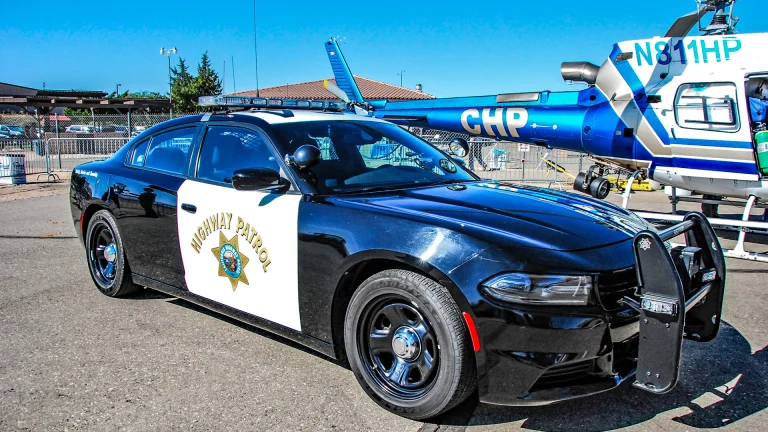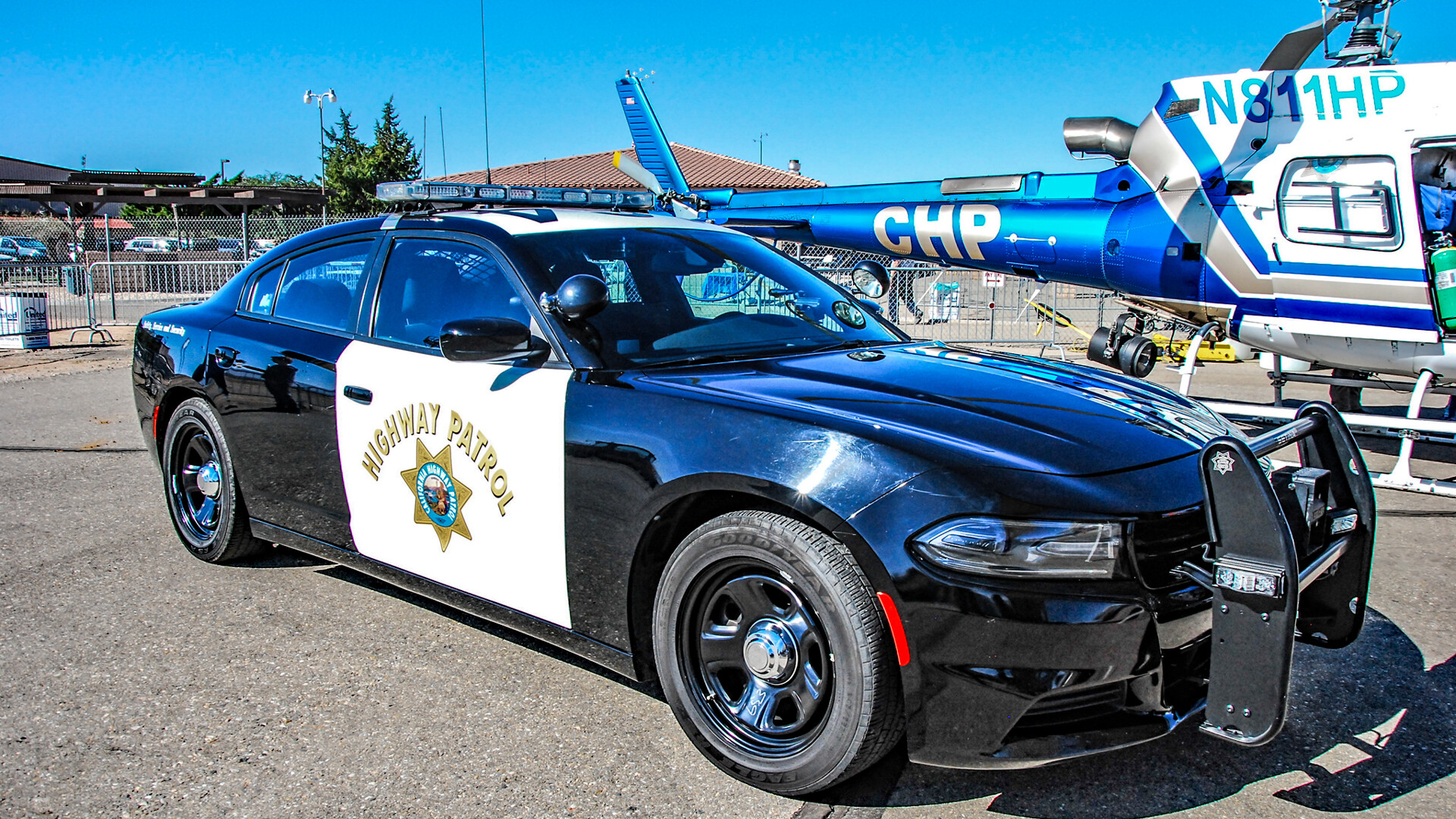
Photo: <a href="https://commons.wikimedia.org/wiki/File:California_Highway_Patrol_Dodge_Charger.jpg">Tomás Del Coro via Wikimedia Commons</a>, <a href="https://creativecommons.org/licenses/by-sa/2.0/">CC BY-SA 2.0</a>
The California Highway Patrol’s Monterey Area office posted two photos to its Instagram account on Oct. 19 of a 19-year-old driver it said one of its officers had arrested for DUI. In the first, he stands in a black T-shirt that reads “THIS IS NO TIME TO BE SOBER.” In the second, cropped below his eyes, an officer holds a handheld breath-testing device to his mouth at night, with a light pole and a parked SUV behind him.
The shirt got the laughs. The device in the second photo is what will decide what the stop costs him, because in California a driver under 21 can lose his license for a year on a reading of 0.01 percent, one-eighth of the adult limit, without being convicted of anything.
View this post on Instagram
Photos: California Highway Patrol, Monterey Area (@chp_monterey) via Instagram
What CHP released, and what it didn’t
The post is short. CHP did not say where in Monterey County the stop happened, on what date, what his breath tests showed, or which Vehicle Code section he was booked under. It did not name him, and without a name there is no Monterey County Superior Court case to look up. An arrest is an accusation; nothing in the post says he has been charged or convicted.
The caption is a message aimed at young drivers: “If you’re under 21, the message is simple: don’t drink and always stay sober behind the wheel.” By Oct. 22 the post had more than 14,000 likes, and the most-liked reply asked whether that meant drivers over 21 could go ahead. The answer, in the Vehicle Code, is that California holds the two groups to different numbers, and the gap between them is where this driver’s case sits.
California’s 0.01 percent law and the breath tester in the photo
For drivers 21 and older, the per se limit is 0.08 percent under Vehicle Code Section 23152. For anyone younger, Section 23136 makes it unlawful to drive with a blood-alcohol concentration of 0.01 percent or more, “as measured by a preliminary alcohol screening test or other chemical test.” A preliminary alcohol screening test, or PAS, is the handheld unit an officer uses at the roadside, the kind shown in CHP’s second photo.
The same section says any driver under 21 is deemed to have consented to that test if lawfully detained on suspicion of violating it, and must be told that refusing will cost him his license for one to three years. Under Section 13353.1, a first refusal means a one-year suspension. Adults are treated differently: Section 23612 requires an officer to tell an adult driver of the right to refuse the PAS, though not the blood or breath test that follows an arrest. A driver under 21 who turns down the handheld unit loses his license for it.
What happens after a reading of 0.01 percent or more is spelled out in Section 13388. The officer, acting for the DMV, serves a notice of suspension on the spot, takes the driver’s California license, and issues a temporary license that lasts 30 days. Section 13353.2 then requires the DMV to suspend, and Section 13353.3 sets the floor: for a driver found in violation of the 0.01 percent law, the suspension “shall not be for less than one year.” That process runs through the DMV, not a courtroom, and it does not wait for a criminal case. Under Section 13558, a driver who wants a hearing before the suspension takes effect has 10 days from receiving the notice to ask for one.
Two more thresholds, and a second suspension from the court
The 0.01 percent rule is the bottom rung. Section 23140 makes it a separate offense for a driver under 21 to have 0.05 percent or more. That section isn’t on the Vehicle Code’s list of offenses that are always misdemeanors in Section 40000.15, so under the code’s default rule in Section 40000.1 it is an infraction. At 0.08 percent, a 19-year-old falls under the same Section 23152 DUI law as everyone else, a misdemeanor that on a first conviction carries 96 hours to six months in county jail and a fine of $390 to $1,000 under Section 23536.
Age adds another layer at either level. Section 13202.5 requires a court to suspend the license for one year when someone 13 to 20 is convicted under Section 23140 or the DUI article that includes 23152, and says that suspension is in addition to any other penalty. Under Section 13353.3, when the DMV’s administrative suspension and the suspension that follows a Section 23152 conviction arise from the same stop, they run concurrently. The DMV’s driver handbook adds that a DUI conviction means completing a DUI program and filing a California Insurance Proof Certificate, known as an SR 22.
Under-21 DUI arrests in California, by the DMV’s count
The Monterey arrest is one of thousands a year. The DMV’s 32nd Annual Report of the California DUI Management Information System, dated March 2025, counts 110,017 DUI arrests statewide in 2021, its most recent arrest year. Of those, 5,781, or 5.3 percent, involved drivers under 21, and 5,452 were 18 to 20. The report says the under-21 share fell from 7.8 percent in 2011. Monterey County recorded 2,306 DUI arrests of all ages in 2021, up 8.7 percent from 2,121 the year before.
The same report found that 66.6 percent of 2020 DUI arrests ended in a DUI conviction, the lowest rate in the report’s history. For an adult, a case that falls apart in court can mean keeping a license. For a driver under 21 who blew 0.01 percent or more, the one-year administrative suspension is already in motion the night of the stop, whatever the district attorney later decides. Adults are measured against 0.08 percent; a 19-year-old doesn’t get that margin.
What comes next for the Monterey County driver
CHP hasn’t released his test results, so it isn’t public which of the three thresholds applies. If the roadside or later chemical test came in at 0.01 percent or higher, the law required the officer to serve the suspension notice that night, which would start the 10-day clock for a DMV hearing and the 30-day temporary license. Any criminal charge is up to the Monterey County District Attorney’s Office; CHP’s post doesn’t mention one. The rules differ for commercial drivers and for drivers with prior offenses.
A 19-year-old can lose his license for a year on a 0.01 handheld reading, before any court weighs in. Is that a fair line for drivers who can’t legally drink, or should they get the same 0.08 standard and the same day in court as everyone else?
About the Author