Most traffic stops that start with a passenger half out of a car window end with a warning, a small ticket and an awkward ride home. The one that started just after 11 p.m. on Friday, Aug. 7, in downtown Lake Geneva, Wisconsin, ended with a car roughly 100 feet out in Lake Como, four people swimming for a pier in the dark, and an 18-year-old driver facing felony charges.
The Lake Geneva Police Department has now released the dashcam and body-camera footage from that night. Nobody died, which is the headline that matters most. The second headline is how fast a seatbelt problem turned into a case that can carry years of prison exposure.
What police say happened
Police said an officer near Broad Street and Wrigley Drive saw a passenger hanging out of the vehicle without a seatbelt and tried to pull it over. The driver sped up instead.
From there, according to police, the car went the wrong way on a one-way street, ran stop signs and left the city for the Town of Geneva. The run ended at the public boat launch on Schofield Drive, where the car kept going down the ramp and into Lake Como. Police put the car about 100 feet from shore.
All four people inside got out and swam to a nearby pier, where officers helped them out of the water. Police said two were taken to a hospital and the other two declined further treatment. TMJ4 reported at the time that Town of Geneva police assisted and that a tow crew pulled the car out the next morning.
What the footage shows, and what it doesn’t
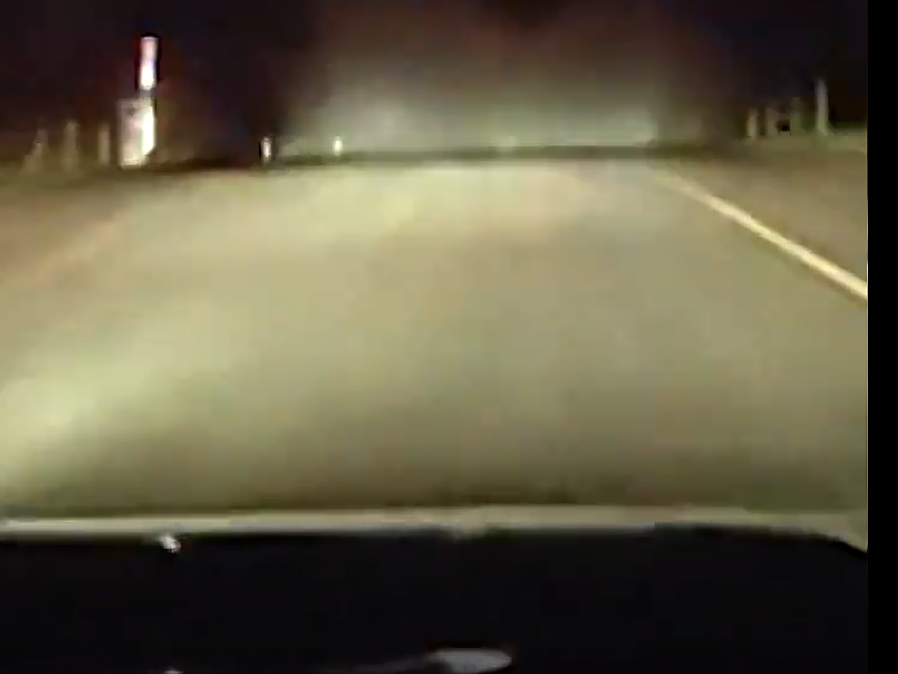
As aired by WISN in Milwaukee, the department’s dashcam video shows sparks coming from under the fleeing car. A witness interviewed by TMJ4 in August described the same thing. On body-camera audio transcribed by CBS 58, the driver tells officers, “I wasn’t thinking,” and adds that he could have hurt other people and “made my life worse.”
The limits of the public record matter here. Police have not released the car’s make or model, and they have not given a speed for the pursuit. Sparks under a car can come from several sources, and a video can’t tell you which one this was. The record released so far also doesn’t explain why the car went down the ramp instead of turning. Until court filings or the department say more, those are open questions. They aren’t material for guesses.
One thing needs no explanation. A boat launch is a paved slope built to lead straight into the water, and a driver who reaches one in the dark with police close behind has almost no room for error. For a comparable chase that ended badly on dry land, see this Arkansas dash-cam pursuit that ended in a rollover.
The charges
Police identified the driver as Cash Rauscher, 18, of Delavan. FOX6 reported that he faces one count of vehicle operator flee/elude officer and three counts of second-degree recklessly endangering safety, and that bond was set at $10,000 cash. The citations listed in local reports cover almost the entire rulebook: operating without a license, operating without insurance, failure to obey a traffic officer, failure to stop at a stop sign, unreasonable and imprudent speed, reckless driving, and a violation of Wisconsin’s absolute sobriety law.
These are allegations. Rauscher has not been convicted of anything, and his next court date is an arraignment on Sept. 28.
Why running is the most expensive choice in Wisconsin
The stop started over a seatbelt. In Wisconsin that’s a small civil forfeiture, the kind of ticket people complain about and then forget.
Fleeing is a different category. Under Wis. Stat. § 346.04(3), anyone who gets an officer’s signal and knowingly flees by speeding up, killing the lights or willfully ignoring the signal in a way that endangers others is committing a felony. The state court system’s criminal jury instruction lists the base offense as a Class H felony. It becomes a Class G felony if the flight causes bodily harm or property damage, and it climbs from there if someone is seriously hurt or killed. Second-degree recklessly endangering safety is a separate Class G felony. Under Wisconsin’s felony classes, a Class H conviction carries a maximum of six years and a Class G conviction a maximum of 10. Those are ceilings, not predictions. Even so, one reckless decision can stack several felony counts on top of each other.
The absolute sobriety citation is also worth understanding, because many young drivers don’t. The Wisconsin Department of Transportation is blunt about it: drivers under 21 can’t legally drive with any alcohol in their system at all, so the 0.08 limit doesn’t apply to them. WisDOT’s youth penalty chart lists a $200 fine, a three-month suspension and four demerit points for a violation. It’s a citation, not an OWI charge, and police haven’t released any test result.
For another look at how state law handles driving that leaves the expected path entirely, see our story on the Washington driver who took a car down the I-90 floating bridge’s bike path.
The part every driver should take away
All four people in that car got out, and that’s the best part of this story. Cars don’t float for long, and escaping one in the water is mostly about speed. AAA’s guidance breaks it into a short sequence. Stay calm, unbuckle, get a window open or broken, and get out, with children first. Power windows may keep working for up to about a minute after the car hits the water. Opening a door lets water rush in and speeds up the sinking, and waiting for the cabin to fill before you try to escape is the advice AAA calls deadly.
@cnn Police in Lake Geneva, Wisconsin, released dashcam footage of a high-speed car chase which ended with the driver of the vehicle crashing into Lake Como. Four people in the vehicle were pulled from the water with no serious injuries. The driver was charged with reckless driving.
♬ original sound – CNN
One gearhead footnote: a spring-loaded window punch only works on tempered glass. Many newer vehicles use laminated side glass, which cracks but stays in one piece, so check your window markings or owner’s manual before you trust a glovebox tool to get you out. If you’re putting together an emergency kit, our guide to car essentials that actually earn their keep is a good place to start. For more on what happens when a car meets water on purpose, our look at Mercedes’ floating-SUV patent gets into the buoyancy math.
The traffic stop was over a passenger who wasn’t buckled in. Everyone in the car still ended up in Lake Como.
Sources: Lake Geneva Police Department dashcam and body-camera footage and statements, as released to and reported by WISN, CBS 58, FOX6 and TMJ4; Wisconsin Court System criminal jury instruction 2630; Wisconsin Department of Transportation; AAA.
About the Author