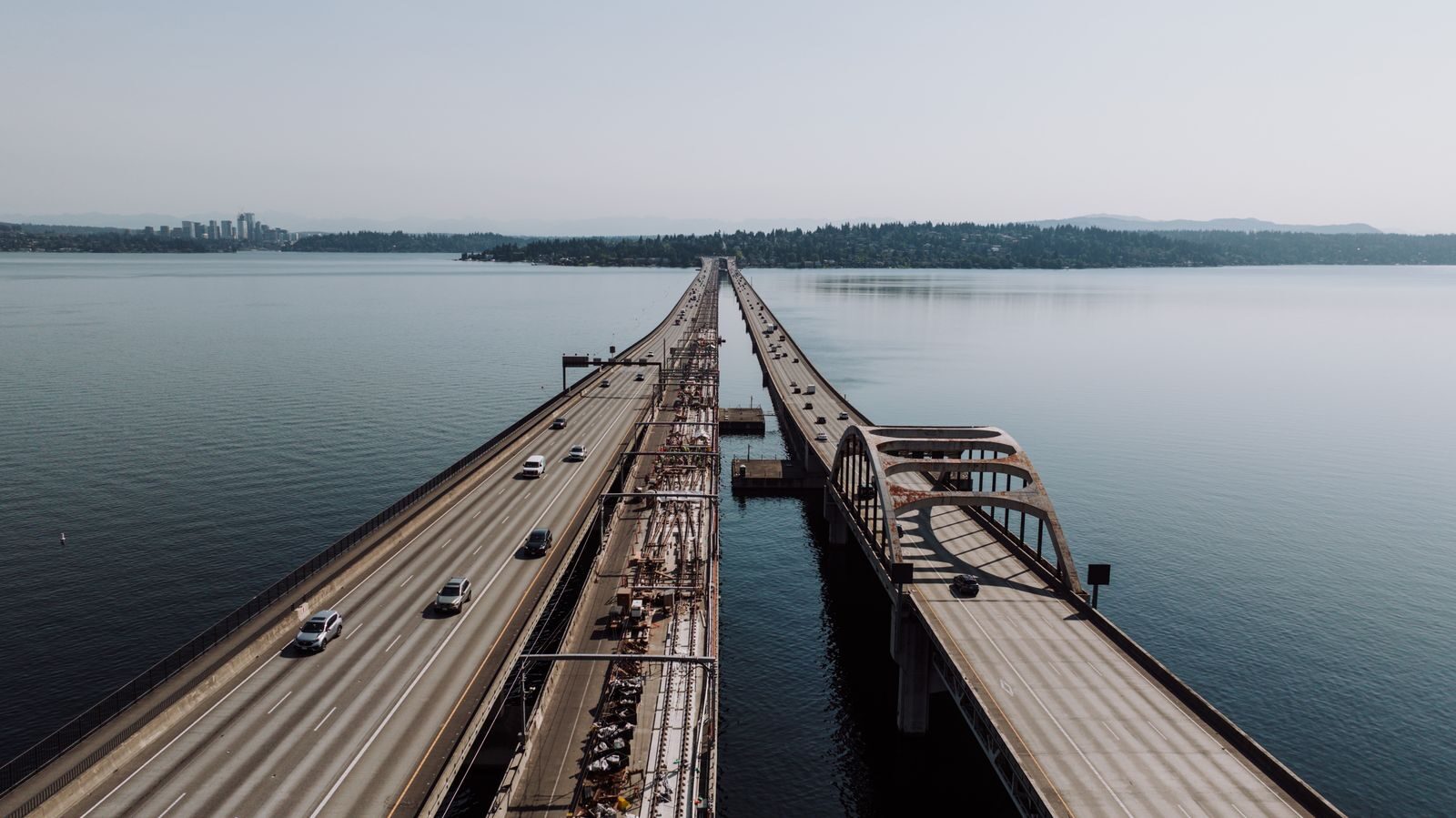
On the afternoon of September 10, video started circulating of a car driving along the I-90 Trail, the shared-use path that runs across Lake Washington on the side of the Homer M. Hadley Memorial Bridge. It went up on Reddit that same day and onto Bluesky by early evening, passed along by cyclists who use the crossing daily. The clips show a car moving along a path built for people on foot and on bikes, with nowhere for anyone to go but over the railing into the lake.
The reaction has been predictable and the coverage has mostly stopped at “look at this.” The more useful question is what actually happens to someone who does this in Washington, and the answer turns out to be a genuine mess.
The trail exists because cars are banned from the bridge deck
Start with why there is a path there at all. Washington Administrative Code 468-58-050 prohibits all nonmotorized traffic on state highways built as fully controlled limited-access facilities, with an explicit carve-out for “pedestrian overcrossings and undercrossings or other facilities provided specifically for the use of such traffic.” The I-90 Trail is that carve-out. It is not a bike lane bolted onto a highway. It is a separate legal facility that exists precisely because bikes and pedestrians are barred from the roadway beside it.
That framing matters when you start looking for the statute a driver would be charged under, because the trail is not a road and it is arguably not a sidewalk either.
Four statutes, four wildly different outcomes
RCW 46.61.606 is the obvious one and the weakest. It reads, in full: “No person shall drive any vehicle upon a sidewalk or sidewalk area except upon a permanent or duly authorized temporary driveway.” It has been on the books since 1975. Washington’s infraction statute, RCW 46.63.020, does not list it among the criminal exceptions, so violating it is a civil traffic infraction, not a crime.
There is a second problem. Washington defines “sidewalk” in RCW 46.04.540 as the property between the curb lines or lateral lines of a roadway and the adjacent property. That definition is built around a strip of concrete next to a street. Whether it stretches to cover an elevated path floating on pontoons over a lake is not a question the statute answers.
RCW 47.52.120 is the more precisely aimed statute, and it lives in the highways title rather than the traffic code. It prohibits driving “over, upon, or across any curb, central dividing section, or other separation” on a limited-access facility, and entering such a facility at unauthorized points. That is almost a literal description of getting a car onto this path. It is a misdemeanor. The fine is “not less than five dollars nor more than one hundred dollars,” plus five to 90 days in jail.
Five dollars. That fine range has apparently never been adjusted, and in a state where a routine speeding ticket runs several times that, a statute written for a different era is the one that most exactly describes the conduct.
RCW 46.61.500, reckless driving, is where the real exposure sits: driving “in willful or wanton disregard for the safety of persons or property.” It is a gross misdemeanor, up to 364 days in jail and a fine up to $5,000, plus a mandatory license suspension of at least 30 days. Reckless driving is specifically exempted from the civil-infraction statute, so it stays criminal.
RCW 9A.36.050, reckless endangerment, stacks on top if anyone was on the path. Recklessly creating a substantial risk of death or serious physical injury to another person is also a gross misdemeanor.
Negligent driving in the first degree requires signs of impairment and does not apply absent evidence of it. Second-degree negligent driving is a $250 civil infraction.
So the same drive is somewhere between a hundred-dollar misdemeanor and a year in jail with a suspended license, depending entirely on which statute a prosecutor reaches for. That spread is not unusual in traffic law, but it is rarely this wide.
The bollard problem is a design decision, not an oversight
The obvious follow-up is how a car gets onto a protected path in the first place. The answer is in WSDOT’s own Design Manual, chapter 1515, which covers shared-use paths and states directly: “Do not use barriers such as z-gates and fences located within the width of a shared-use path.” The manual prefers splitter islands instead.
That is not agency sloppiness. Bollards and gates in the middle of a path are a documented hazard to the people the path is for. Cyclists hit them, particularly at night, in groups, or when the rider in front obscures them. Trail designers across the country have spent two decades removing them for exactly that reason, accepting a small risk of vehicle incursion in exchange for eliminating a constant risk to legitimate users.
The same manual sets the geometry: 12 feet of operating width is desirable, 10 feet is the minimum, with at least two feet of shoulder on each side, and where adjacent traffic runs above 35 mph the path needs either more than five feet of separation or a concrete barrier tall enough to support a cyclist leaning on it. Those dimensions are generous for bikes. They are also, unavoidably, wide enough for a car.
What is actually under that pavement
The crossing itself deserves more respect than a viral clip gives it. The Homer M. Hadley Memorial Bridge carries roughly 133,000 vehicles on a typical weekday, and it floats. The I-90 floating bridges are held in position by a system of 38 steel anchor cables that get replaced on a 25- to 30-year cycle, with the most recent full replacement running spring through fall of 2022, most of it performed underwater from barge-mounted cranes.
Washington learned what happens when that system is disrespected. The neighboring Lacey V. Murrow Memorial Bridge sank on November 25, 1990, during construction work. The review that followed produced a set of standing recommendations from WSDOT: independent third-party review at project milestones, floating bridges built and maintained using marine rather than standard highway construction practice, watertight integrity maintained throughout construction, and contract limits on major work during storm season.
The Hadley bridge’s center roadway has since been converted to carry light rail, an engineering problem serious enough that a 2005 load test found rail loading combined with a one-year storm event produced stresses at 97 percent of allowable. That is a structure with very little margin being managed very carefully, which is a decent argument for not treating its bike path as a shortcut.
What is not confirmed
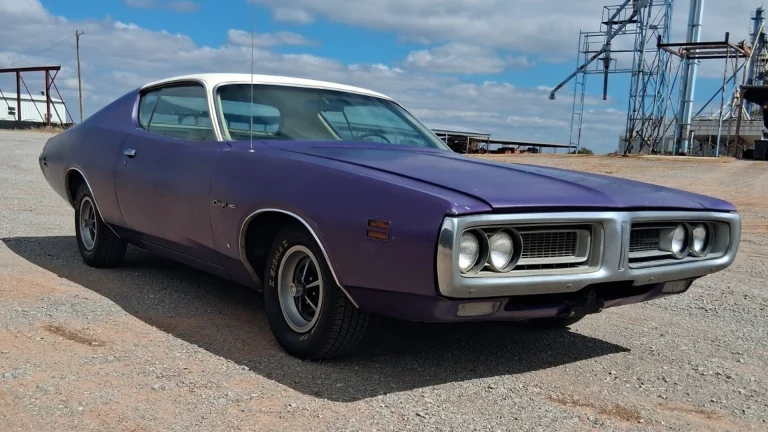
Worth being straight about the limits here. As of this writing there is no Washington State Patrol media release addressing the incident, no posted agency statement, and no public record of a citation, an arrest or an identified driver. The vehicle’s make, model and speed are not established by anything verifiable. What exists is footage, posted by trail users, of a car somewhere it has no legal right to be. It is not the first time a vehicle has ended up on infrastructure never meant to carry it, and those situations rarely end with a tidy citation.
If a citation does come, the insurance side is worth understanding too. A reckless driving conviction is a criminal conviction that follows a driver’s record, and it is the sort of entry that moves a premium far more than a speeding ticket does. Washington drivers dealing with the aftermath of any at-fault incident should expect the conviction, not the crash, to be the expensive part. The state’s Office of the Insurance Commissioner has not published guidance specific to this scenario, and any claim about automatic coverage denial for reckless conduct should be treated skeptically until someone points at actual policy language.
For now, the practical takeaway for anyone who uses that crossing: the path is a legally distinct facility, it is deliberately not barricaded, and the statute that describes driving on it most precisely carries a maximum fine of one hundred dollars. If that seems out of proportion to a car threading through people on bikes a hundred feet above Lake Washington, that is because it is.
Featured image: Vladislovas Sketerskis via Pexels, a stock photo and not the I-90 Trail. Statutes quoted from the Washington State Legislature; path design standards from the WSDOT Design Manual.
Your Turn: Have you seen a driver do something this baffling on the road? Share your story in the comments.
About the Author