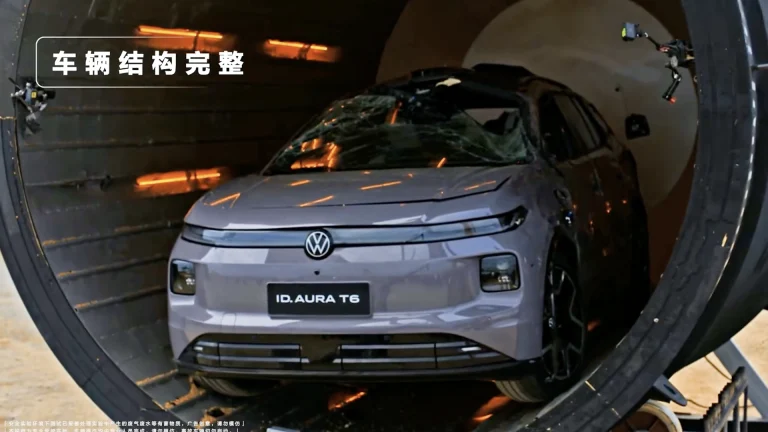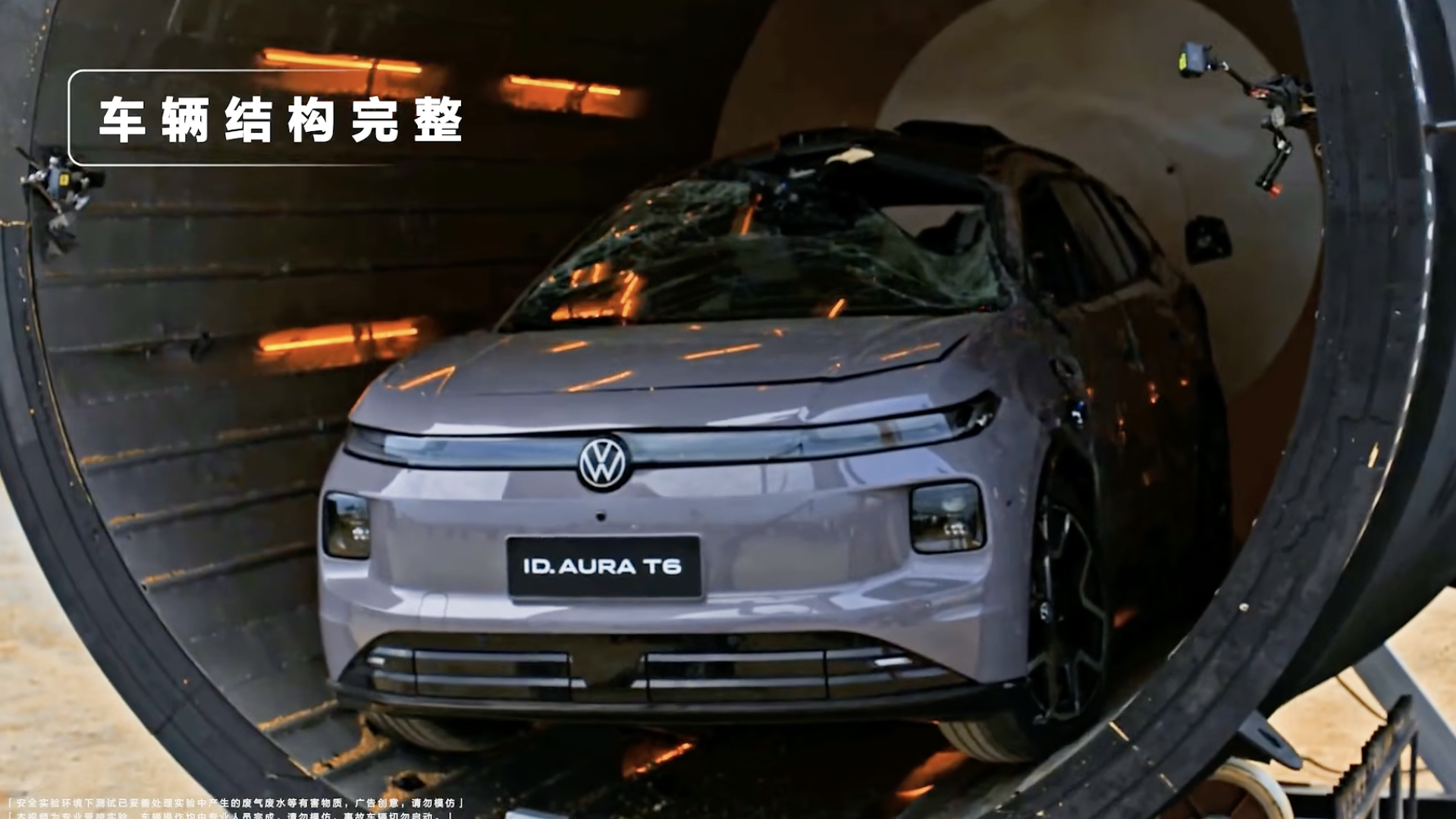
Most crash tests involve a barrier, a sled, and a room full of engineers with clipboards. Volkswagen’s latest involves a drum, a heat source, and a snack-food metaphor. A video titled “Volkswagen ID. AURA T6 vs. a 160°C Popcorn Machine — Can It Survive 50 Spins?” puts the new electric crossover inside a giant rotating cylinder, heats it, and rolls it over and over. youtube
160°C works out to 320°F. That’s the kind of temperature you’d use to roast vegetables, now applied to an SUV.
It makes great content. It’s also a good excuse to talk about what rollover protection actually involves, because spinning a car in a drum and surviving a rollover crash are very different events.
What a drum actually does to a car
Picture the car inside a slowly rotating cylinder. On each revolution, the body rolls onto its side, then its roof, then its other side, then back onto its wheels. If the drum turns slowly and the car stays roughly in place, every panel takes a turn supporting the car’s own weight. If the car slides or drops as the drum rotates, there’s an impact load on top of that. How large that impact is depends on drum speed and how much room the car has to fall. The video’s title doesn’t give either number.
Related Articles
- Bentley Torcal Shows Up in Beverly Hills With Its Grille Lit Four Days After the London Reveal
- Talan Skeels-Piggins Ran 200.254 MPH at Elvington on a Hayabusa That Spent a Decade Under a Tarp
A real rollover is a different kind of violence. A car tripping off a road shoulder at speed lands on its roof with momentum behind it, often more than once, and usually on uneven ground. That’s why U.S. regulators focus on roof strength rather than endurance.
For context, NHTSA’s upgraded roof standard doubled the force a light vehicle’s roof must withstand in testing, from 1.5 to 3.0 times the vehicle’s unloaded weight. The agency’s compliance test procedure requires that each side of the roof structure resist up to 3.0 times the vehicle’s unloaded weight, with the force applied to each side separately. In other words, the federal benchmark is a measured load at a known multiple of the car’s weight, applied with a hydraulic platen. A slow drum that repeatedly rests the car on its roof can involve loads well below that. Fifty rotations prove the structure can repeat a load. They don’t show its maximum capacity. govinfo nhtsa
Heat is the more interesting variable
The 160°C figure sounds dramatic, and for EV skeptics it touches a real worry: heat and battery packs. But the air temperature inside a drum isn’t the battery temperature. A pack is a large thermal mass inside an insulated, sealed enclosure, usually with its own cooling loop. How hot the cells actually get depends on how long the car stays inside, how the heat is delivered, and whether the thermal-management system is running. None of that is in the title.
If VW released cell temperature logs from the test, that would be the most valuable output of the whole exercise. Without them, “it got hot outside the car” is the only verified statement.
What owners should take from it
If you ever own a car that has actually rolled over, don’t treat “it still drives” as a clean bill of health. A few practical points:
Related Articles
- A Text in Heather Gibbs’ Files Asked What Car Chris Gabehart Drives, 23 Days Before JGR Sued
- Bonnie and Clyde’s Death Car Took 100-Plus Bullets. Now It’s Parked in a Nevada Casino
- Structure first. Pillars, roof rails and door apertures can deform without obvious cosmetic damage. A frame-and-body shop should measure the car against factory dimensions before anyone signs off on it.
- Inspect the HV enclosure. On an EV, the battery case is both a structural part and a safety barrier. Gouges, dents or compromised seals underneath justify a dealer-level inspection, even if the dashboard shows no warnings.
- Heat damages more than cells. Sustained high heat can soften adhesives, weaken window bonding, and degrade wiring insulation and seals. Those failures tend to appear months later as leaks and electrical faults.
- Expect insurance to treat it seriously. Between structural repair, potential pack replacement and the required inspections, a rollover-damaged EV can easily be written off even if it can still drive away.
The bottom line
As marketing, the popcorn drum works: it’s memorable, it’s easy to share, and it shows a car taking punishment and coming out the other end. As engineering evidence, it’s a demonstration rather than a test. There’s no published rotation speed, no load data, and no temperature traces from inside the pack. If Volkswagen wants buyers to take it seriously as a safety claim, the most impressive thing it could release next is a spreadsheet.
Images Via: DiscoverChinaAuto on Youtube
About the Author