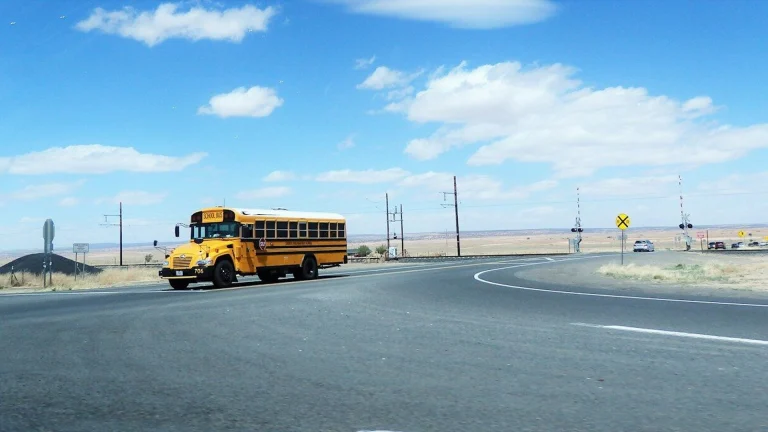
Interstate 84 in eastern Oregon, near La Grande. (Ken Lund/Wikimedia Commons, CC BY-SA 2.0)
Ammon Bundy was stopped on Interstate 15 near New Harmony, Utah, at about 8:18 a.m. on Oct. 7 in a 2020 Ford F-250 with no license plate, and the traffic stop ended with four officers carrying him to a patrol vehicle after he would not get out of a truck an Iron County sheriff’s deputy planned to impound.
According to KUTV’s report on the sheriff’s account, Bundy told the deputy the truck was not registered, and when asked why, said, “You can talk to my lawyer.” A records check showed his driver’s license had expired, and a state tax impound was requested. Bundy refused an order to get out. The sheriff’s account says he grabbed the steering wheel with his right arm, and in video obtained by Boise station KBOI, more deputies and state troopers open the door and pull him out. After he was handcuffed, four officers lift him by the arms and legs and carry him to a patrol vehicle. The sheriff’s account says he refused to walk and dragged his legs.
Bundy, who helped organize the 2016 takeover of the Malheur National Wildlife Refuge in Oregon and has since moved to the Cedar City, Utah, area, was booked into the Iron County Jail, received a medical evaluation because force was used, and bailed out a short time later. He has said he bought the truck new in 2020 and never registered it, and that he paid more than $1,100 in fees and fines to get it back. KUTV reported that it still has no plate.
Four counts in Iron County Justice Court
The sheriff’s booking record lists failure to obey a peace officer, interfering with a peace officer, driving without registration, and no valid license. KUTV reported that all four are in Iron County Justice Court, that arraignment is set for Feb. 1, and that Bundy says he does not need a license or registration and intends to contest the charges. A booking and a charge are accusations. Bundy has not been convicted of anything in this case.
Two of the counts sit at the bottom of Utah’s penalty ladder. Section 41-1a-1303 bars driving a vehicle that is required to be registered but is not properly registered on any highway, and it makes a violation an infraction with no jail term in the section. Under Section 53-3-202, a first violation of the driving-without-a-license rule is an infraction too, and it becomes a class B misdemeanor only when the driver has a previous conviction under that section. Both sections apply to a person driving on a highway in the state. I found no exception in either for a claimed right to travel, which is the argument Bundy has made on the video.
Where the jail exposure comes from
KUTV reported that the most serious count is interference, a class B misdemeanor that carries up to six months in jail and a $1,000 fine, and that it stems from his refusal to leave the truck. Section 76-8-305 reaches a person who knows, or with reasonable care should know, that an officer is trying to make a lawful arrest or detention and who interferes by, among other things, refusing to perform an act required by a lawful order that is necessary to carry out the arrest or detention. The statute asks twice whether the officer’s action was lawful. A conviction would depend on whether the deputy had legal authority to take the truck and order Bundy out of it.
That authority is in Section 41-1a-1101. It lets a peace officer seize a vehicle without a warrant in several listed situations, including when the vehicle is being operated on a highway with registration that has been expired for more than three months. It also directs an officer to seize a vehicle when the operator has no driving credential in possession, after checking the state criminal justice database for one, unless an exception applies. The exceptions include an operator whose credential has expired, a public safety concern, an operator under 18, and a licensed passenger willing to drive. Bundy’s license was expired, according to the sheriff’s account as KUTV relayed it. Which ground the deputy relied on for the truck is not in the reporting, and I could not retrieve the deputy’s report or the charging documents.
What the stop cost
Bundy’s more than $1,100 in fees and fines got the truck out, and it left the impound lot in the condition that started the stop. A plate dispute that would ordinarily end in a citation and a trip to the DMV produced four counts, a medical evaluation, and a jail booking because of what happened after the deputy told him the truck was going away. Utah is not the only place where tow trucks and vehicle rules collide. Backfire News also reported on a Missouri suburb sued over towing more than 150 cars from driveways and backyards without a warrant.
Utah law lets officers seize a vehicle at the roadside without a warrant, and it makes a driver’s refusal to cooperate with a lawful detention a jail-eligible misdemeanor. Should that refusal carry jail time when the underlying violation is only an infraction, or should a plate dispute end at a citation and a fine?
About the Author