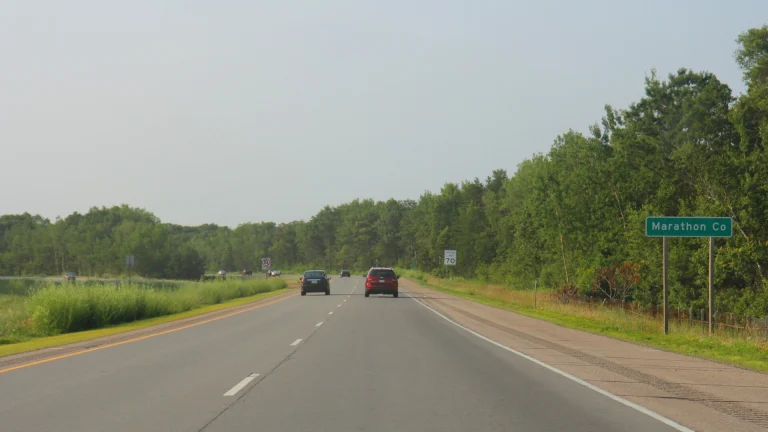
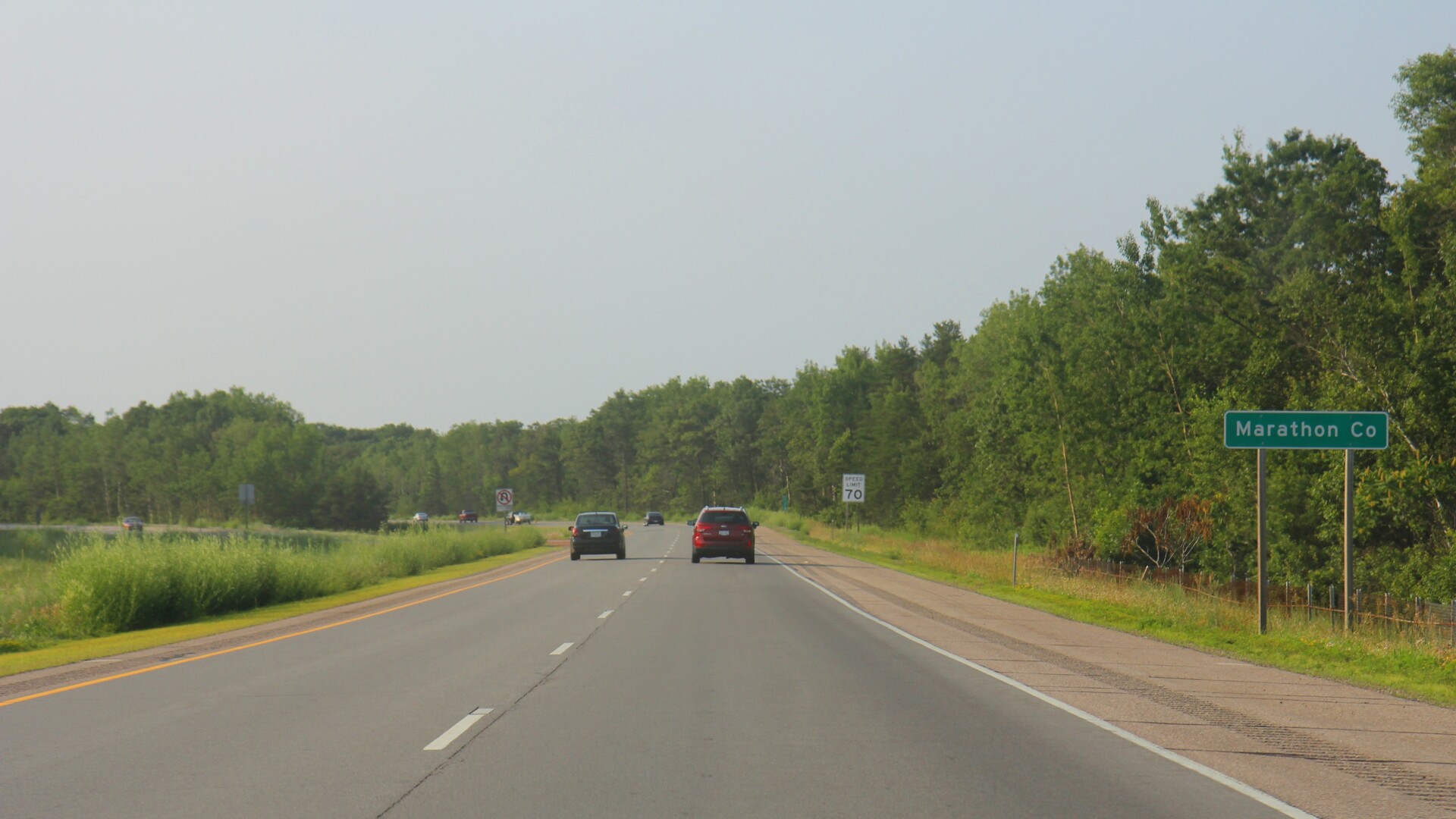
A Marathon County sign on Interstate 39 in Wisconsin. Photo: Royalbroil / Wikimedia Commons, CC BY-SA 4.0
Brendan Cutrell, then a Marquette County, Wisconsin, sheriff’s deputy, finished explaining speeding and window-tint citations to a driver and his passenger on Interstate 39 at 10:57:24 p.m. on Dec. 9, 2023. A drug dog alerted on their car at 10:57:41. On Oct. 29, 2026, U.S. District Judge J.P. Stadtmueller of the Eastern District of Wisconsin ruled in Milwaukee that those 17 seconds were an unconstitutional extension of the stop, and he denied Cutrell qualified immunity in the driver’s federal lawsuit.
The order in Burnside v. Marquette County, No. 25-CV-195, grants driver Brian Burnside partial summary judgment on liability and leaves only damages for trial. Stadtmueller wrote that the Fourth Amendment “does not allow for a de minimis extension of a traffic stop,” and that Cutrell “had at most a hunch” of drug trafficking. According to the order’s summary of their motion, Cutrell and the county argued that he did not unreasonably delay the stop, that he had reasonable suspicion for its duration, and that he is entitled to qualified immunity. The judge rejected all three.
A speeding stop near the 96 mile marker
The order recites facts the parties largely agree on. Cutrell was driving north on I-39 around 10:30 p.m. when he saw two vehicles heading south at about 85 mph. One changed lanes without signaling and weaved within its lane. Cutrell then saw that same car, driven by Burnside, accelerate to 89 mph, and he turned on his lights and siren. The car took about 23 seconds to slow and signal and about 52 seconds to pull over. Cutrell could not see into the rear window and suspected illegal tint, but he did not have a tint meter with him.
At the passenger window, Cutrell smelled cologne and saw an air freshener hanging from the mirror. The passenger, who owned the car, said they were coming from Wausau and headed to the Wisconsin Dells. Cutrell thought exits at the 106 and 100 mile markers offered a more direct route, though the order notes that I-39 southbound connects to another highway that also reaches the Dells. The conversation lasted about two minutes. By the end of it, the order says, Cutrell did not believe he had reasonable suspicion that Burnside was driving while impaired, but he did believe the car contained illegal drugs or alcohol.
Walking back to his squad car, Cutrell asked for a second unit and, a few seconds later, a K-9. Dispatch told him neither traveler had restrictions or open cases and neither was on probation, and the order says he kept searching Wisconsin’s online court records anyway. Deputy Nicholas Spanske arrived with a tint meter and found the tint violated state law. Cutrell printed citations for speeding and window tint and a warning for lane deviation, waited about a minute, conferred with Spanske for about 30 seconds, and then told the travelers they were not free to go with the citations in hand.
The dog began its sniff at 10:57:16 p.m., while Cutrell was still talking with the occupants. He finished delivering and explaining the citations at 10:57:24. The dog alerted at 10:57:41. Officers searching the car found a pistol, ammunition, an open whiskey bottle and a bag of leafy green material that later tested positive for THC, the order says. State charges followed and were dropped after Burnside won a motion to suppress. According to the federal docket, he sued Cutrell and Marquette County on Feb. 7, 2025, under 42 U.S.C. § 1983.
The clock runs until the paperwork is done
The rule Stadtmueller applied comes from Rodriguez v. United States, which the Supreme Court decided 6–3 on April 21, 2015. A Nebraska officer in that case had finished a written warning, and seven or eight minutes passed before a dog alerted. The Court rejected the lower court’s view that the wait was a minor intrusion and held that a stop may last only as long as it takes to handle the traffic violation and related safety checks. Anything else, including a sniff, has to fit inside that time or be backed by reasonable suspicion of another crime.
Cutrell’s side argued that the sniff began before the stop’s mission ended, since the dog started eight seconds before he finished with the citations. The court was not persuaded. The sniff prolonged the stop for at least the stretch between Cutrell finishing the citations and the dog’s alert, Stadtmueller found, and Rodriguez leaves no room for a short delay. The judge wrote that it did not matter whether Cutrell had been diligent up to that point: once he handed over the citations and told the occupants they could not leave, he was holding them for the sniff. The judge did not reach the parties’ other arguments about the earlier minutes of the stop.
The practical measure, then, is when the tasks tied to the ticket end, not when the officer asks for the dog and not how long the dog needs. Seventeen seconds counted.
Six ordinary facts and one with a specific link
With the stop extended, it could stand only if Cutrell had reasonable suspicion, which the order describes as objective, particularized facts pointing to criminal activity by the people stopped. The defendants offered six: the driving, the tint, the cologne, nervousness, Wausau as the starting point, and the route. Stadtmueller weighed each.
The driving got minimal weight. Many people speed, the judge found, and taking under a minute to pull over does not point to drug trafficking, and by the end of the conversation Cutrell no longer suspected impairment. The tint got “some weight,” because dark windows can hide the inside of a car, and it was the only factor the judge found had a particularized connection to drug trafficking. He still discounted it, because tint applies to a broad group of lawful drivers. The cologne got minimal weight; by the order’s account the smell had faded by the time Spanske measured the tint, and Spanske, who noted it was windy, did not detect it. After watching the video, the judge had trouble seeing nervousness in either occupant and called the exchange “friendly, polite, and brief.” Wausau, which the defendants called a known “narcotics hub,” and the route to the Dells added little, and the order says the travelers were on a valid route.
The judge wrote that he was troubled by the defendants’ inclination to list innocent facts and label them suspicious. Citing Judge Richard Posner’s remark in a 2005 Seventh Circuit opinion that police can describe nearly any behavior as suspicious, he wrote: “Collecting a list of innocent facts does not establish reasonable suspicion.” An officer is not required to rule out innocent explanations, the order says, but one who wants to turn a hunch into reasonable suspicion has to ask follow-up questions or otherwise investigate. The order describes Cutrell as having asked for the K-9 within seconds of ending a two-minute conversation.
Why qualified immunity failed
Qualified immunity shields officials from damages unless they violated a right that was clearly established when they acted, and once a defendant raises it, the plaintiff has to defeat it. The order says a case precisely on point is not required. It relies instead on Rodriguez and a Seventh Circuit decision, United States v. Rodriguez-Escalera (2018), in which an officer’s suspicion rested on Los Angeles as a drug-source city, travel stories that did not match and a pungent air-freshener smell. The appeals court held those facts insufficient. The Seventh Circuit covers Wisconsin, Illinois and Indiana.
Stadtmueller acknowledged that Burnside’s stop differs from Rodriguez-Escalera in two ways, the driving and the tint, and said in a footnote that those differences made qualified immunity a difficult call. He denied it anyway, holding that “no officer familiar with Rodriguez and Rodriguez-Escalera could have had reasonable suspicion of drug trafficking when detaining Plaintiff.” The order leaves open two questions he did not need to answer: whether Rodriguez set a bright-line rule, and whether case law from outside the Seventh Circuit can clearly establish a right there.
Damages, the county and other Wisconsin stops
The order notes that how long Cutrell prolonged the stop may matter to damages, and it lets the parties argue that in pretrial briefing. How much a jury puts on 17 seconds is open. In San Antonio, a federal jury awarded a driver $76 over a stop that ran more than an hour, according to the Institute for Justice, which represented him. Marquette County is in the case, but the order says no municipal liability claim is asserted against it and that it is included for indemnification purposes. The claim is against the deputy.
The ruling is not the first from a Wisconsin federal court on this mix of facts. The order cites Lewis v. Columbia County, a Western District of Wisconsin decision from April 2024 in which the court held an officer lacked reasonable suspicion for a stop and denied qualified immunity, though the evidence included speeding, a strong cologne or perfume odor and nervous travelers. Stadtmueller noted that Lewis post-dates the Burnside stop and did not rely on it to show the law was clearly established. Backfire News has covered other stops that began with a lane violation, including a Virginia woman’s account to the ACLU of an officer who, by her account, stopped her for the left lane and then cited her travel patterns.
A district court order binds the parties in this case and does not set precedent for other courts. Rodriguez applies in every state, though, and courts weigh reasonable suspicion case by case, so the same facts can come out differently elsewhere. In Burnside’s case, the judge’s own look at the video settled the nervousness question. What’s left is the fight over what 17 seconds are worth.
Should an officer who has finished writing the ticket have to let the driver go on the spot, even when a drug dog is seconds from finishing its sniff, or is a delay that short too small to matter?
About the Author