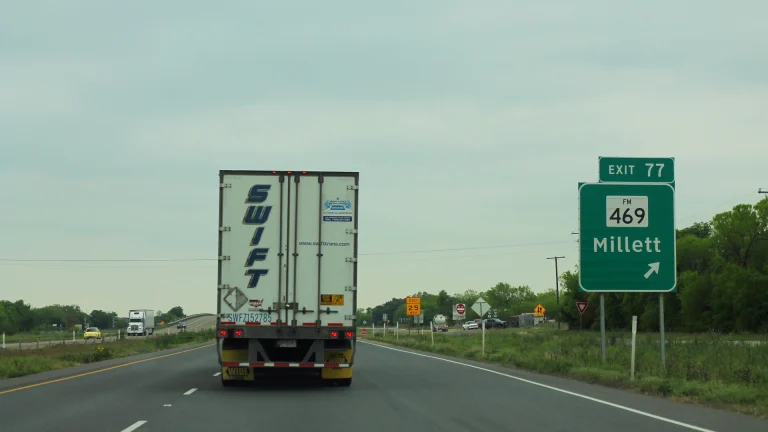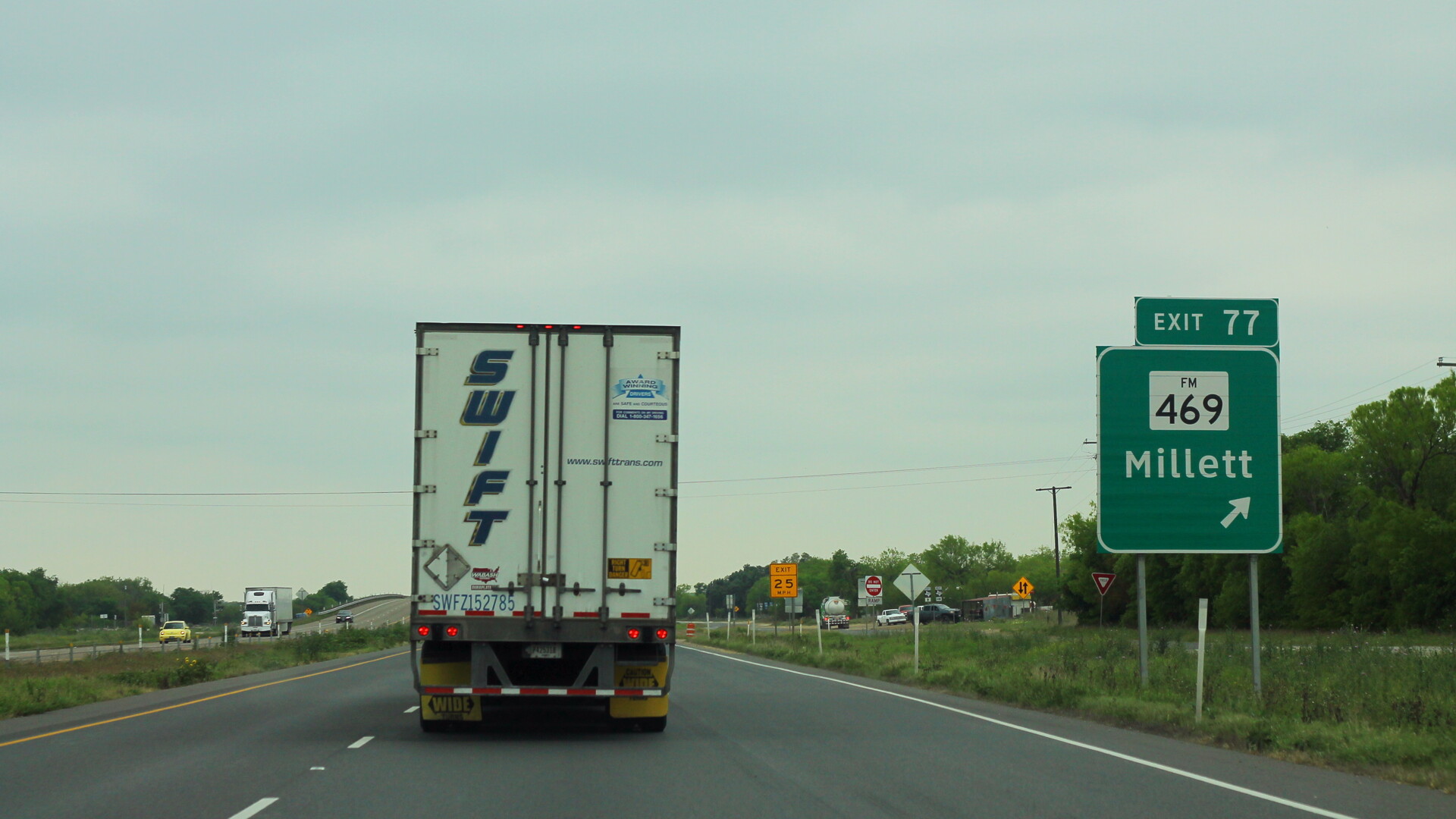
Interstate 35 southbound in South Texas. Photo: formulanone / Wikimedia Commons (CC BY-SA 2.0)
Deputy Joel Babb of the Bexar County Sheriff’s Office stopped Alek Schott’s Ford F-250 on northbound Interstate 35 south of San Antonio, Texas, at about 11:15 a.m. on March 16, 2022. According to Schott’s federal complaint, Babb told him it would be a warning, not a ticket, and said, “I don’t give tickets. I give warnings.” The stop ran more than an hour, and three deputies spent about 40 minutes searching the truck. They found nothing. On Sept. 28, 2026, the Institute for Justice, the law firm representing Schott, announced that a federal jury in San Antonio had held Bexar County liable and awarded him $76.
A warning leaves no ticket to fight
The complaint quotes Babb giving one reason for the stop: Schott had drifted over the fog line. Texas Transportation Code § 545.060 tells drivers on a roadway with marked lanes to drive “as nearly as practical” within a single lane and not to leave it unless the move can be made safely. That standard is the legal footing for this kind of stop, and it rests on a factual claim the deputy makes at the roadside. IJ says the evidence at trial showed Schott never crossed the line, and its case page says Schott’s own dashcam footage shows no drift.
Choosing a warning changes who can check that claim. A ticket can be contested in traffic court, where the officer has to describe the lane violation under oath. A written warning carries no charge, so nothing goes before a judge unless the driver sues. Schott says he tried the cheaper route first: in IJ’s release, he says he complained to the Sheriff’s Office, that the department reviewed it and saw no violation, and that he was told to sue if he had a problem.
Two Supreme Court rules and a 20-minute wait for a dog
The Supreme Court permits the first half of this. In Whren v. United States (1996), a unanimous Court held that a stop is reasonable when the officer has probable cause of a traffic violation, whatever else the officer hoped to find. A deputy can be fishing for drugs as long as the lane violation really happened.
The second half is tighter. In Rodriguez v. United States (2015), a 6-3 majority led by Justice Ruth Bader Ginsburg held that authority for a traffic stop ends when the tasks tied to the violation are, or reasonably should have been, finished, and that a dog sniff is not one of those tasks. Holding a driver for a sniff takes reasonable suspicion of something else.
The complaint says Babb asked to search Schott’s truck about 10 minutes in, Schott declined, and Babb called for a drug dog that arrived about 20 minutes later. Deputy Martin Molina’s sniff lasted about two and a half minutes, and he reported a positive alert. IJ alleges the bodycam video shows the dog handler gesturing upward just before the dog jumped on the truck. As summarized in a magistrate judge’s report, the complaint also alleges the written warning said no search had taken place. The complaint adds that Schott accepted $7,268.46 from Bexar County for damage the dog caused to his truck.
How one stop became the county’s liability
A county is not liable just because one of its employees broke the Constitution. Under Monell v. Department of Social Services (1978), a plaintiff suing a local government under 42 U.S.C. § 1983 has to show that an official policy or custom caused the violation. According to IJ, Schott’s jury had to find a practice of stopping and searching drivers this way, that the sheriff knew or should have known about it, and that the practice caused his stop, and it found all three.
The county tried to get the case thrown out in 2023. In a Sept. 27, 2023 report, U.S. Magistrate Judge Richard B. Farrer recommended denying the county’s motion to dismiss, finding the complaint plausibly alleged that the stop lacked justification, was unlawfully prolonged, and led to an unlawful search. He cited, among other things, Babb’s statements and the Sheriff’s Office’s internal-affairs responses in support of an inference that the county had a custom behind the stop. U.S. District Judge Orlando Garcia adopted the report on Oct. 30, 2023.
The tip came through a WhatsApp group
IJ describes the practice as five steps: cameras log plates, analysts or tipsters flag ordinary travel such as driving toward the border and back, deputies invent a traffic violation, drivers are questioned in a patrol car and asked to consent to a search, and a dog alert supplies probable cause if they refuse. IJ says it ran for four years. In Schott’s case, IJ says, Babb testified that the tip reached the department through a WhatsApp group called the “Northwest Highway Group,” from a man he knew only as “Kiki,” whom Babb believed worked at a federal fusion center in Laredo. The county’s account of that tip is not in IJ’s release, and I found no county statement in the court documents I reviewed.
IJ’s case page cites 2022 Texas Commission on Law Enforcement data: 7,191,167 stops, 6,780,292 of them for alleged traffic violations, and 379,680 that ended in searches, with contraband found in fewer than half of those searches. By Backfire News’s math, that is about one search for every 19 stops.
What the injunction would decide
IJ says Schott asked for $76, a dollar for each minute he was held. The complaint he filed in June 2023 also asks for a declaration that the county’s stop policy violates the Fourth and Fourteenth Amendments, a permanent injunction against using traffic stops for searches and seizures without reasonable suspicion of a crime, and attorneys’ fees and costs. IJ says it will now ask Judge Garcia for the injunction. No ruling on the injunction or on fees appears in the documents I reviewed.
The verdict covers one stop and the county practice behind it. Whether a Bexar County deputy may keep pairing a roadside lane claim with a dog sniff is the injunction’s question. Everywhere else, the rules are the same two cases: a pretext is allowed, a stop prolonged for a sniff without other suspicion is not, and refusing consent did not spare Schott a wait on the shoulder for a dog. The Rodriguez limit was enforced here after the fact, by a lawsuit that took more than four years from stop to verdict.
Backfire News reported a Virginia driver’s account of a left-lane stop that ended with a self-described FBI officer showing her where her plate had been scanned, and The Auto Wire also covered the Texas verdict.
Featured photo: Interstate 35 southbound in South Texas, by formulanone / Wikimedia Commons, licensed CC BY-SA 2.0.
Should courts keep letting deputies use a minor lane violation as the legal reason for a stop that a camera tip actually prompted, or should the tip itself have to be on the record before the stop counts?
About the Author