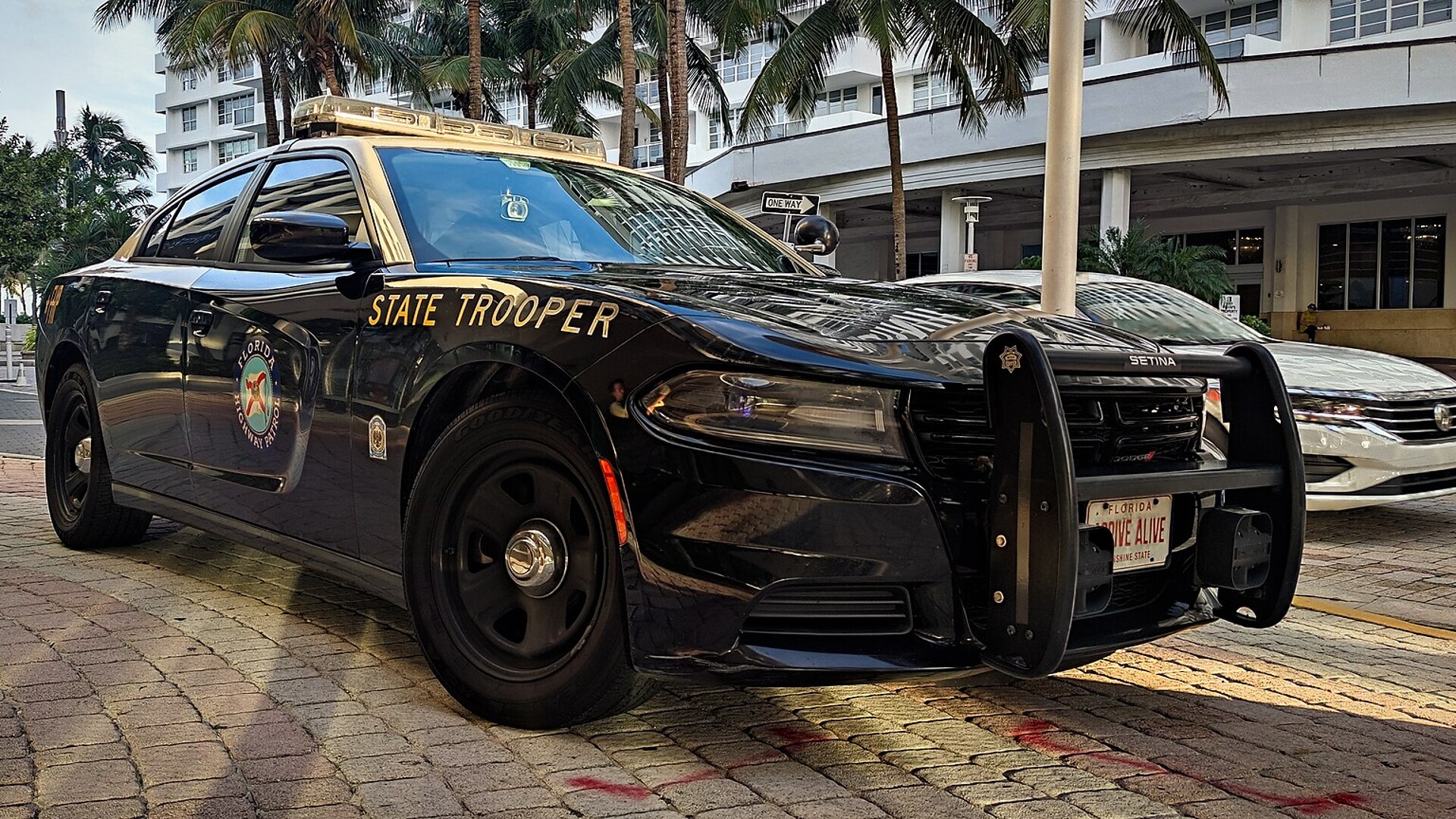
A Florida Highway Patrol Dodge Charger. File photo, not the vehicle involved. Credit: Elbert Hampton / Wikimedia Commons (CC0)
A 59-year-old DeLand man died Saturday on I-95 in Fort Pierce, Florida, after a Florida Highway Patrol trooper clocked his 2020 Volvo S60 at 101 mph and tried to end the run with a PIT maneuver, the technique that FHP’s pursuit policy calls its primary way to stop a chase. The PIT failed, FHP said.
FHP has not released the driver’s name, and a traffic homicide investigation is open. The agency’s public account is short. It does not say how fast the Volvo was traveling when the PIT was tried or what the trooper could see ahead. The policy that governed the decision is posted online, and I read it.
Featured image: Elbert Hampton / Wikimedia Commons (CC0). File photo of a Florida Highway Patrol Dodge Charger; not the vehicle involved.
What FHP says happened on I-95
A trooper clocked the car southbound near mile marker 141 at about 7:05 a.m., CBS12 reported, citing FHP. The agency said the driver did not stop, weaved through traffic and used the paved shoulders to keep moving. WPBF reported that a PIT attempt north of Okeechobee Road, State Road 70, did not work. The Volvo then went onto the inside shoulder and into the grass median, where it hit several large palm trees on the driver’s side. FHP said the driver was ejected and pronounced dead at the scene.
Southbound I-95 was closed for about five miles, with traffic forced off at Okeechobee Road, before the lanes reopened, CBS12 reported. Neither station’s account, both updated through Sunday, mentions another vehicle being hit.
Why running from a stop is a felony in Florida
FHP’s policy lets a trooper start a pursuit when a driver is actively fleeing and eluding, or has already committed a forcible felony. The same policy defines forcible felonies and says fleeing or eluding under section 316.1935 is not one. The flight itself is the trigger, so the speed that got a driver noticed does not have to be a violent crime.
The statute makes the flight a crime of its own. Refusing to stop for an officer’s order is a third-degree felony. If the officer is in a marked patrol car with lights and siren on and the driver drives at high speed, or with wanton disregard for people or property, during the flight, it becomes a second-degree felony. If that driving causes serious bodily injury or death to another person, it is a first-degree felony with a three-year mandatory minimum. A conviction also requires the court to revoke the driver’s license for one to five years, bars a judge from withholding adjudication, and makes the car contraband that police can seize and the state can forfeit. Backfire News laid out those penalties in an earlier piece on license revocation and a car the state can forfeit.
What the PIT section of Policy 17.05 says
The version of FHP Policy 17.05 posted online carries a revision date of November 4, 2026, ten days before the crash. It calls the PIT “the primary technique” the Division uses to terminate a pursuit. It classifies a PIT as a use of control rather than deadly force and requires that the trooper’s actions be objectively reasonable. The trooper is to weigh roadway condition, visibility, traffic volume, pedestrian traffic, the type of vehicle, the occupants, and the vehicle’s speed, and the policy reminds members that higher speed means a greater likelihood of injury or death. The PIT section I read sets no mph limit. I could not tell from the document what changed on November 4 or which version was in force Saturday morning.
A reminder is not a limit, so the call rests with the trooper in the moment. Kinetic energy rises with the square of speed, and Backfire News’s math (101 squared over 50 squared) puts a car at 101 mph at about four times the energy of the same car at 50 mph. When the Florida Trident reported on the policy change in 2024, in a story carried by WUSF, it noted that the Police Executive Research Forum and the Justice Department had recommended in fall 2023 that pursuits be limited to violent felonies or drivers who endanger the public, and that FHP did not adopt that limit.
What the data on FHP chases shows
Dave Kerner, who heads the Florida Department of Highway Safety and Motor Vehicles, defended the revisions, saying on a podcast that a PIT should follow quickly once a vehicle flees, according to the same Florida Trident report. A TC Palm analysis published in August 2025 found FHP chase deaths had tripled in the months after the change, WUSF reported; its summary gives no counts. Nationally, San Francisco Chronicle reporters linked at least 87 deaths from 2017 through 2022 to PIT maneuvers, and nearly half of those who died were bystanders or passengers, according to their account for Investigative Reporters and Editors. FHP’s account of Saturday’s crash does not mention a bystander.
What comes next in the Fort Pierce investigation
The traffic homicide report, any dash- or body-camera video, and the pursuit review that Policy 17.05 says it requires for each pursuit are the documents that would answer the open questions: the speed at the PIT, the trooper’s reasoning, and whether anyone weighed breaking off. The policy lists a trooper’s belief that the risk of continuing outweighs the danger of letting a suspect escape as a reason to end a chase.
Should FHP troopers be allowed to attempt a PIT at 100 mph on a busy interstate, or should the policy set a speed above which they have to break off?
About the Author