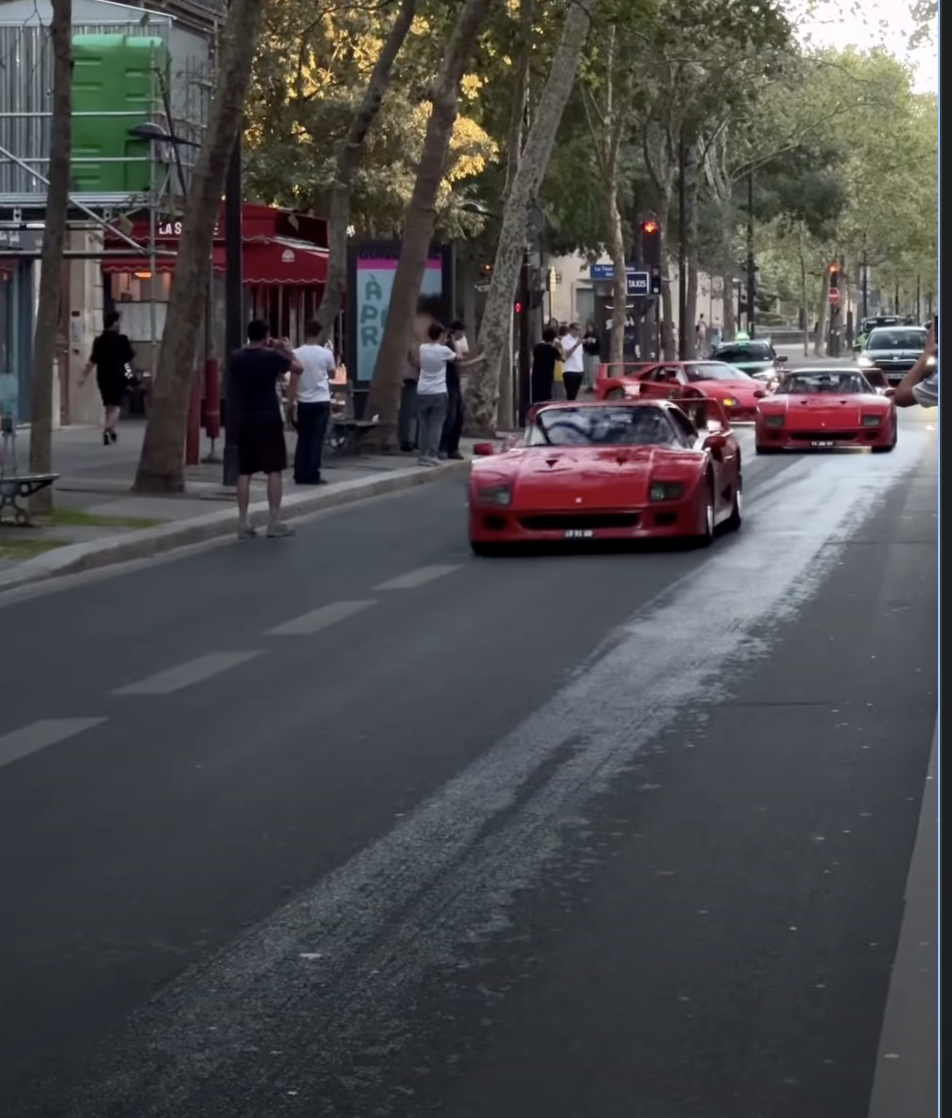
A clip making the rounds online shows a line of eight Ferrari F40s rolling through Paris, apparently all red, while pedestrians grab their phones. You’ll hear plenty about how loud and how pretty that looked. The more interesting question is how unlikely it is, and what it takes to keep eight of these cars healthy and legal enough to drive through a modern European capital.
Why eight is a big number
Start with production. Ferrari says 1,311 F40s left the Maranello factory before production ended in 1992, per its own F40 history page. That was a huge run by halo-car standards. Still, eight cars is roughly 0.6 percent of the entire global build, sitting nose-to-tail on one street. Many surviving F40s live in climate-controlled collections, some on other continents, and some barely move. Eight of them turning up together in traffic is an organized event, not a coincidence, whether or not anyone announced it. Ferrari
Related Articles
- Pour the Coffee: Your Backfire News Round-Up for September 15 Is Ready
- What’s Worth Watching This Week: Bristol’s Cutoff, NHRA’s First Run at a New Track, and 300 Cars in a Colorado Field
The car’s backstory explains why owners bother. Ferrari named it for the company’s 40th anniversary, and it was the last model unveiled with Enzo Ferrari present before his death in August 1988. It was sold as close to a race car as Ferrari dared put on the road. The factory calls it a road-going racer with twin turbos making nearly 160 bhp per liter. Ferrari
What’s actually under that engine cover
Ferrari’s archive entry lists a rear-mounted, longitudinal 90-degree V8 displacing 2,936.25 cc, making 478 hp at 7,000 rpm, with a 324 km/h top speed. That’s about 201 mph, from a car with no driver aids at all. Ferrari
The construction is where the F40 still teaches lessons. According to Ferrari’s magazine, the doors, bonnet and bootlid were carbon fiber, and the tubular steel spaceframe was stiffened with bonded Kevlar. The weight savings reached the cabin too: no carpet, no sound deadening, no door trim, and a pull cord in place of an interior door handle. Ferrari’s heritage writeup adds that the seats are carbon fiber trimmed in fireproof Nomex. Enzo’s final masterpiece: The F40
For a driver in Paris traffic, this means a heavy clutch, turbo lag, abrupt boost, no sound insulation, and the heat of a mid-mounted V8 sitting right behind your head. City driving is arguably the F40’s least natural habitat. Eight owners choosing to do it together says something about how this crowd treats its cars.
The French connection
Paris is a fitting place for this. The racing F40 exists partly because of a Frenchman. RM Sotheby’s catalog for a 1987 F40 LM notes that the LM went racing in 1989 at the request of French Ferrari importer Charles Pozzi rather than the factory, with Michelotto doing the development and pushing output past 700 bhp. The road cars in this clip are the tamer cousins of a program a Parisian importer helped start. RM Sotheby’s
What these cars are worth now
Values have gone well past the original sticker. At Monterey in August 2025, RM Sotheby’s reported that a single-owner 1990 F40 with just 360 km from new, never before shown publicly, sold for $3,855,000. The same auction house release reported that a 1993 F40 LM by Michelotto, the 14th of 19 built to 760-hp GTC specification, sold for $11,005,000. That’s about double the previous record of $5,530,232. RM Sotheby’s Tops $165 Million at Monterey Car Week, Led by $26 Million Ferrari Daytona SP3 and Multiple World Records | RM Sotheby’s
Don’t multiply the Monterey road-car result by eight and call it the value of this convoy. That car was a near-zero-mileage, unseen example, which is exactly the kind of car that never ends up in city traffic. Cars that are driven sell for less, and the gap between a used F40 and a preserved one is real money. Even so, every car in that line is a seven-figure asset idling at crosswalks.
The maintenance bill nobody films
Driving an F40 is expensive before you even turn the key. An RM Sotheby’s London lot description gives a rare look at the costs. A February 2025 specialist service on a 1991 car covered new cam belts, replacement fuel tank foam, wheel refurbishment, an air-conditioning recharge, re-trimmed seats and headliner, and new Pirellis, totaling almost £49,000. RM Sotheby’s
Two items on that list matter most for buyers. Cam belts are a routine interval job on these V8s, and skipping one risks an engine that costs far more to rebuild. The fuel tank foam is less obvious: the tanks contain foam elements that age, and period-correct upkeep means replacing them. Buyers should read the service history as closely as the odometer. The same listing highlights matching-numbers engine, gearbox and body, and in this market, originality is often worth more than low mileage. RM Sotheby’s
Modification also matters. RM Sotheby’s Monterey “Blue Chip” car was Classiche certified in 2013 before being fitted with an LM gearbox, larger Brembo brakes, a Tubi exhaust, and KW adjustable suspension. The order of those events is the point: the certification came first, and later changes complicate it. That listing also included a regulatory warning: because of California emissions rules, the car had to go to a dealer or an out-of-state buyer. For an 80s turbo supercar, where you register it can decide who is allowed to buy it. RM Sotheby’s
How these cars stay legal in Paris
That brings us back to the city. Paris sits inside a low-emission zone, and a petrol car from 1987 to 1992 is nowhere near the favorable end of France’s Crit’Air sticker scale. The way around that is registration status. The Métropole du Grand Paris ZFE FAQ says that vehicles whose registration papers carry the “collection” designation qualify for an exemption, currently handled as a local derogation requested through the ZFE platform. Métropole du Grand Paris
Related Articles
- Today in Car History: The Quad-Turbo Bugatti That Launched on a Birthday and Died in Four Years
- Zero-Mile Le Mansory Ford GT Resurfaces For Sale At $1.63 Million
For owners, that means an F40 on French plates probably needs collection status to cross the city without worry. For foreign-plated cars coming in for an event, it’s worth checking the zone rules before loading the transporter. Collection status is also a factor in insurance. Collector policies are usually agreed-value, with mileage and usage limits, and a group drive through a dense city is the kind of use an underwriter will want to know about ahead of time. With parts like carbon bodywork and a thin supply of original panels, even a slow fender-bender can turn into a long, costly repair.
The takeaway
The clip is fun, but the real story is the effort behind it. Eight owners had to keep their belts and fuel cells current, sort out their registration status, accept the insurance risk, and drive seven-figure, 35-year-old race cars at walking pace through one of Europe’s most regulated cities. The F40 was built to show what Ferrari could do in 1987. Nearly four decades later, it takes that same kind of commitment to keep one on the road.
Images Via: siix_mp4 on Instagram
About the Author