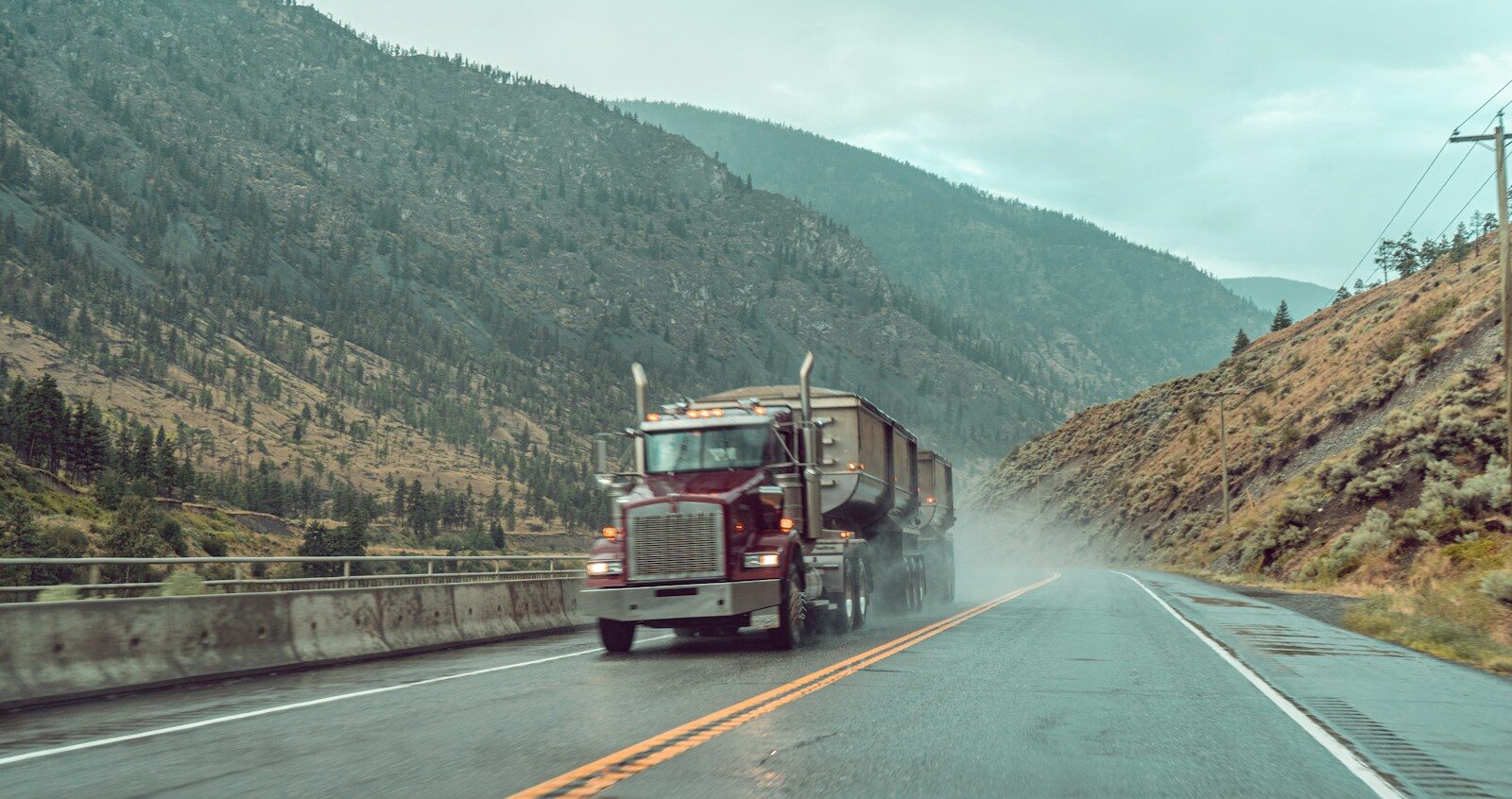
Smoke pouring off a semi’s brakes on a mountain grade is never a good sign. Smoke pouring off those brakes while the truck is still moving at highway speed, with nowhere to go but down, is the kind of moment that separates a bad day from a fatal one. Footage captured near Keystone, Colorado shows exactly that scenario playing out on Interstate 70, and the reason nobody got hurt has less to do with luck and more to do with a pile of gravel engineers built for precisely this failure mode.
The clip, credited to the Colorado State Patrol and photographer Connor Storer and dated this September, shows a loaded tractor-trailer trailing a visible plume of brake smoke as it comes down the grade near Keystone. Instead of running out of road, the driver aims for one of I-70’s runaway truck ramps, a steep, gravel-packed spur built into the shoulder specifically for trucks that have lost their brakes. The truck buries itself in the loose rock and stops. No barrier strike, no jackknife, no chain-reaction pileup below.
@accuweather A runaway semi with smoking brakes was caught on camera using an emergency ramp on Colorado’s I-70, where deep gravel helped bring it safely to a stop. 🚛 If you see a runaway truck approaching from behind, stay calm and move left when it’s safe to do so, keeping the ramp clear, according to the Colorado State Patrol.
♬ original sound – AccuWeather
These ramps aren’t glorified pull-offs. They’re gravity arrester beds: a rising grade covered in several feet of loose, rounded aggregate, engineered so a truck’s tires sink in and lose momentum through pure rolling resistance instead of friction brakes. There’s no ABS module or hydraulic assist involved, just the same principle as pushing a wheelbarrow through deep sand. The steeper the ramp and the looser the material, the faster an out-of-control truck sheds speed, which is why the design shows up specifically on descents long and steep enough to cook a truck’s brakes, corridors like the stretch of I-70 running through the high country around the Eisenhower-Johnson Tunnel and down toward the Dillon and Silverthorne valley, where loaded trucks drop thousands of feet in just a few miles.
Brake fade is the mechanical villain here. Semi trucks run air brakes rather than hydraulics, but the failure mode is thermal either way: drum or disc surfaces absorb heat faster than they can shed it on a long, sustained descent, the friction material’s coefficient drops, and pedal effort increases even as stopping power disappears. That’s why commercial drivers are trained to descend in a low gear and lean on engine or exhaust braking to hold speed, rather than riding the service brakes the whole way down. Skip that step, or misjudge the grade with a heavy load, and the brakes can overheat to the point of smoking, glazing, or failing outright, which is exactly the scenario visible in this footage.
Colorado State Patrol’s advice for the drivers around a runaway truck is worth remembering because it runs against instinct. If a truck without brakes is closing in from behind, the guidance is to stay calm and move left when it’s safe, keeping the ramp lane clear rather than braking hard directly in front of it. A loaded semi with no service brakes generally still has steering, so the escape ramp only works if it’s open when the driver actually needs it. A passenger car blocking that lane turns a controlled emergency stop into a much worse outcome for everyone on the road.
Colorado’s mountain corridor has a long history of runaway truck incidents, which is exactly why the state has spent decades adding and lengthening arrester beds along I-70 and US 6. When a truck does end up in one, the fallout isn’t cheap: pulling a fully loaded tractor-trailer out of several feet of packed gravel requires a heavy wrecker, and the ramp itself has to be re-graded before it’s ready for the next emergency. Carriers can also expect scrutiny from their insurer and potentially federal regulators if a post-incident inspection turns up worn linings or a skipped pre-trip brake check, since brake violations remain one of the most common reasons trucks get pulled from service during roadside inspections. Mechanical failure rarely stays a minor inconvenience once it happens at speed, a lesson that applied just as much when a wheel separation turned I-76 into a hazard zone for the car behind it, and when a brake failure left a classic Corvette’s owner choosing between a fence, a lake, or his own garage door. Even without a mechanical failure, Colorado’s mountain highways have a way of turning bad decisions into spectacles, like the pack of supercars that treated a Colorado highway like their personal straightaway before deputies were waiting at the finish line.
The practical takeaway for anyone driving a loaded vehicle, whether that’s an 80,000-pound rig or a pickup towing a travel trailer, is to treat the descent the way you treat the climb. Pick a gear before you start down, not after the brakes start smelling hot, and let the drivetrain absorb the load your brakes can’t sustain for miles at a time. Runaway ramps like the one near Keystone exist because that lesson doesn’t always get followed, and on this particular day, a few feet of loose gravel did the job no set of brake pads could.
About the Author