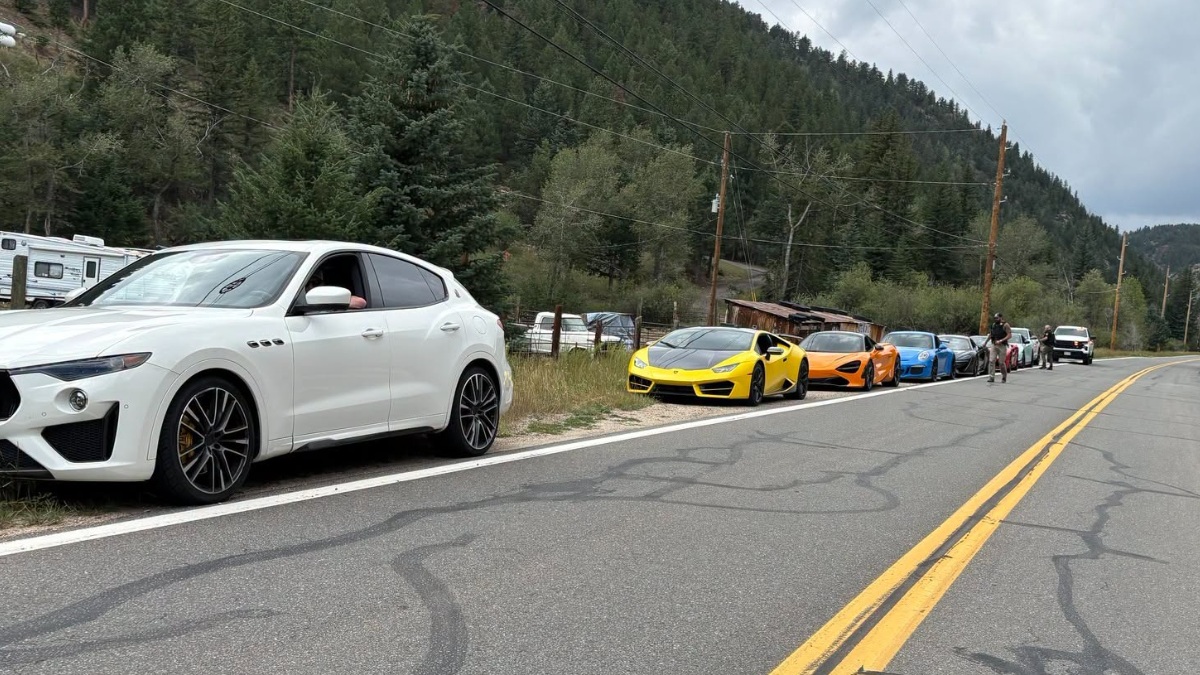
Highway 103 in Clear Creek County, Colorado isn’t a closed circuit, a canyon run with a scenic pull-off, or anyone’s private test track. It’s a public mountain road connecting Evergreen to Idaho Springs by way of Echo Lake, and on a recent afternoon it briefly became the venue for a seven-car “Follow the Leader” convoy that included at least two Lamborghinis and a pair of McLarens. The Clear Creek County Sheriff’s Office had other plans.
A Tip, an Unmarked Cruiser, and a Straightaway
According to Sheriff’s Office Public Information Officer Jennifer Fulton, a tip pointed deputies toward the group before they ever hit the throttle. An unmarked patrol vehicle picked up the pack near Echo Lake as they headed west, and for a while the drivers behaved themselves, holding what Fulton described as a moderate pace through 103’s tighter switchbacks. Then they hit a straightaway and, in her words, the group “opened up.” Radar clocked them at 85 mph in a 45 mph zone, 40 mph over the posted limit, on a road with enough elevation change and blind curves to make that kind of overshoot genuinely dangerous, not just illegal.
The sheriff’s office had already staged patrol units near mile marker two, close to Idaho Springs, and deputies had stop sticks ready in case anyone decided to turn the stop into a pursuit, the kind of scenario that’s turned routine traffic stops into genuine chases elsewhere. Nobody ran this time. All seven cars pulled over voluntarily, which says more about the drivers’ sense than it does about their coordination as a group.
The Math Behind $1,680
The citations added up to at least $1,680 across the group, and the driver who set the pace, the “front runner,” in Fulton’s phrasing, walked away with considerably more than a fine. He’s now facing a court summons on three counts: exhibition of speed, reckless driving, and traveling 40 mph over the posted limit. In Colorado, that combination isn’t a routine speeding ticket. Reckless driving is a misdemeanor that can carry points, a potential license suspension, and a criminal record, not just a check written to the county. Exhibition of speed is a separate charge built specifically for driving that looks like racing even when nobody can prove a wager or a finish line existed.
That distinction matters for anyone who owns something with a few hundred extra horsepower under the hood. A misdemeanor reckless driving conviction, as other high-profile car owners have discovered, doesn’t just cost court fees. It’s the kind of entry that specialty and exotic car insurers comb through at renewal time. Carriers who write policies on Lamborghinis and McLarens tend to price risk aggressively, and a client with a fresh reckless driving conviction can see a policy non-renewed outright rather than simply repriced. For a car worth a quarter-million dollars, losing coverage is a far more expensive outcome than a few hundred dollars in citations.
Why This Stretch of Road Keeps Making the Sheriff’s Blotter
Fulton didn’t mince words about why the department was staged and waiting rather than reacting after the fact: deputies field regular complaints from residents about supercars and motorcycles using Highway 103 “basically as a raceway.” That’s not a new complaint. Roads like 103, narrow, curvy, low-traffic, and scenic enough to draw exotic car meetups, have been informal proving grounds for enthusiasts across Colorado’s Front Range for years, the same way canyon roads outside Los Angeles draw the same crowd for the same reasons. The tradeoff is that these roads also run through real communities with driveways, wildlife, and blind intersections, which is exactly why sheriff’s departments in mountain counties treat them as recurring enforcement priorities rather than a one-off inconvenience.
It’s also why the “Follow the Leader” framing in Fulton’s statement wasn’t just a colorful turn of phrase. Group runs organized loosely around an informal hierarchy, one car setting pace while the rest match it, are functionally difficult to distinguish from an actual speed contest once someone’s exceeding the limit by 40 mph. Colorado’s exhibition-of-speed statute doesn’t require prosecutors to prove there was a bet or a finish line, only that the driving was intended to show off speed or acceleration. That’s a lower bar than street racing statutes in some other states, and it’s a meaningful part of why the lead driver is the one facing a summons rather than just a ticket.
What Owners Should Actually Take From This
The fines here are trivial next to the value of the cars involved, and the sheriff’s office knows it. Fulton’s crack about the summons joining the front runner’s “trophy wall” was a dig at exactly that math. But the real financial risk for the cited drivers isn’t the $1,680 tab. It’s the ripple effect: insurance non-renewal, a criminal misdemeanor record, and, if it happens again, the kind of habitual-offender enhancement that turns a second reckless driving charge into a far bigger legal problem, including potential vehicle impoundment under Colorado’s aggravated street racing provisions. Anyone who’s sunk real money into a supercar and actually wants to enjoy it long-term is better served booking a track day than finding out the hard way that a public mountain highway comes with deputies, stop sticks, and a Public Information Officer with a sharp sense of humor already waiting around the bend.
About the Author