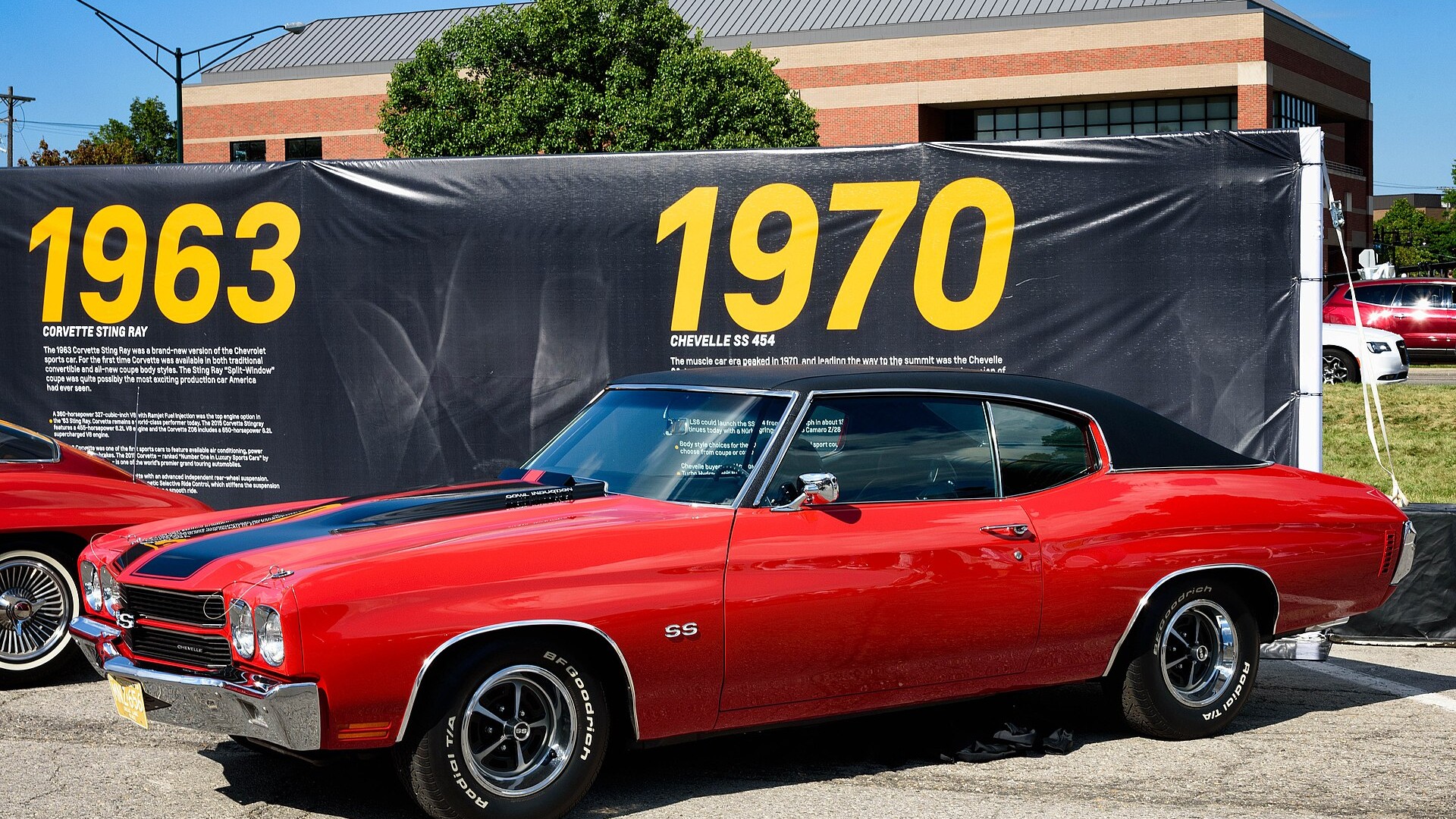
1970 Chevelle SS 454. Photo: Mustang Joe, CC0, via Wikimedia Commons
Some muscle cars were built to be legends. The Chevrolet Chevelle wasn’t. It started as a sensible, mid-size family car meant to steal sales from Ford, and within six years it was wearing the most powerful engine rating of the classic muscle car era. Here’s how Chevy’s middle child grew into one of the most wanted American cars ever built, plus a few myths that still follow it around.
Born to Fight Ford (1964)
.jpg?width=1024)
In the early 1960s, Chevrolet had a gap in its lineup. The compact Chevy II was too small for many families, and the full-size Impala was too big and too pricey for others. Ford had already filled that middle ground with its 1962 Fairlane.
Chevy answered with the Chevelle, built on GM’s new A-body platform and launched in the fall of 1963 as a 1964 model. It was a hit right away, with more than 338,000 sold in its first year. Buyers could choose coupes, sedans, convertibles and station wagons, and the revived El Camino car-truck shared its bones.
Most early Chevelles were modest six-cylinder and small V8 commuters. But the sporty Malibu SS trim, plus an available 327 cubic-inch V8, hinted at what was coming.
The Z16: A 201-Car Warning Shot (1965)
For 1965, Chevrolet added a 350 hp version of the 327, and then did something far more interesting. It quietly built the Z16 package: a Malibu SS with a new 396 cubic-inch big-block V8 rated at 375 hp, a reinforced frame, bigger brakes and upgraded suspension.
Only 201 Z16 cars were built, including a prototype, and they weren’t really sold to the general public. Chevy used them mainly to get the big-block into the hands of the right people. Today they rank among the rarest and most valuable Chevelles in existence.
The SS 396 Gets Its Own Badge (1966 to 1967)

The Z16 experiment worked. For 1966, the Chevelle got new, curvier styling, and the SS 396 became its own model series. Buyers could pick from three versions of the 396, rated at 325, 360 or 375 hp.
Suddenly, the working man’s muscle car had arrived. The SS 396 offered big-block power in a lighter, cheaper package than a full-size car, and it went head-to-head with the Pontiac GTO, Ford Fairlane GT and Plymouth’s mid-size muscle. The 1967 model was a light refresh with improvements like available front disc brakes.
A New Shape and Serious Muscle (1968 to 1969)
.jpg?width=1024)
The second-generation Chevelle arrived for 1968 with the look most people picture today: a long hood, short rear deck and muscular, fastback-style curves. Chevy also split the wheelbase, putting two-door models on a shorter 112-inch chassis for a sportier stance.
For 1969, the SS 396 became an option package instead of its own series. But the real story happened behind the scenes. GM corporate rules still limited mid-size cars to engines of 400 cubic inches or less, so savvy dealers found a workaround called COPO, the Central Office Production Order system.
.JPG?width=1024)
Through COPO, about 323 Chevelles were built in 1969 with the L72 427 cubic-inch V8, rated at 425 hp. Pennsylvania dealer Don Yenko ordered 99 of them and sold them as Yenko Chevelles, which are now some of the most coveted muscle cars on the planet.
1970: The Year the Chevelle Became King
_(55220899684).jpg?width=1024)
For 1970, GM dropped its 400 cubic-inch limit for mid-size cars, and Chevrolet went all in. The Chevelle SS could now be ordered with a 454 cubic-inch V8 in two versions: the LS5, rated at 360 hp, and the legendary LS6, rated at 450 hp and 500 lb-ft of torque.
That 450 hp rating was the highest factory horsepower figure of the classic muscle car era. Only 4,475 LS6 Chevelles were built, and paired with the available cowl-induction hood, bold stripes and SS badges, the 1970 SS 454 LS6 became the high-water mark for the entire muscle car movement.
Detuned but Not Forgotten (1971 to 1972)
The party didn’t last. Rising insurance costs, tightening emissions rules and the move to unleaded fuel pushed automakers to lower compression ratios. The LS6 disappeared from the Chevelle lineup after 1970, and by 1972 horsepower was being quoted in lower SAE net figures, making the numbers look even tamer.
The Chevelle SS still looked the part, and a 454 remained available, but the golden age of the big-block Chevelle was over.
The Colonnade Years and a NASCAR Second Act (1973 to 1977)

For 1973, the Chevelle moved to GM’s new “Colonnade” body, with fixed rear side windows, thick roof pillars and big safety bumpers. The emphasis shifted toward comfort and luxury, especially on the upscale Laguna.
Oddly enough, this era gave the Chevelle its biggest racing success. The sleek-nosed Laguna S-3 was a NASCAR favorite, and Cale Yarborough drove Chevelle Lagunas to the 1976 and 1977 Cup Series championships, the first two of his record three straight titles.
.jpg?width=1024)
The 1977 model year was the Chevelle’s last in the U.S. For 1978, Chevrolet launched a smaller, lighter mid-size car and dropped the Chevelle name in favor of Malibu.
Chevelle Myths and Rumors
Rumor Mill: Was the LS6 underrated? Many owners and dyno fans have long argued that the 450 hp rating was conservative, possibly to keep insurance companies calm. Chevrolet never said so officially, but the debate has raged at car shows for more than 50 years.
Rumor Mill: Did Chevy build a 1970 LS7 Chevelle? The even hotter LS7 454 appeared in some early 1970 literature, and stories of a handful of factory LS7 Chevelles have circulated for decades. No verified factory-built LS7 Chevelle has ever surfaced.
Rumor Mill: Is the Chevelle coming back? Every few years, rumors pop up that Chevrolet will revive the name on a modern muscle car. GM has never announced any such plan.
Why the Chevelle Still Matters
The Chevelle hit a sweet spot few cars have matched. It was affordable enough for everyday buyers, practical enough for families and, in the right trim, fast enough to embarrass far pricier machines. That mix made it a staple at drag strips, drive-ins and high school parking lots across America.
Pop culture has kept the legend alive, too. Dom Toretto’s 1970 Chevelle SS in 2009’s Fast & Furious introduced the car to a whole new generation. Today, restored SS 396 and SS 454 models command serious money at auction, and restomod builders keep the platform alive with modern engines, brakes and suspensions.
More than half a century after the last big-block SS rolled off the line, the Chevelle remains exactly what it became in 1970: the benchmark for what an American muscle car should be.
Images via Wikimedia Commons under the licenses listed in each caption.
About the Author