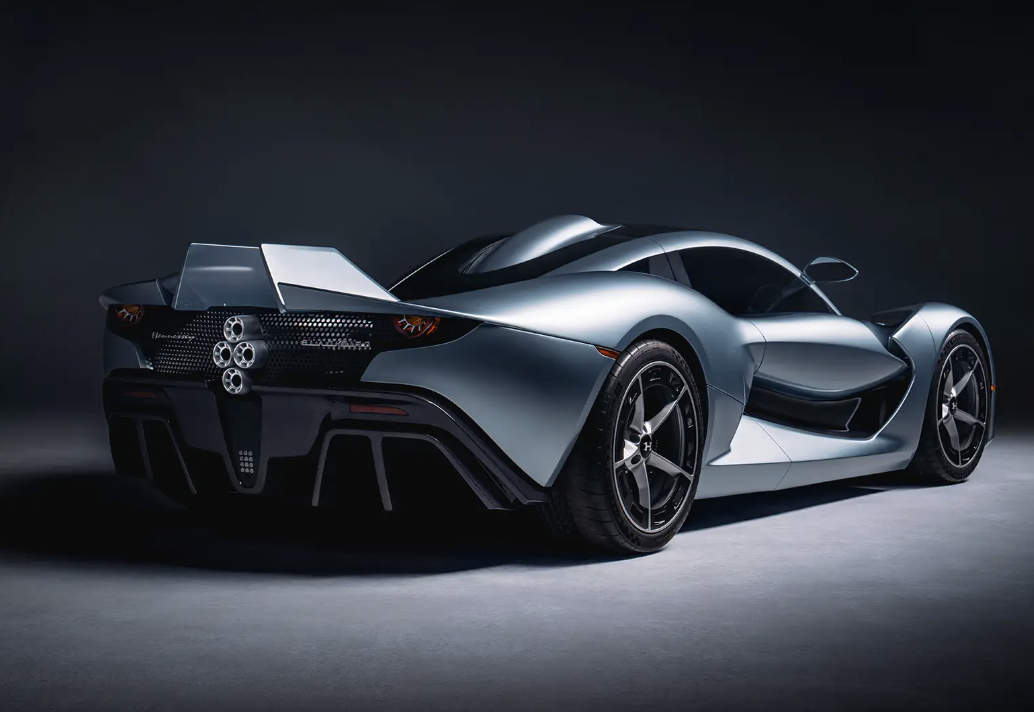
All 71 build slots for Hennessey’s new Blackbird are gone, and the company waited five days to say so.
Hennessey Special Vehicles confirmed on August 19 that every example of its third hypercar is contracted and deposited, with the final allocations claimed within four hours of the car’s public debut at The Quail during Monterey Car Week. The more interesting number is buried in the same release: more than 60 of the 71 cars were already spoken for before anyone outside the tent had laid eyes on it. So the “four-hour sellout” was a race for roughly ten slots among a crowd that had spent two weeks looking at the August 3 reveal photos. That’s not a knock — it’s how boutique hypercars have worked for a decade. Pagani said the 99-car Utopia run was fully assigned before Horacio Pagani drew the first line of it. The reveal is theater; the selling happens in private, months earlier, over phone calls to people who already own something from the same badge.
What actually deserves scrutiny here is the hardware, because Hennessey has written a check that no production engine has cashed.
The engine claim is harder than it sounds
The Blackbird runs an all-new naturally aspirated 6.2-liter V8 co-developed with Ilmor Engineering, targeting 800–850 horsepower and more than 9,000 rpm. Hennessey expects it to be simultaneously the most powerful and the highest-revving naturally aspirated road-car V8 ever built.
Related Articles
- Ends Today: Win a 700-HP Porsche 911 Turbo S in the Dream Giveaway Sweepstakes
- This Daytona Coupe Nearly Doubled the American Car Record — and It Never Won a Major FIA Race
The current benchmark is Chevrolet’s 5.5-liter LT6 in the Corvette Z06, which the automaker describes as the highest-horsepower naturally aspirated V8 to reach market in any production car, at 670 hp with an 8,600-rpm ceiling. Beating it by 130-plus horsepower is the easy half. Beating it on revs while adding 700cc is the part that should make engine people sit up.
Divide the displacement by eight and the Blackbird runs roughly 775cc per cylinder against the LT6’s 687cc. Bigger cylinders mean a longer stroke or a wider bore, and both fight high rpm — longer strokes push mean piston speed into territory where road engines don’t live, and wider bores create flame-travel problems that force compromises in combustion chamber design. This is why flat-plane screamers have historically stayed small. Ferrari never exceeded 4.5 liters with its V8s. Ford’s Voodoo was 5.2. Chevrolet’s engineers described 5.5 as pushing the practical ceiling. Hennessey went to 6.2 and asked for another 400 rpm on top.
Ilmor is the right phone call for that problem. The company was founded in 1983 by Mario Illien and Paul Morgan with Roger Penske’s backing, won Indianapolis with Chevrolet, powered Mercedes-badged Formula 1 engines through the McLaren era, and reunited with Chevrolet in 2012 for IndyCar’s twin-turbo V6. Race engines rev. The catch is that race engines also get rebuilt on a schedule, and this one has to survive a customer’s 800-mile touring day and a warranty.
What owners are actually signing up for
Customer production is targeted for 2029–2030. That is three to four years of holding a deposit on a car that does not yet exist in production form, and prospective buyers on the waiting list should read the contract terms with that in mind — specifically whether deposits sit in escrow, what happens if the announced 800-hp target lands at 760, and whether Hennessey holds a right of first refusal on resale. Limited-run makers commonly do, and with 71 cars and a growing wait list, the flipping incentive is obvious.
That timeline also tells you something. Hennessey says the Blackbird is homologated for key global markets, meaning it’s chasing full compliance rather than the low-volume exemption route that 49 CFR Part 555 makes available to small manufacturers. Full FMVSS certification plus European approval on a clean-sheet carbon tub is a multi-year crash-test and emissions program, not a manufacturing bottleneck. Three years is a certification schedule, not a build schedule.
Mechanically, a few things follow from the spec sheet that Hennessey doesn’t spell out. A gated six-speed behind 850 horsepower puts the clutch squarely in the consumables column, and in a mid-engine carbon-tub car, a clutch replacement is a powertrain-out job — budget accordingly, and expect the work to be dealer-only for the first several years. A 9,000-rpm naturally aspirated V8 will also want short oil intervals and a specified lubricant; the Pennzoil partnership referenced in the reveal materials is a fairly strong hint about what will be in the owner’s manual.
On the insurance side, a deposit isn’t a vehicle, and no auto policy covers it — that exposure belongs in a conversation with an attorney, not a broker. At delivery, this is agreed-value collector coverage territory, and owners should understand that with bespoke carbon bodywork and an engine built in tiny numbers, even moderate damage can cross a total-loss threshold fast because there is no parts shelf to draw from.
The analog bet
The screen-free cabin is the part that will age most interestingly. There’s no infotainment display, no digital gauges, no steering-wheel buttons — just a large central analog tachometer, a physical ignition key, and a whiskey compass on the dash. Navigation and CarPlay run off the driver’s phone in a fixed holster. That’s a genuinely smart hedge: phones get replaced every three years, embedded infotainment does not, and a 2030 hypercar with a 2029 touchscreen would look ancient by 2035. Hennessey has essentially outsourced the obsolescence.
Related Articles
- This Porsche Carrera GT Was Custom-Ordered by Schumacher Himself — Now It’s Hitting the Auction Block
- EPA’s New Diesel Rule Could Change What You Pay for a 2027 Truck — Here’s How
Elsewhere, the active vertical stabilizers deploy at 71 mph and sit at ±71 degrees — a cute nod to the SR-71 that also means they’ll be up basically any time you’re at a legal cruise on a Texas interstate. The quad diamond exhaust references the Bell X-1’s nozzle shape. The doors are gullwings, the frunk swallows two carry-ons, and there are four cup holders in a two-seat hypercar, which is either a typo or the most honest detail in the entire program.
Venom F5 production is expected to wrap around 2028, which makes the Blackbird the company’s next cornerstone rather than a side project. Whether it lands its engine targets is the story worth following. The sellout was never really in doubt.
Images Via: Hennessy
About the Author