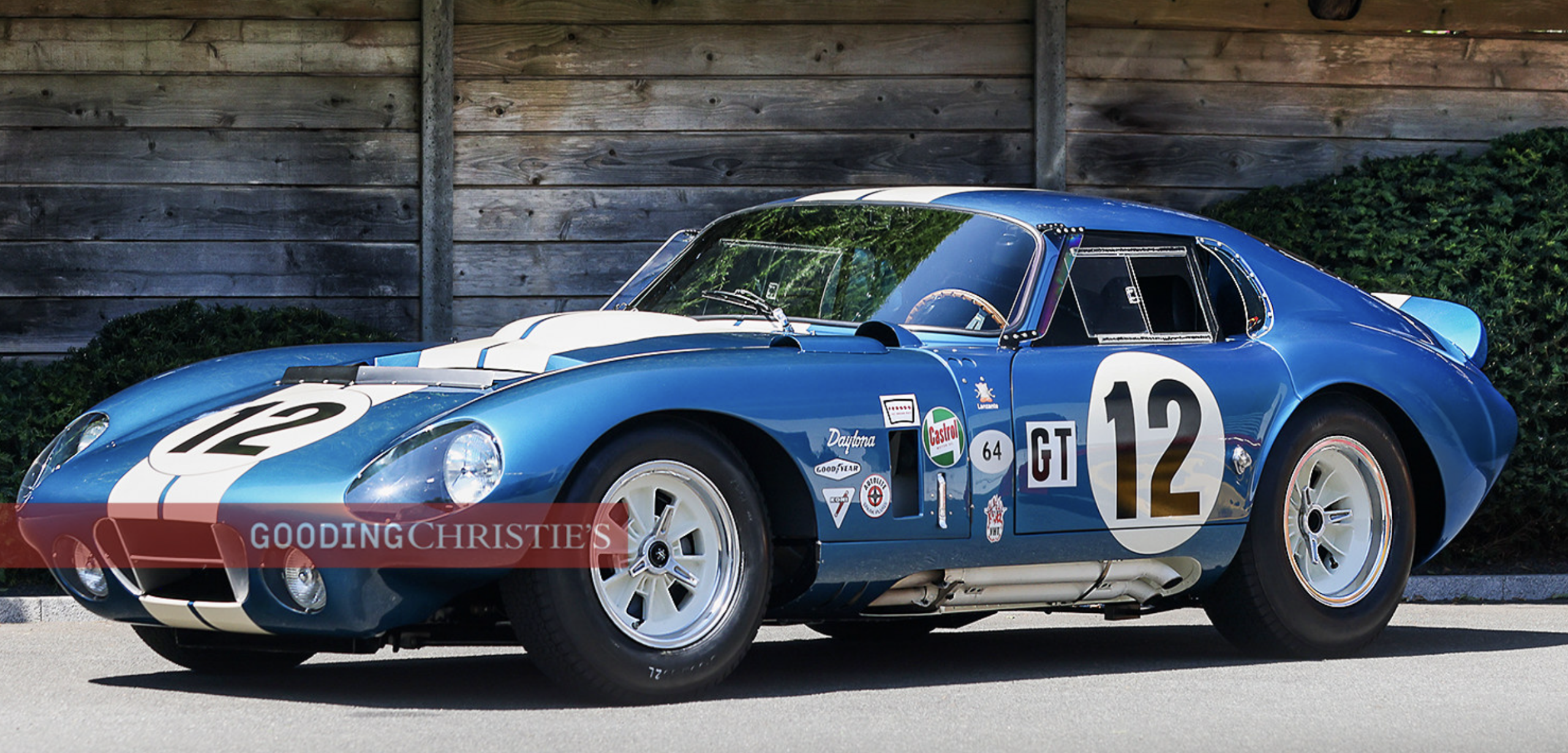
Forget the $42,905,000 headline for a second. That is the all-in number, the one that includes Gooding Christie’s buyer’s premium. Run the house’s own published schedule backward — 12 percent on the first $250,000, 10 percent on everything above it — and the figure the auctioneer actually dropped the gavel on was $39,000,000 flat. Somebody in that tent at Pebble Beach raised a paddle for thirty-nine million dollars and did not blink.
The car was a 1964 Shelby Cobra Daytona Coupe, chassis CSX2300, and it is now the most valuable American automobile ever sold at public auction. The previous holder of that title, the ex-Gary Cooper 1935 Duesenberg SSJ, managed $22 million on the same lawn in 2018. CSX2300 beat it by 95 percent. Records in this hobby usually get nudged. This one got detonated.
The Résumé Is Mostly Fourth Place
Here is the part that makes this sale genuinely strange, and it is sitting right there in the auction catalogue if you read past the photography. CSX2300 never won a major international race. Not one.
Its competition file for the championship-winning 1965 season reads: sixth overall at the Daytona Continental 2000 Km, thirteenth overall at the 12 Hours of Sebring, twelfth overall at the Nürburgring 1000 Km, ninth overall at the 12 Hours of Reims. Class podiums, yes — third, third, third, second. Overall victories, none. Its 1964 debut at the Tour de France Automobile, with Bob Bondurant and Jochen Neerpasch aboard and Viking Blue paint on the flanks, ended in retirement.
Those class results are the entire point, and they are why the number is what it is. The 1965 FIA World Manufacturers’ Championship was decided on GT class points, not outright finishes. A Daytona Coupe grinding out a third-in-class while prototypes disappeared over the horizon was doing exactly the job Shelby American built it to do: bank points, beat the Ferrari 250 GTOs in the only column that counted, and hand the United States its first world championship title in the category. CSX2300 is a scoring machine, not a trophy hoarder, and the market just paid $39 million for the distinction.
It Won Its Outright Races in Japan
The wins came later, and from a direction almost nobody in American collector circles thinks about. When Shelby American wound down the FIA program, CSX2300 went to Oscar Koveleski in Scranton, then to Don Nichols, and then — in 1966 — to Tadashi Sakai in Tokyo.
Sakai raced it hard. He took it to the Japan Grand Prix in May 1966 and retired. Later that same month he won the All Japan meeting at Suzuka outright. In June he won the Diamond Trophy at Fuji outright. He ran Funabashi in September, finished second overall at Fuji in 1967, and Kazuo Myouchin campaigned the car at the 1968 Japan Grand Prix, finishing eleventh. Six Japanese owners passed it hand to hand across those years, ending with the Rodem Corporation in Tokyo by 1974.
Of the six Daytona Coupes built, CSX2300 is the only one that kept racing seriously after the factory let go of it. The most expensive American car in history earned its only outright victories on the other side of the Pacific, four years after Ford’s marketing department stopped caring. That is the sort of detail that separates a $10 million Cobra from a $39 million one.
Why Peter Brock Cut the Tail Off
The engineering deserves more credit than it usually gets. The open Cobra roadster was a brick with a 289-cubic-inch V-8 behind it — devastating out of a corner, hopeless down the Mulsanne Straight, where the 250 GTO’s slippery shape simply walked away. Shelby needed aerodynamics, and Peter Brock gave him a fastback coupe with a Kamm tail.
If you have never had the Kamm principle explained properly, it is worth thirty seconds. The lowest-drag shape for a body moving through air is a long teardrop, tapering to a point. The problem is that a teardrop long enough to work is also long enough to be heavy, structurally awkward, and impossible to package around a live axle. Wunibald Kamm’s insight was that most of the drag benefit is captured well before the taper finishes, and that if you truncate the body at roughly half the theoretical length — chopping it off with a flat vertical panel — the airflow behaves almost as though the missing tail were still there. You get most of the aerodynamic gain and none of the weight penalty. Brock applied it to a car still running a T10 four-speed and a leaf-sprung chassis underneath, and turned a machine that could not chase a GTO into one that could.
There is a delicious wrinkle in how it got built. The body on CSX2300 was fabricated by Carrozzeria Grandsport — in Modena. Shelby’s weapon for killing Ferrari on the world stage was hand-formed by Italian panel beaters working a few minutes’ drive from Maranello.
The Damage Is the Asset
Michael L. Shoen tracked the car down in Japan and sold it to Carroll Shelby in 1975, making CSX2300 the only Daytona Coupe its own creator ever personally owned. Shelby kept it for twenty-three years and had Torrance specialist Mike McCluskey return it to 1965 specification. A second restoration followed around 2000 under Larry Bowman. The current owner bought it in 2005 and — crucially — has actually used it, at Goodwood Revival in 2004, 2011 and 2015, at Tour Auto, at Modena Cento Ore, and at the Festival of Speed as recently as this year.
Neither restoration erased the car’s history. The rear-end damage from Sebring in 1965 is still legible. So are the Japanese registration markings. Twenty years ago a restorer would have sanded both away without asking, and a judge would have rewarded him for it. We flagged this dynamic back in July when the car was announced, and it played out at the podium: the market now pays a staggering premium for evidence, and treats a perfect respray as a destroyed document. The same logic is why Paul Newman’s Daytona-winning Mustang is heading to auction still caked in dirt, and why celebrity provenance only moves the needle when the paperwork backs it up.
Practical translation for anyone with an old car and a body shop appointment: photograph everything before you touch it, keep the original panels even if you replace them, and stop treating an unmolested car as a project to be finished. Originality cannot be reinstalled later.
What a 95 Percent Jump Actually Signals
Gooding Christie’s had its best week ever around this car: north of $159 million in total sales, 158 lots sold, a 94 percent sell-through rate, 28 lots past the million mark, and an average of $1,005,681 per lot — up 19 percent year over year. Put differently, one automobile accounted for roughly 27 percent of the house’s record-breaking two days. Against a Monterey Car Week that cleared $636 million across all houses, CSX2300 alone was better than one dollar in every sixteen spent on the peninsula.
The more telling comparison is internal. The next lot down was a 1963 Ferrari 250 P at $18,705,000 — itself a model world record, and a car we covered on its way to the block. The American car outsold the best Ferrari in the room by a factor of 2.3. For fifty years the collector market has applied a quiet discount to American machinery, on the reasoning that European exotica carried deeper competition history and a broader international buyer pool. Thirty-nine million dollars of hammer says that assumption is now negotiable, at least at the very top, where the buyers are global and the criterion is documented significance rather than nationality.
Do not, however, read this as a rising tide for Cobras generally. Records of this kind are set by singularities, and CSX2300 is about as singular as it gets: one of six, the only one Shelby owned, the only one with a meaningful post-factory racing career, with a documented chain of custody running through fourteen owners and four published reference books. There is no read-across to a small-block 289 roadster, and certainly none to a continuation car. The gap between a car with a file and a car with a story is exactly what this sale measured. If you are buying at any level, that file is the thing to underwrite before you register to bid.
The Boring Part Nobody Mentions
Two consequences follow a sale like this that never make the highlight reel. First, insurance. Agreed-value policies on cars in this bracket are underwritten against comparable sales, and a public transaction at $42.9 million resets the comparables for the other five Daytona Coupes overnight. Every one of those owners is about to have a conversation with a broker, and the premium on a car valued in the tens of millions is not a rounding error — it is a running cost that quietly filters out buyers who can afford the purchase but not the carry.
Second, use. The consignor’s own position was that CSX2300 remains genuinely drivable and eligible for road use, historic racing and concours. That eligibility is worth real money, because a car with valid historic papers can be entered at Goodwood and Le Mans Classic, and a car that gets entered stays visible, stays documented, and keeps compounding its own provenance. The tragedy of eight-figure valuations is that they tend to send cars into climate-controlled purgatory. This one has spent the last twenty years earning its number in public — which, more than the Shelby signature or the Sebring dents, is probably what the winning bidder was really paying for.
Best of Show went elsewhere that weekend, and the Duesenberg that won the lawn had its own excellent afternoon. But the story of Monterey 2026 is a blue coupe with Italian bodywork, a Japanese race record, visible crash damage and not a single outright win in a world championship round, becoming the most valuable thing Detroit’s orbit has ever produced. Carroll Shelby, who was rarely short of an opinion about what his cars were worth, would have found that very funny indeed.
About the Author