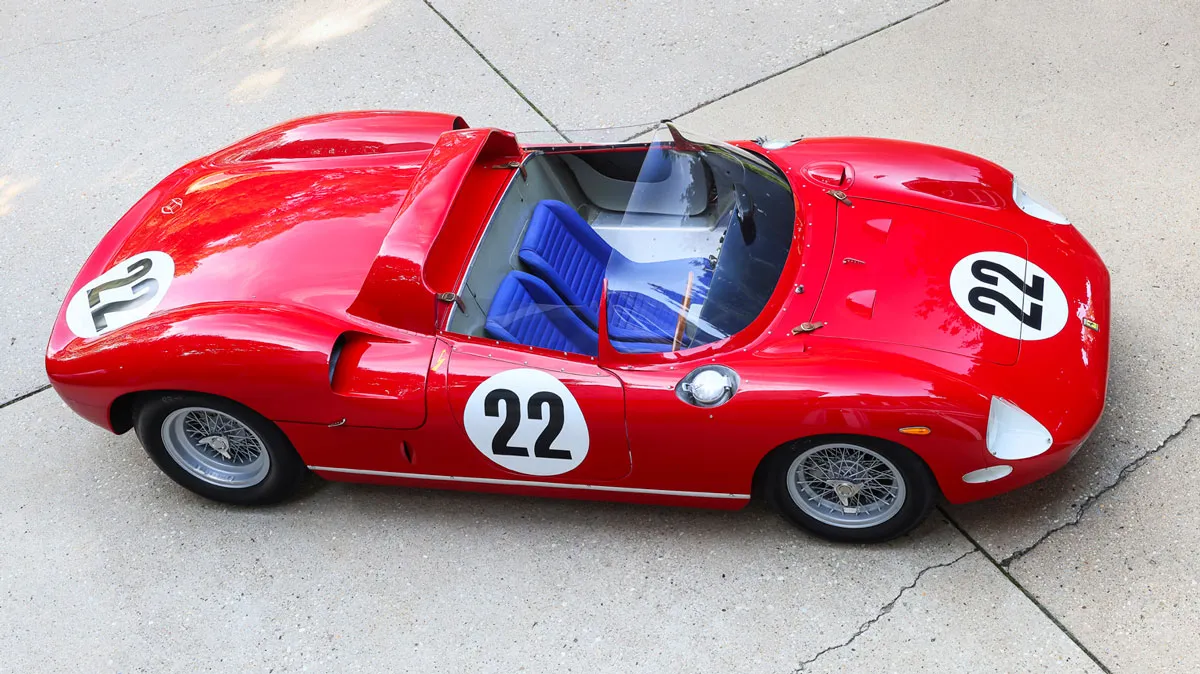
Every mid-engine V12 Ferrari that has ever won at Le Mans, Sebring, or Daytona — the 275 P, the 330 P4, the 512 S, even the 333 SP that dragged Ferrari back into prototype racing in the 1990s — owes its entire layout to a car Enzo Ferrari didn’t actually want built. That car, chassis 0810, is the first Ferrari 250 P ever completed, and on August 15 it crosses the block at Gooding Christie’s Pebble Beach sale during Monterey Car Week carrying a presale estimate of $15 million to $20 million.
It’s listed as Lot 26, and the estimate isn’t hype. This is a factory Scuderia Ferrari entry with a Sebring podium, a Le Mans podium, and a second career under Luigi Chinetti’s North American Racing Team, all wrapped around an engineering story that’s more interesting than the price tag.
The Engineering Gamble Enzo Didn’t Want to Make
Through the 1950s, Ferrari’s sports-racing success — the 250 Testa Rossa, the 290 MM, the 315 S — was built entirely around engines mounted up front. Even after Ferrari’s own mid-engine Tipo 156 won the 1961 Formula 1 championship, Enzo wasn’t convinced the same layout belonged in a sports-racer. His skepticism wasn’t stubbornness for its own sake. An F1 car carries a few dozen liters of fuel and runs short stints; an endurance racer has to survive 12 or 24 hours fully loaded, and hanging a three-liter V12 behind the driver changes the car’s balance in ways that don’t show up on a Grand Prix circuit.
The job of proving him wrong fell to Mauro Forghieri, who’d just been made chief engineer while barely into his twenties. Working through the winter of 1962-63 with new signing John Surtees, Forghieri designed a tubular chassis engineered to keep no more than 55 percent of the car’s weight over the rear axle — a specific target, not a guess. By his own later account, the reaction inside the factory to the whole idea was blunt: “It can’t work with all that weight in the back.”
Pininfarina drew the body, and Carrozzeria Fantuzzi hand-formed it in aluminum. Underneath sat a longitudinally mounted, dry-sumped V12 derived from the Testa Rossa engine, a rear-mounted transaxle, fully independent suspension, and inboard rear disc brakes. Forghieri also talked Ferrari into full-scale wind tunnel testing at the University of Stuttgart, which was unusual for a sports-racer at the time and is the reason the car ended up with a low wraparound windscreen and a distinct aerofoil over the tail. On a circuit like Le Mans, where cars spend long stretches flat-out on the Mulsanne straight, that kind of aero development is the difference between a fast car and one that’s still pointed the right way at 170 mph.
Proving the Concept, One Podium at a Time
Chassis 0810 debuted at Monza on March 4, 1963, then went straight to Sebring three weeks later for the opening round of the FIA World Sportscar Championship. Driven by Willy Mairesse, Lorenzo Bandini, and Nino Vaccarella, it ran nose-to-tail with sister car 0812 for twelve hours; a late-race battery change scrambled the official lap charts long enough that scorers had to recheck everything before confirming 0810 had finished second, right behind its twin. Ferrari swept the first six positions overall. The layout that half the factory had doubted a few months earlier had just finished 1-2 on its debut.
The car retired at the Targa Florio and the Nürburgring later that season, then ran to third overall at Le Mans in June while a sister 250 P took the outright win — the first of back-to-back Le Mans victories for the model. When Ferrari moved on to the larger 275 P for 1964, 0810 was handed off to Luigi Chinetti’s North American Racing Team, effectively Ferrari’s unofficial factory squad in the United States. Pedro Rodríguez took over and immediately finished second overall at the Bridgehampton Double 500, then won the Canadian Grand Prix at Mosport a few weeks later. Ferrari kept upgrading the car in place that season, first to 3.3-liter 275 P specification and later to a full four-liter 330 P engine, which says something about how these cars were viewed at the time: nobody thought of them as artifacts. They were tools, updated as the championship demanded.
From Works Ferrari to a $12,000 Fire-Sale
That utilitarian attitude explains one of the stranger footnotes in this car’s history. After Chinetti sold it to Pittsburgh industrialist William McKelvy in late 1964, it kept racing under McKelvy’s Scuderia Bear banner — a third Sebring outing in 1965, then a full SCCA and USRRC season with Bob Grossman behind the wheel. By 1966, Grossman was trying to sell it. His asking price was $12,000, in the neighborhood of a new Corvette at the time. A car that had podiumed at both Sebring and Le Mans as a factory works entry was, for a brief window, worth less than a new sports coupe, simply because nobody had yet decided that old racing Ferraris were worth collecting.
That market got invented in the years right after, largely by a handful of early buyers — Carl Bross, Kirk White, Ken Starbird, Don Fong, Wayne Sparling, and Harley Cluxton among them — who kept passing this specific car along intact instead of parting it out or rebodying it for something newer. Gordon Tatum, who owned it through the late 1960s, even repainted it dark blue just to match his own 250 GTO, which tells you how casually significant machinery got treated back then. It’s also why 0810 still carries its original Tipo 128 LM 63 engine and Tipo 564/D transaxle, components that on most surviving 1960s prototypes were swapped out or lost decades ago. If you’re curious what separates a genuine collector-grade bargain from a trap in this hobby, our guide to buying a collector car at auction walks through the same due-diligence questions on a more attainable scale.
The current owner has held the car since 1988, as part of one of North America’s most significant Ferrari collections, and hasn’t kept it parked. It’s been driven at the Goodwood Festival of Speed, the Ferrari Historic Challenge, and the Monterey Historics at Laguna Seca, and it picked up the Spirit of Ferrari award at the Amelia Island Concours d’Elegance. That matters more than it sounds: in vintage racing, a car that’s still track-legal and actively campaigned tends to hold value better than a static museum piece, partly because it proves the mechanical bones are sound and partly because buyers at this level are often people who intend to actually race what they buy. That same logic about usage history driving price shows up constantly in far cheaper corners of the hobby, which our look at smart buys in today’s collector car market breaks down in more everyday terms.
Why Bidders Don’t Need a Title to Feel Comfortable
One detail worth flagging for anyone unfamiliar with vintage race car ownership: Gooding Christie’s notes this car is being sold on a bill of sale rather than a title. That’s standard for a pure competition car that never had road registration, but it means the provenance paperwork is doing the job a title normally does. In this case, that paperwork runs deep — the car’s history has been documented by Ferrari historian Marcel Massini, whose research is treated as close to gospel in Ferrari collecting circles — and that level of verification is a real part of why bidders are comfortable backing an eight-figure estimate on a car with no clear title.
Genuine, verifiable period history is exactly what separates a car like this from the kind of auction story that ages badly. A supposedly numbers-matching Hellcat wearing a fake 1968 Charger body recently showed how fast a car’s value can evaporate once its backstory turns out to be more marketing than metal. Chassis 0810 is the opposite case: a car whose entire value proposition rests on decades of factory race results and an unbroken, documentable ownership chain, the same reason a genuine Le Mans winner or a Daytona-winning race Mustang commands attention that a replica never will. Whoever wins the bidding at Pebble Beach isn’t just buying a rare old Ferrari. They’re buying the specific car that talked Enzo Ferrari out of his own worst engineering instinct, and every mid-engine V12 Ferrari race car that followed is proof he was wrong to hesitate.
About the Author