Every August, a stretch of California coastline between Monterey and Carmel turns into the most expensive parking lot on Earth, and this year the receipts were even more absurd than usual. Add up what RM Sotheby’s, Gooding Christie’s, and Broad Arrow Auctions moved during Monterey Car Week 2026, and you get more than $636 million in collector cars sold across just three sales, before Mecum’s marathon week-long docket or Bonhams’ Laguna Seca sale even get counted. But the combined total is almost the boring part. The real story is what specific cars did to get there: a Shelby became the most valuable American car ever auctioned, a McLaren race car eclipsed the road-going F1 it was built from, and a brand-new Ferrari commissioned purely for charity outsold nearly every vintage exotic in the room.
Start with the number that will anchor bar-stool arguments for years: $42,905,000. That’s what Gooding Christie’s got for the ex-Carroll Shelby 1964 Shelby Cobra Daytona Coupe, one of only six built to do a very specific job: out-run Ferrari’s GTOs on the Mulsanne straight without giving up the Cobra’s V8 grunt in the corners. Pete Brock’s slippery coupe body did exactly that, winning its GT class at Le Mans and helping deliver America’s first FIA manufacturers’ championship in 1965. The sale didn’t just top the charts, it obliterated the old American-car record by more than $20 million; the previous mark was the $22 million Gooding got for Clark Gable’s 1935 Duesenberg SSJ back in 2018, at the same venue. Gooding Christie’s overall Pebble Beach sale grossed $159 million on a 94 percent sell-through rate across 158 lots, a 24 percent jump over last year, with world records also falling for a 1963 Ferrari 250 P ($18,705,000) and a 1959 Maserati Tipo 61 Birdcage ($4,240,000).
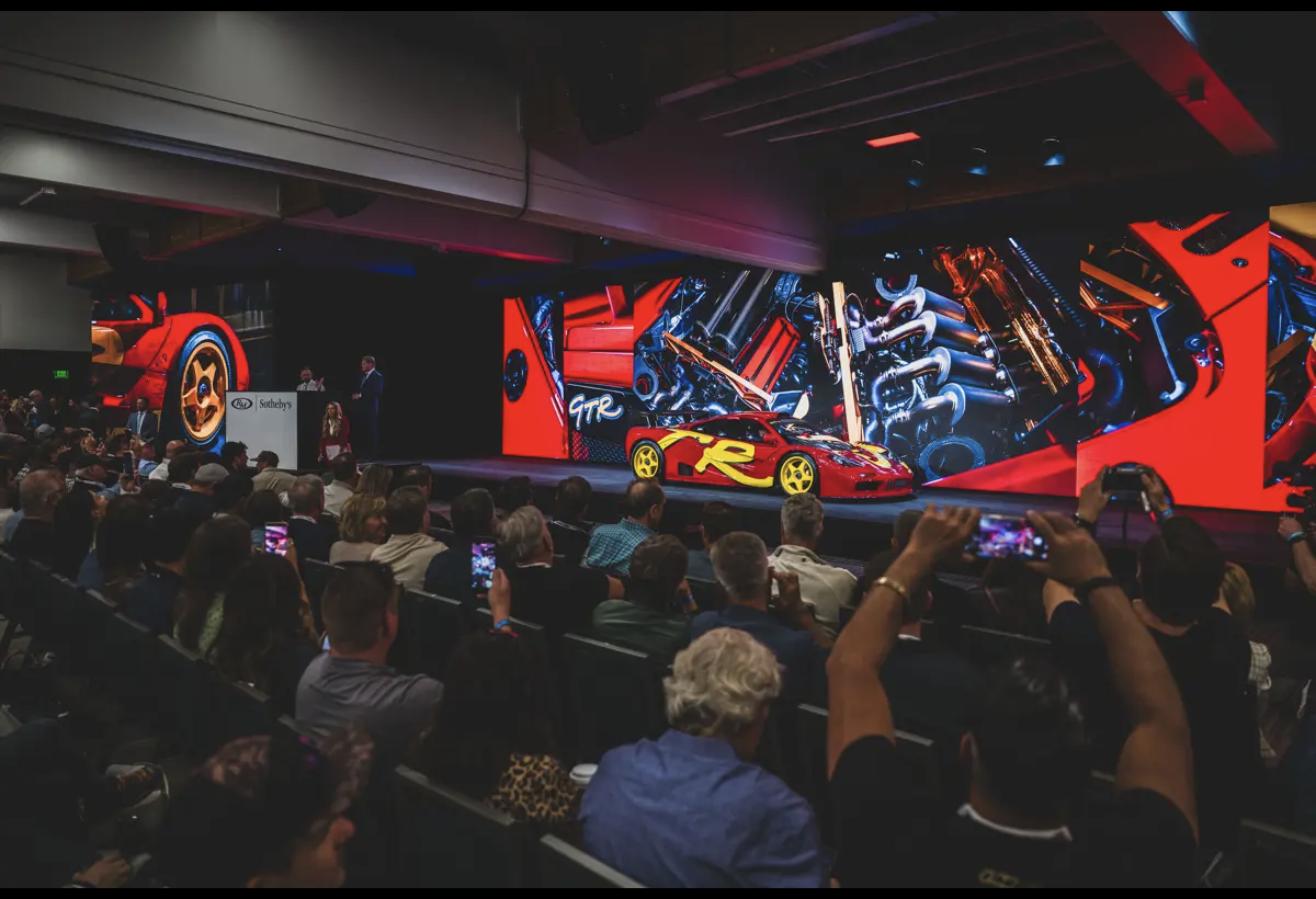
RM Sotheby’s had the bigger single-week number: $380 million across three nights, a 90 percent sell-through rate, and bidders logged in from 39 countries. Competition cars did the heavy lifting. A 1996 McLaren F1 GTR sold for $34,655,000, making it both the most valuable McLaren F1 variant and the most valuable British car ever auctioned, a genuinely wild outcome for a homologation special that exists only because McLaren needed to go racing, not because anyone at Woking expected it to out-earn the standard road car. Right behind it, a 1963 Chevrolet Corvette Grand Sport, one of five aluminum-bodied factory lightweights GM built and then quietly killed off once the AMA racing ban got enforced, sold for $18,705,000, the most any Corvette has ever brought at auction. Then there was the number that should come with an asterisk: $40,000,000 for a 2026 Ferrari Luce “Tailor Made,” a brand-new bespoke commission sold purely for charity, with every dollar earmarked for the Ferrari Foundation. Calling that a market price is a bit like calling a gala dinner ticket the price of chicken; the winning bidder is paying for the tax write-off and the applause as much as the car. It’s now technically the most valuable new car ever sold at auction, but treat it as a data point about philanthropy and Ferrari’s marketing machine, not about where new Ferraris actually trade.
Broad Arrow Auctions ran its first Monterey sale as the official auction partner of The Quail, and the $97.4 million result, on an 85 percent sell-through rate with over 1,400 registered bidders, came with the week’s most telling anecdote. The top lot, a 2003 Ferrari Enzo finished in an inverted Nero D.S.-over-Rosso color combination, sold for $10,675,000 to Jesus Ortiz Paz, frontman of the regional Mexican group Fuerza Regida. It’s a small detail that says a lot: the buyer pool for six- and seven-figure Ferraris increasingly skews toward people who grew up with these cars as posters, not as showroom brochures. That shift shows up in the record book, too. Broad Arrow set new world-record prices for a 2025 Bugatti W16 Mistral ($8,805,000), a 2011 Bugatti Veyron 16.4 Grand Sport ($3,305,000), an unmodified 1988 Porsche 959 Komfort ($2,865,000), and a Hennessey Venom F5 Revolution Coupe ($2,837,500). None of those are pre-war coachbuilt classics; they’re low-production modern hypercars with clean paperwork and first- or second-owner histories, which makes them far easier to authenticate, and therefore easier to bid on with confidence, than a 90-year-old car with six decades of ownership gaps to research.
Down the peninsula, Mecum ran its own multi-day Monterey sale in its usual high-volume, lower-average-price format, with Saturday’s session alone topping out at $14,575,000 for a 1996 Ferrari F50 and $12.1 million for a 2003 Ferrari Enzo. It’s a useful reminder that Monterey Car Week isn’t only a showcase for eight-figure hammer prices. Honda brought a fleet of championship-winning race cars to the concours side of the week without a price tag in sight, and the quieter end of the market keeps grinding on in the background the same way it always does: a clean Ferrari 512TR that spent 14 years in a storage unit can still command $458,000 without ever touching an auction stage. The headline sales make the record books; most of the collector-car economy still runs through classifieds, dealer lots, and consignment deals nobody live-streams.
For anyone actually holding one of these cars, or insuring, transporting, or authenticating one, the practical implications are real. A car worth eight figures cannot be covered by a standard auto policy; it needs an agreed-value specialty policy from an insurer built for the job, climate-controlled storage, and enclosed transport, all of which add real annual carrying costs that serious buyers factor in well before the gavel falls. Provenance research isn’t optional at this level, either. Ferrari’s own Classiche certification program, cited in several of this week’s sales, exists precisely because six- and seven-figure prices attract sellers willing to fudge chassis histories, and buyers who skip that homework can end up owning a very expensive argument instead of a car. Documented celebrity or racing history remains its own line item on the invoice, the same dynamic that made Paul Newman’s dirt-caked, Daytona-winning Mustang a story worth writing about long before it ever crosses an auction stage. And the generational pattern Broad Arrow’s Enzo sale hinted at isn’t isolated; it lines up with Cristiano Ronaldo’s own garage of Ferraris, a Bugatti, and a McLaren Senn. Modern hypercars have become the status symbol of choice for buyers decades younger than the traditional concours crowd, and their money is chasing 2000s-and-newer halo cars as hard as it once chased pre-war classics.
None of this means an ordinary Cobra kit car or a well-worn Ferrari 348 is about to appreciate by 2,000 percent. What it does mean is that the top of the collector market keeps getting further from the middle of it, while the definition of a “blue chip” car keeps expanding to include machines that were still under warranty a decade ago. Pebble Beach’s Concours d’Elegance, celebrating its 75th year, handed Best of Show to the same Clark Gable Duesenberg SSJ that set the old American-car auction record back in 2018, proof that the old guard hasn’t gone anywhere. It’s just sharing the stage now with a rotating cast of Ferraris, McLarens, and Bugattis that didn’t exist the last time that Duesenberg won anything.
About the Author