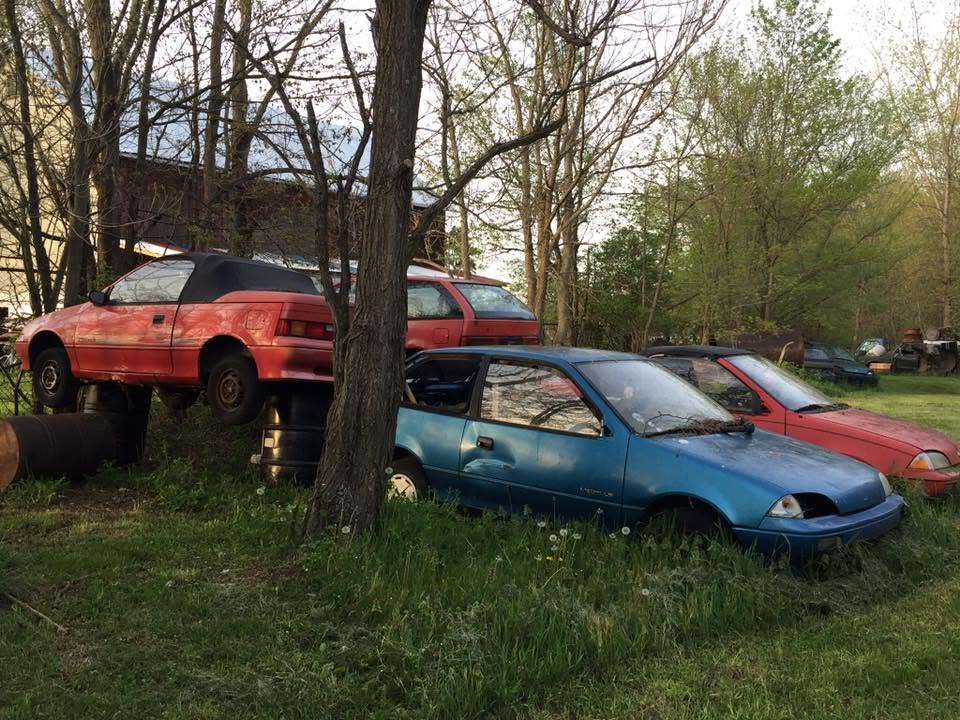
Harry has fourteen Geo Metros sitting in a field in Gnadenhutten, Ohio, and he will sell every single one of them for $5,000 — but only as a set. The Facebook Marketplace listing is blunt about it: no parting out, no cherry-picking the good one, no calls asking about buying just an engine. It’s the whole herd or nothing.
The listing itself is a little strange before you even get to the cars. Facebook marks it as posted six years ago, meaning this pile of Metros has either been advertised on and off since roughly 2019 or 2020, or it simply never sold and never got taken down. Anyone calling about it should assume the deal, the inventory, and the price are all worth double-checking before making the drive to central Ohio.
It’s also worth understanding what Facebook’s own listing fields actually describe here. The platform’s structured details — 50,000 miles, red exterior, gray interior, “fair” condition, a single manual transmission — are built for a one-vehicle listing. On a 14-car package deal, those fields can only describe whichever single car got used as the cover photo. The real information about the other thirteen lives entirely in the seller’s written description, not the spec sheet up top.
According to that description, the lot spans model years 1989 through 1993, all with Geo’s three-cylinder engine, mostly paired to manual transmissions with a handful of automatics mixed in. Two of the fourteen are convertibles. The cars reportedly ran until rust ate through their frames badly enough to make them unsafe for the road, though three are said to still have good frames. Titles exist for “most” of them, not all of them — the kind of detail a buyer needs nailed down before any money changes hands.
Geo Metro doesn’t get much respect in enthusiast circles, but it’s a more interesting car than its reputation suggests. It was built by CAMI Automotive, a joint venture between General Motors and Suzuki in Ingersoll, Ontario, and shared its underpinnings with the Suzuki Swift sold overseas. The base three-cylinder engine, a 1.0-liter making roughly 55 horsepower, wasn’t built for speed. It was built to be light, and the Metro XFi’s highway fuel economy rating in the low 50-mpg range was class-leading for years before hybrids made numbers like that common.
That obsession with weight is exactly why the Metro has a small but devoted following today. A stripped three-cylinder Metro weighs around 1,600 to 1,700 pounds, which makes its drivetrain and chassis popular donor parts for kit cars, autocross builds, and mileage-chasing competitions where hypermilers try to set economy records. None of that explains why anyone needs fourteen of them, but it does explain why a field of “junk” Metros can still carry real value, engine by engine and gearbox by gearbox.
The two convertibles are the detail worth paying the most attention to. Geo only built a factory drop-top version of the Metro for a handful of years in the early 1990s, and it was never a high-volume model to begin with. Soft tops, top frames, and the trim unique to that body style are considerably harder to source than drivetrain parts, which means those two cars alone could end up worth more to a Metro-focused collector than the other twelve combined — assuming they aren’t as rust-compromised as the rest of the lot.
Buyers should treat “rusted frame” literally rather than cosmetically. On a Metro’s unibody, that typically means perforated rails or floor pans, not surface rust on a fender — the kind of damage that fails safety inspections and raises genuine structural concerns for anyone who tried to put one back on the road. Missing titles complicate things further; a car without paperwork in Ohio can still be registered through the state’s bonded title process, but that’s an added cost and a multi-week wait, not a same-day fix. And hauling fourteen cars off a rural property is its own project: figure on multiple flatbed trips, somewhere to store what’s worth keeping, and a plan for scrapping whatever doesn’t make the cut.
Do the math and $5,000 for fourteen cars works out to about $357 apiece, which is cheap even by parts-car standards. Whether it’s actually a good deal depends entirely on how much is left of those three “good” frames, and whether Harry still has the cars, the titles, and the patience to deal with buyers six years after he first posted the ad.
Bulk lots and long-forgotten fleets like this one turn up more often than people assume. A 1957 Chevrolet Bel Air barn find recently resurfaced after sitting untouched for decades, and a 1973 Dodge Charger SE barn find just returned to market after its would-be restorer walked away mid-project. Even a seemingly abandoned Corvette C8 has managed to generate its own online mystery. The details always differ, but the lesson doesn’t: a “deal” on a forgotten car is only ever as good as the rust you can’t see in the photos.
About the Author