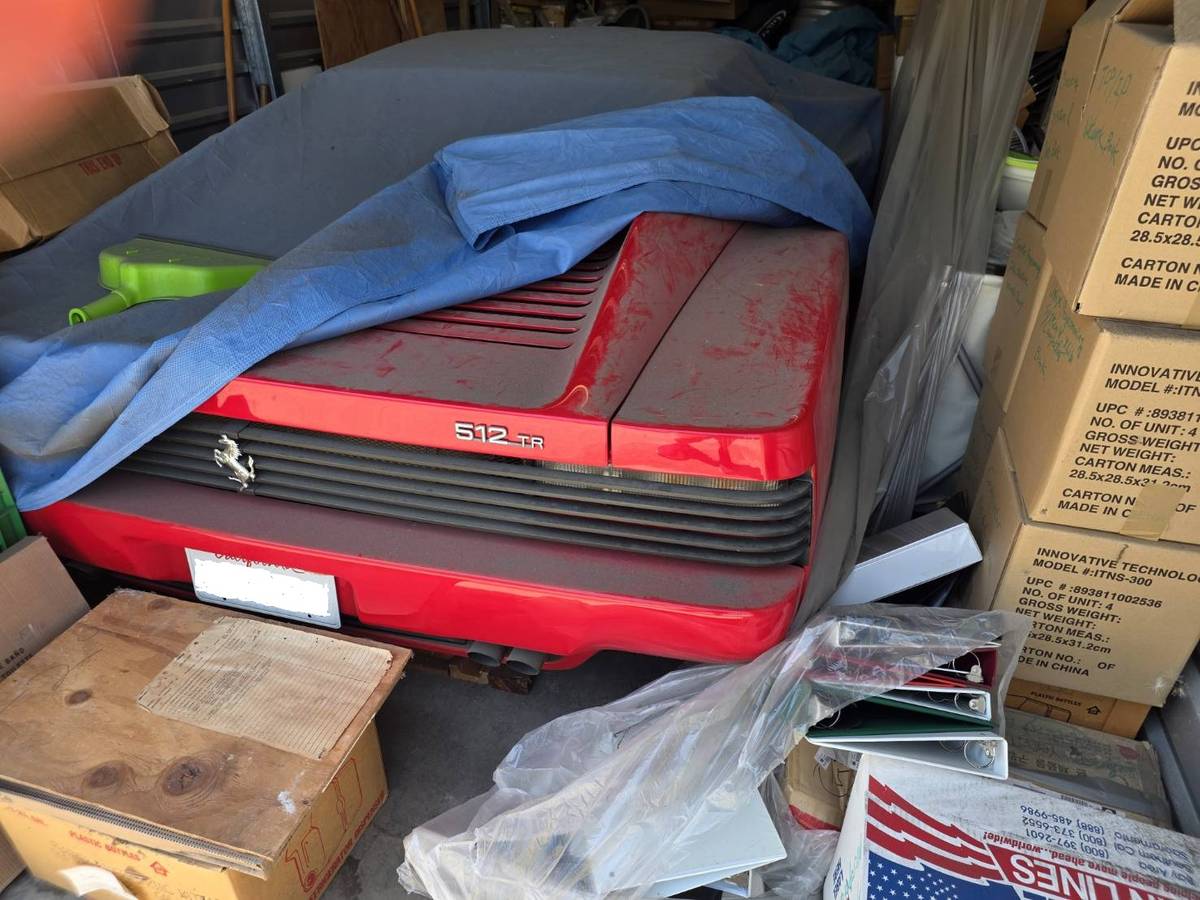
The first photo in this Craigslist ad is a Ferrari 512TR shot by somebody who knew what they were doing with a camera — low sun, clean pavement, the car sitting on its 18-inch five-spokes looking like it just rolled off a Pininfarina turntable. Scroll to the last photo and you get the same car under a gray cover with a blue tarp thrown over the tail, wedged into a storage unit between cardboard boxes, a green plastic gas can, and a bundle of three-ring binders in a garbage bag. The rear deck lid, where the cover has slipped, is visibly streaked with dust.
The seller wants $458,000. He is also very clear that you are buying the second photo, not the first.
The listing is out of Alamo, in the East Bay, and it deserves credit for something most ads like this never manage: it is honest. There is no “runs and drives great.” The seller states flatly that the car has been in storage for 14 years, that the current condition for sale is as-is, that it is heading to a shop for restoration at the end of August, and that “the price will increase as I restore the car step by step along the way.” He would rather sell it sorted. He will sell it now if you make an offer he cannot refuse.
That is a genuinely unusual pitch, and it is worth unpacking, because the gap between what this car is today and what the comps it is being priced against actually are is where the entire deal lives.

Start With the Ad Contradicting Itself
The headline says 17,000 miles. The odometer field in the same posting says 18,000. That is a thousand-mile spread that will not move the needle on value much, but an ad that cannot agree with itself about the single most important number on a low-mileage car is a reason to ask for photos of the actual gauge cluster before anything else happens.
The word “rare” is doing some work, too. Ferrari built 2,261 512TRs between 1991 and 1994 — chassis numbers 89100 through 99743, per Ferrari’s own records. That is not a scarce car by early-90s Maranello standards. Red over tan is not rare either; it is close to the default combination on these, which is fine, it just is not a premium.
The claim that matters most is the seller’s assertion that the car has “a market value of 400k to 800k in 2026.” The floor of that range is defensible. The ceiling is not, and it is worth knowing why.
The 512TR Is Not a Facelifted Testarossa
The ad calls it “Testarossa 2.0,” which undersells what Ferrari actually did. The 512TR kept the 4,943cc flat-12 and the tubular steel frame, but Ferrari dropped the entire engine and gearbox assembly 30mm lower in the chassis to bring down the center of gravity — a real structural change, not a trim update. Output went up 38 horsepower to 428 hp at 6,750 rpm (Ferrari rated US cars at 421), with 491 Nm arriving at 5,500 rpm. Engine management moved to Bosch Motronic M2.7. The car got cross-drilled ventilated discs with four-piston calipers, a single-plate clutch, and 8J×18 front and 10.5J×18 rear wheels. Ferrari quoted 313.8 km/h — a hair under 195 mph.
Those changes matter to a buyer for an unglamorous reason: the 512TR is the version of this platform that people who actually drive Testarossas tend to want, which is precisely why it commands the money it does. The F512 M that followed in late 1994 went further still — 10.4:1 compression, 440 hp, titanium rods, ABS, and those polarizing fixed headlights under glass — and only 501 were built, which is why the M is its own separate market.
If you want a sense of how much heat this specific car has been catching lately, we covered the collector-market ripple when a 512 TR turned up in a Kendall Jenner Instagram post and the classic world lost its mind.
What 512TRs Are Actually Bringing Right Now
2026 has been a strong year for these. On Bring a Trailer, an 18,000-mile 1993 sold for $620,000 in early July. A 21,000-mile 1992 brought $486,000 in May. A 23,000-mile 1992 hit $418,000 in early August. Further down the condition ladder, a 1992 sold for $329,000 in February. Two did not clear reserve — a 7,000-mile 1992 stalled at a $500,000 bid in January, and a 27,000-mile car stopped at $315,000 in June. Gooding sold a delivery-mileage 1994 with 462 kilometers on it for $582,500 at Amelia Island back in 2023.
So $458,000 for a sorted, documented, sub-20k-mile 1994 car is not a fantasy number. It is roughly market.
The $800,000 ceiling, though, appears to come from one sale: a 512 TR Speciale that brought €747,500 in Paris this past January. Ferrari built fifteen of those. It is not a comparable car, and pricing a standard 512TR against it is like pricing a Fox-body against a Cobra R.

The Bill That Is Not in the Ad
Here is the problem with anchoring to those auction results: every one of those cars ran, drove, stopped, and came with a bidder pool competing in public. This one has not turned a wheel since roughly 2012.
The seller’s best card is that the day the car went into storage was the same day it came out of Ferrari Palo Alto with a fresh timing belt. That is genuinely good history. It is also the exact detail that a buyer needs to think hardest about, because Ferrari’s service interval on this engine is 30,000 miles or five years, whichever comes first. A belt installed in 2012 is now roughly three intervals past due on the calendar, and the calendar is the binding constraint on a car that is not accumulating miles. Rubber does not care that it has been sitting still. Tensioner bearings that have not rotated in fourteen years arguably care less for having sat.
On the flat-12, the belts and tensioners live at the back of the engine against the bulkhead, so the drivetrain comes out of the car to reach them. That is the famous engine-out major. J. Scuderia Automotive, one of the few Ferrari specialists that publishes prices openly, lists the Testarossa/512 major starting at $12,100, covering cam belts, tensioner bearings and bushings, accessory belts, brake, clutch and power steering fluid flushes, and injector service. Most shops quote this privately, and “starting at” is doing real work in that number.
Then there is everything the major does not cover, all of which a fourteen-year sleep guarantees you will be shopping for: perished rubber fuel lines and tank hoses, injectors and pumps varnished by stale gasoline, tires that are aged out regardless of tread depth, a clutch disc that may have rusted itself to the flywheel, dried-out cam and main seals that announce themselves the moment there is oil pressure, brake and clutch hydraulics full of moisture, and an A/C system that has almost certainly lost its charge along with the compressor shaft seal.
None of that is speculation. It is the standard recommissioning list for any car that has been parked this long, and it is the reason we put together a guide to evaluating long-dormant cars before you write the check. It is also why “as-is” deserves more respect than buyers usually give it — a Hall of Fame recently sold its own pace car as-is and then spent $23,000 putting it right, and that was a car with nothing exotic about it.
Cars that sit also generate problems that have nothing to do with mechanical wear. Ed Sheeran caught a conviction over an Aston Martin that had not moved since 2021, and we have written up a Firebird that spent its dormancy in a shipping container. Storage is not a neutral state.

Check the Fuel Line Recall Before You Turn a Key
This is the part nobody mentions, and on a car about to be woken up it is the single most important item in this article.
In July 1994, Ferrari opened NHTSA recall campaign 94V131000 covering 512TRs. The defect: the metal fuel supply line banjo fitting can fracture if the nut attaching the fuel line to the fuel filter was overtorqued. NHTSA’s own language on the consequence is blunt — fuel leaks in the engine compartment can result in a fire when exposed to a source of ignition. The remedy was replacement of two fuel supply lines with reinforced banjo fittings.
That recall is 32 years old, which means a car whose paperwork stops in 2012 needs it verified, not assumed. A separate campaign, 03V142000 from April 2003, covers the passive seat belt system — inconsistent electrical operation of the motorized track assembly — and calls for replacing the ECUs, retractor mechanism, and both motorized tracks. Both are worth running against the VIN before any money moves.
Service history is exactly where these cars get decided. We looked at a crashed Testarossa carrying $44,000 in documented service work and it still came with a warning label attached. Documentation is a floor, not a guarantee.
California Paperwork Is Its Own Project
A 1994 Ferrari is not smog exempt in California. The exemption line sits at model year 1975 — every gasoline vehicle from 1976 forward is in the program, tested biennially at renewal, and a smog certification is required on change of ownership. The transfer exemption only covers vehicles four model years old or newer. So this car has to pass a full California inspection, including the visual and functional check on the Motronic system and catalysts, before a sale can be recorded. On a car that has not idled in fourteen years, that is not a formality.
The other question to ask is whether the car has been on Planned Non-Operation the whole time or simply lapsed. PNO does not require annual renewal — once filed it sits on the record indefinitely with the expiration date frozen — but California has no grace period, and a car that fell off registration without PNO can carry back fees and penalties. If it is on PNO, a Certificate of Non-Operation (REG 102) is needed to bring it back, and a Vehicle Moving Permit (REG 172) lets you legally move it to a shop and a smog station before you register it. Ask for the DMV record, not the seller’s recollection.
So What Is It Worth?
Here is the inversion at the center of this listing. Normally a seller eats the recommissioning cost to reach retail money. This seller is asking retail money now, telling you he is about to start spending, and putting you on notice that the number goes up as he does. That is a defensible business decision. It also means the as-is buyer is being asked to pay a sorted-car price and then fund the sorting.
Back the math out and it gets clearer. Take the current market for a running, documented sub-20k-mile 512TR — call it the $420,000 to $500,000 band the 2026 results support. Subtract a major service that starts at $12,100 and realistically will not stop there, plus fuel system, hydraulics, tires, clutch, and whatever the seals do when oil pressure returns. Subtract again for the fact that a private-party as-is car with a fourteen-year gap in its history will never bring what a fully documented public-auction car brings. What is left is the honest number, and it starts with a smaller digit than $458,000.
The path forward is not complicated: pull the VIN’s recall status, get photos of the odometer and the service invoice from Ferrari Palo Alto, get the DMV record, and get a marque specialist — not a general shop — to look at it in the unit before it moves. Our pre-purchase inspection checklist covers the process, and if you are benchmarking against public sales, our guide to buying collector cars at auction explains why as-is means something different when there is no auction house standing behind the description. For a sense of the wider Testarossa-family market, Dennis Collins put his own 1988 Testarossa up online not long ago.
The good news for whoever buys it: a 512TR that has been asleep in a dry California storage unit with fresh belts installed the day it was parked is about the best version of this problem you can get handed. It is still a problem. Price it like one.
Via Craigslist
About the Author