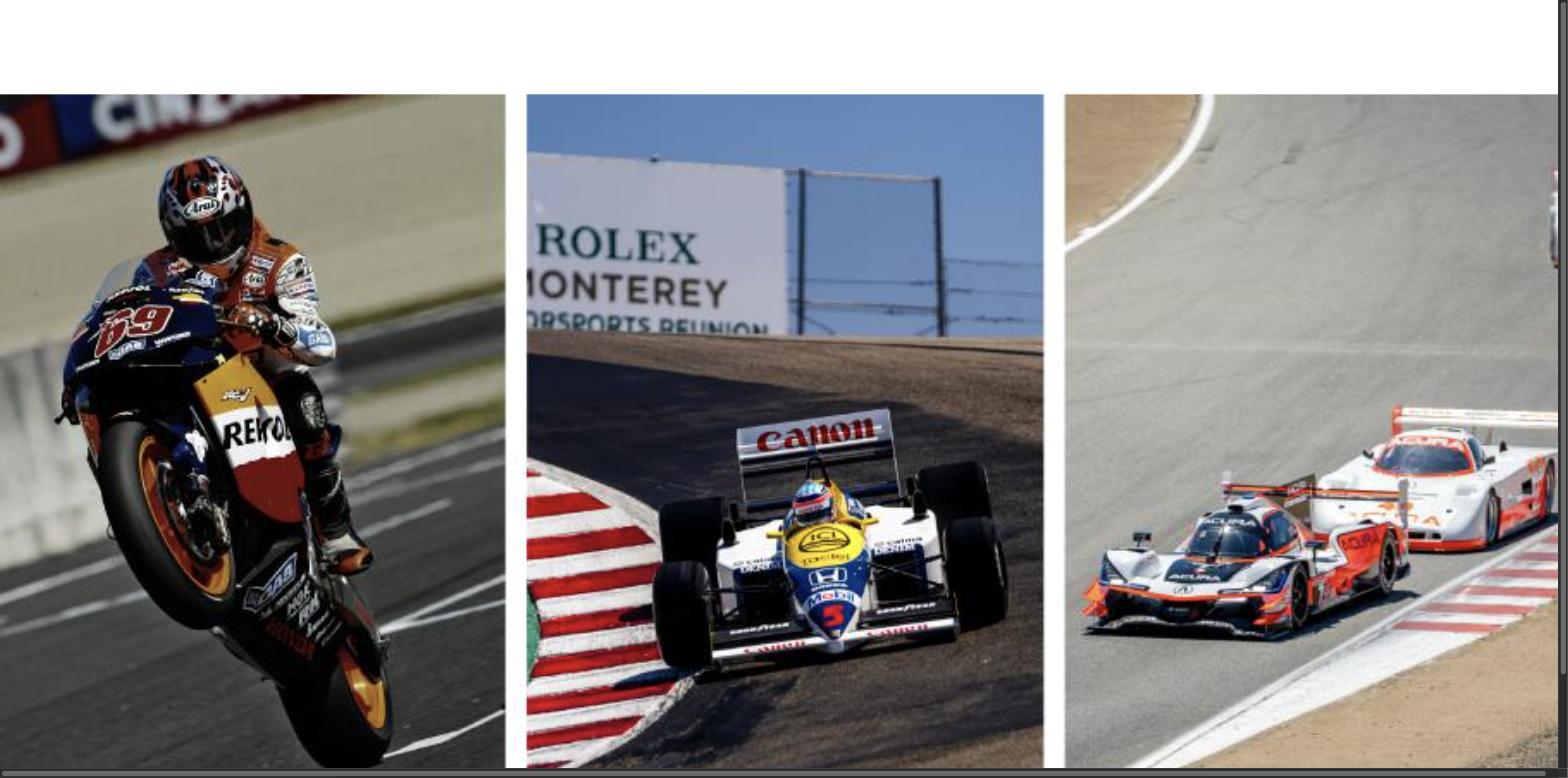
Soichiro Honda believed racing made better engineers, better products, and a sharper company. Eight decades on, that philosophy has produced enough hardware to fill a small museum, and that’s essentially what’s landing at Monterey Car Week this year. Between August 12 and 16, Honda and Acura are trucking in more than 20 championship-winning race cars and motorcycles pulled from the American Honda Collection Hall, the Honda Collection Hall in Motegi, and a handful of private owners who’ve spent real money keeping this stuff track-ready.
The scale is the actual story. Plenty of manufacturers can point to a heritage fleet built around one or two disciplines they dominated. Honda’s rolling in cars and bikes that won at Indianapolis, in Formula 1, at Le Mans, in IMSA’s GTP class, at the Isle of Man TT, in MotoGP, at the Dakar Rally, and in AMA Supercross, with decades separating some of the wins and original livery still on the sheet metal.
Where the cars actually show up
None of this is parked in a single tent for the week. Honda is spreading the collection across Motorlux, The Quail, a dedicated Motorsports Gathering, the Rolex Monterey Motorsports Reunion (RMMR) at Laguna Seca, and the Pebble Beach Concours d’Elegance. Some cars are strictly static; a good number are running demonstration laps or full vintage races at RMMR, which is the detail worth knowing if you’d rather hear a two-stroke five hundred on boost than look at one behind a velvet rope.
Forty years since Honda’s first F1 title
The four-wheel headliner is the 1986 Williams Honda FW11, marking 40 years since Honda’s first Formula 1 Constructors’ championship. This same FW11 already made a trip up Goodwood’s hill climb earlier this year for the anniversary, but Monterey gets the better version of the story: demonstration laps at RMMR instead of a straight-line sprint up a driveway. The FW11’s 1.5-liter V6 twin-turbo RA166E was the class of the field in 1986, when Nelson Piquet and Nigel Mansell combined for nine wins in sixteen races. Parked nearby is the opposite end of that engineering timeline: the 2026 Aston Martin Aramco AMR26, running Honda’s new RA626H power unit, a 1.6-liter turbo V6 built around the electrification hardware required by this year’s regulatory reset. Seeing both together is a forty-year lesson in how differently “Honda F1 engine” gets defined depending on the decade.
IndyCar’s most emotionally loaded entries
Honda’s Indy legacy gets three separate cars. Alex Palou’s 2025 Honda-powered Chip Ganassi entry, fresh off eight wins and a fourth championship, will run demonstration laps at RMMR. A 1996 Honda-powered IndyCar honors the late Alex Zanardi on the 30th anniversary of his pass through Laguna Seca’s Corkscrew, still argued over as the best overtake in the series’ history. And a 2001 Reynard raced by the late Gil de Ferran, restored with a period-correct Honda engine through the HRC Heritage Racing Program, now belongs to McLaren Racing CEO Zak Brown, who bought it from Roger Penske earlier this year. That ownership chain says something on its own: heritage race cars with real provenance are increasingly changing hands between people who actually run motorsports operations, not just collectors buying a garage trophy. Honda’s tally of 17 Indianapolis 500 wins remains the most of any manufacturer in the race’s history.
The sports car side reads like a regulations textbook
The IMSA and Le Mans entries double as a crash course in how prototype racing classes have evolved. The Acura ARX-06 GTP won the 2023 Rolex 24 at Daytona, the first race of IMSA’s hybrid GTP era, with a chassis co-developed by HRC US and ORECA and a bespoke AR24e twin-turbo V6 built entirely in-house. Step back a class generation and there’s the Acura ARX-05, a Daytona Prototype International car that took three championships between 2018 and 2022 under the older DPi rules, which allowed manufacturer-specific bodywork over a shared chassis rather than GTP’s more standardized hybrid platform. Older still is the Comptech Spice Acura, one of the first Acura endurance prototypes, running a modified V6 out of the first-generation NSX and winning three straight GTP Lights titles from 1991 to 1993.
The Le Mans side includes the 1996 Team Kunimitsu NSX GT2, built specifically in right-hand drive to suit the clockwise Circuit de la Sarthe, a small but telling engineering decision that most fans never think about when they see a Japanese-market car with the wheel on the wrong side for its home country. It finished third in GT2 on debut and remains the only right-hand-drive NSX GT2 ever built. The Strakka Racing ARX-01c, which won the LMP2 class at Le Mans in 2010, has been restored by HRC US and will actually compete in a vintage race at RMMR rather than just sit still for photos.
For buyers paying attention to the heritage race car market, the most notable machine on this list might be the Acura NSX GT3, chassis No. 5, the winningest NSX GT3 built and currently listed for sale directly through HRC USA. Cars with this kind of factory-documented history, wearing an actual championship livery rather than a tribute paint job, tend to hold value far better than a generic track-day GT3 car, largely because the paperwork and originality are already sorted for the next owner.
The grassroots side started with a Civic
It’s easy to forget Honda’s factory-backed motorsports program didn’t start with prototypes or IndyCars. In 1974, Bob Boileau bought a new Honda Civic 1200 and built what’s recognized as the first American Honda road racing car, a project that went on to win six SCCA GT5 championships. That scrappy, privateer energy is the same thread running through Honda’s tuner and drag racing scene decades later, the same scene that turned a twin-turbo Civic into a record-setting sport compact drag car. The RealTime Racing Acura Integra Type R carried that grassroots momentum into the SPEED Touring Car Championship, winning 23 races and four manufacturers’ titles between 1997 and 2002, while a matching RealTime Acura NSX took the 1996 World Challenge GT drivers’ title before getting supercharged for later seasons.
Off-road and hill climb history that’s easy to overlook
Honda’s desert racing history goes back further than most people assume. A Honda N600 Baja, powered by a 35-horsepower, 600cc air-cooled two-cylinder engine, ran the 1970 Baja 1000 as the first race car fielded by American Honda. On the Dakar Rally side, Ricky Brabec’s 2020 Honda CRF450 RALLY snapped a 31-year drought, giving Honda its first Dakar win since 1989, and Honda has since added three more Dakar victories to reach eight total. An Acura Integra Type S has also made four runs up Pikes Peak in the Time Attack 1 division, proof that Honda’s competition instincts extend well past pavement.
Two wheels, and a genuine engineering curiosity
The motorcycle lineup covers Honda’s current MotoGP effort, the RC213V ridden by Luca Marini and Joan Mir, a 1000cc V4 capable of clearing 223 mph, alongside Nicky Hayden’s 2006 championship-winning RC211V and its unusual V5 layout. The genuinely interesting piece for anyone who wants to understand motorcycle engineering is Mick Doohan’s 1997 NSR500, a 500cc two-stroke that helped pioneer the “Big Bang” firing order. Conventional two-stroke fours fire at even intervals, which sounds smoother but delivers power to the rear tire in a steady stream that can overwhelm available traction. Bunching the firing pulses closer together, then leaving a longer gap before the next group, gives the tire brief recovery windows between power pulses, which is part of why Doohan’s bike could put power down better exiting corners than rivals running a traditional firing order. Doohan actually preferred the older “Screamer” configuration on this particular bike, which makes it a useful reminder that even inside one manufacturer’s factory program, the fastest solution wasn’t always the same solution for every rider.
Also on display: a replica of Dick Mann’s 1970 Honda CR750, the race version of the original Honda CB750 superbike and the machine that delivered Honda’s first Daytona 200 win, plus Jett Lawrence’s 2025 Honda CRF450R from his Supercross and Motocross championship seasons.
Why one company touching every series matters
Most weekends, F1, MotoGP, IndyCar, and NASCAR are competing for the same eyeballs on television, forcing fans to pick one broadcast over another. Monterey Car Week flips that arrangement: instead of choosing a series to follow, spectators get to walk past championship-winning hardware from nearly all of them, built by one manufacturer, parked a few hundred feet apart. Honda counts 25 premier-class Grand Prix and MotoGP constructors’ championships, six Formula 1 drivers’ titles, and six F1 constructors’ titles on top of that Indy 500 total, and Honda Racing Corporation USA alone has banked more than 500 race wins and 60 series championships since it was founded in 1982. Few manufacturers can back up a heritage display this wide with cars that actually still run, and fewer still are willing to let people buy pieces of that history, as HRC USA is doing with the NSX GT3. For anyone planning to be on the Monterey Peninsula next week, RMMR at Laguna Seca is where the machinery earns its keep on track, while Pebble Beach’s Concours d’Elegance is the place to see the rarest pieces standing still long enough to actually study them.
Whether any of that translates into a trophy this weekend at Pebble Beach’s judged classes is beside the point. The value here is walking a few hundred yards and tracing eight decades of racing decisions in metal, from a 35-horsepower Baja microcar to a hybrid-assisted GTP prototype, all wearing the same wing badge.
About the Author