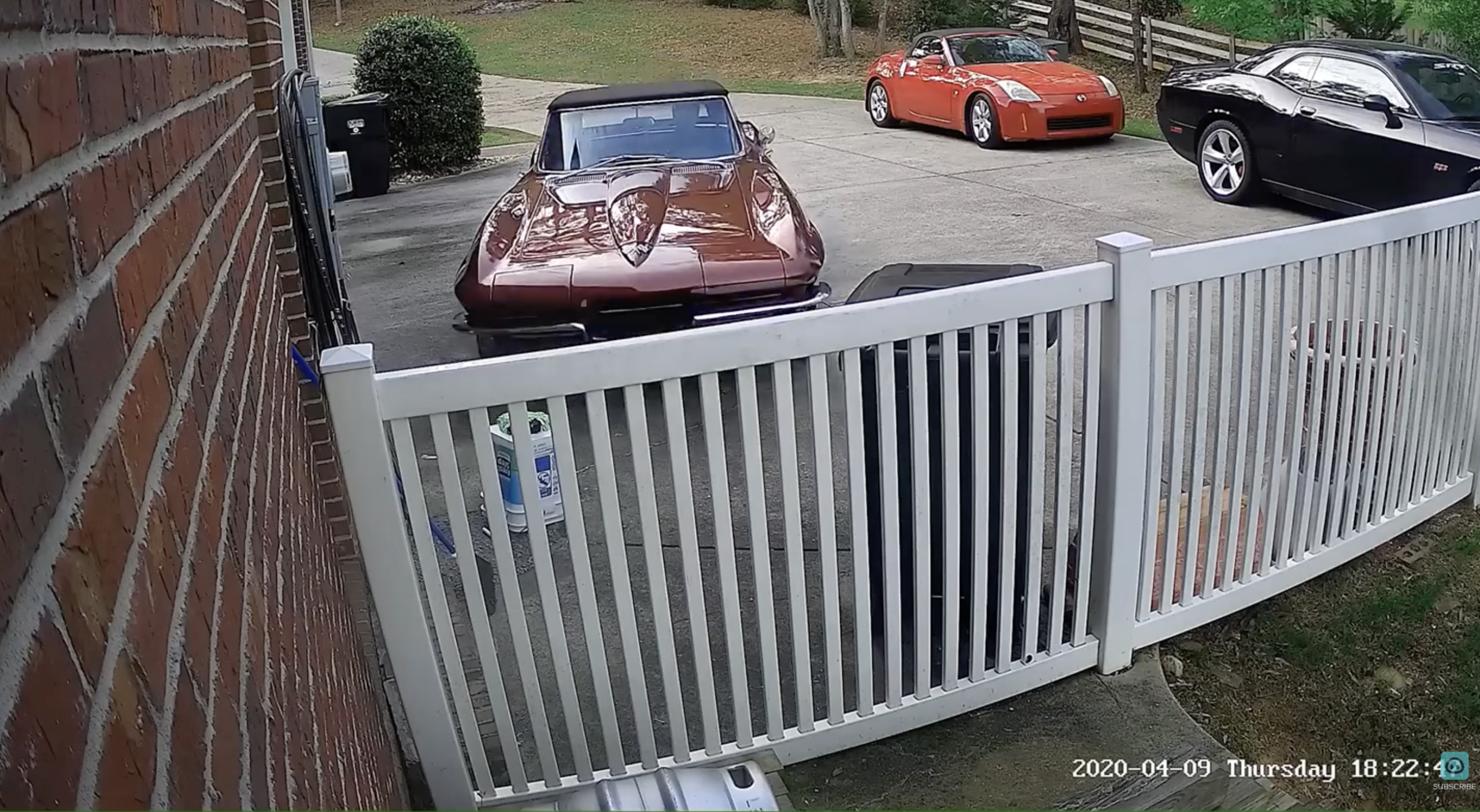
The car was a 1966 Chevrolet Corvette convertible, pulled out of a basement garage after sitting untouched for roughly six months. By the owner’s own account, posted alongside the video that captured the whole thing, this was the first time the car had moved since it went into hibernation. He backed it up his steep driveway to show it off for his daughter’s boyfriend, spinning the tires on the way toward the upper garage. That little flourish, it turns out, burned through the only traction he had left.
Then he tried to stop. The brake pedal sank straight to the floor with nothing behind it. He grabbed the parking brake. Nothing happened there either. By his own description, that left him three options as the Corvette rolled backward down his own driveway: clip the cars parked along the left side, punch through the fence and likely end up in the lake behind the property, or aim for the house. He chose the house.
The homeowner’s own security camera caught the whole sequence, and it plays out fast: wheelspin, a beat of hesitation, then a burgundy convertible disappearing through a section of white fence and into the brick wall of the house. ViralHog published the footage on YouTube in November 2020 under the title “Brake Failure Leads to Classic Corvette Crash,” and the clip has never really stopped circulating since. Five years on, it is still making the rounds, which says something about how well this particular cautionary tale holds up.
None of this is bad luck. A hydraulic brake system that sits for six months is a system that has been quietly working against itself the whole time. Brake fluid is hygroscopic, meaning it pulls moisture out of the air through microscopic pores in rubber hoses and seals even when the car never turns a wheel. That moisture lowers the fluid’s boiling point and, more relevant here, promotes corrosion inside the master cylinder bore. A pitted or corroded master cylinder cannot hold pressure, so the pedal sinks to the floor with no resistance, which lines up exactly with what happened in this driveway. Add a wheel cylinder or caliper piston that has started to seize or leak from disuse, and a car that braked fine in October can be nearly brakeless by spring.
The parking brake failing at the same moment is not a coincidence, either. Corvettes of this generation came standard with four-wheel disc brakes, a genuine rarity in 1966 when most American cars still relied on drums, but the parking brake on a disc-equipped car like this typically is not the disc caliper at all. It is a small drum-and-shoe mechanism tucked inside the rear rotor hats, a common setup on disc-brake cars of that era. If that little drum has not been adjusted or exercised in months, rust and slack in the cable can render it useless at the exact moment a driver needs it most.
It is a reminder of how much engineering sits underneath a car most people associate with straight-line speed. Chevrolet’s decision to standardize disc brakes on the Sting Ray was not a styling exercise; it was a genuine safety upgrade the brand leaned on for years, and it is part of why clean, correct C2 Corvettes keep outperforming expectations at auction, where one recent sale even matched a factory Ferrari dollar for dollar. The nameplate’s engineering swagger has not faded, either. Shops are still building wild reinterpretations of the same car, including a reskinned, 1,560-horsepower version with all-wheel drive. None of that history helps much, though, when the brake system in front of you has not been maintained.
The practical lesson for anyone pulling a car out of long-term storage is simple and unglamorous: do not trust the pedal until the system has been bled and inspected. Brake fluid should be flushed on a calendar schedule, generally every one to two years, regardless of whether the car has actually been driven, since it absorbs moisture whether it is parked or not. Before backing anything down an incline for an audience, a slow test stop on flat ground tells you more than any amount of confidence in a car that always ran great. Long-term storage comes with its own checklist beyond brakes, too. Batteries, tires, fuel systems, and seals all degrade on their own clock, which is exactly what showed up when a barn-find Ferrari F40 needed extensive recommissioning after years of sitting untouched.
There is also a less obvious financial wrinkle when a car crashes into its owner’s own house. Two separate insurance policies typically get involved rather than one: the auto policy’s collision coverage, if the owner carries it, pays out on the Corvette, while the homeowner’s policy covers the structural damage to the house and fence, each subject to its own deductible. A standard personal auto policy can be a poor fit for a car like this anyway, since insurers may value a 60-year-old Corvette on depreciated actual cash value rather than what a clean example would fetch at auction. That mismatch is the entire reason agreed-value classic car policies exist. They lock in a pre-loss value with the insurer so a wreck does not turn into an argument over what a decades-old Sting Ray is really worth.
Owning a classic is its own kind of risk management, and not just the kind involving weird noises from the engine bay. Between fraud-riddled restorations, parts-sourcing headaches, and brake systems that quietly fail from disuse, keeping a car like this roadworthy is a bigger job than washing it twice a year. The owner in this video did not do anything uniquely reckless. He skipped a step that plenty of hobbyists skip, and paid for it in brick and fencing instead of cash. Call it a free lesson, five years running.
About the Author