Image via Scuderia Ferrari HP
Ten months ago, Lewis Hamilton stood in front of reporters at the Azerbaijan Grand Prix and told them, more or less, to stop asking about his garage. He’d sold it off — the whole thing. “I don’t have any cars anymore,” he said. “I got rid of all my cars. I’m more into art nowadays.” Then he added a caveat nobody paid much attention to at the time: if he ever bought a car again, it would have to be a Ferrari F40. Turns out that wasn’t hypothetical. He already had one.
This week Hamilton posted a carousel to Instagram introducing “my very own F40,” a car he says he wanted since childhood and made sure to have waiting for him on his first day at Maranello after signing with Ferrari. The interesting part isn’t that a seven-time world champion driving for Ferrari owns an F40 — that would barely qualify as news. It’s what he says it took to get this particular example running again. He found the car sitting under three decades of dust in a garage, then shipped it to Ferrari’s own factory, where the company’s engineers and mechanics spent weeks tearing it down and rebuilding it rather than farming the job out to an outside restoration shop.
The photos he shared back that up. One shows the tubular steel chassis stripped completely bare, suspension arms and dampers exposed with no bodywork in sight. Another shows the F40’s 2.9-liter twin-turbo V8 pulled entirely and sitting on an engine stand mid-rebuild. There’s a shot of Hamilton inspecting freshly finished red bodywork, one of him behind the wheel of the completed car, and another of the F40 nose-down on a lift being loaded or unloaded from a trailer. That’s not a detailing job. That’s a full nut-and-bolt restoration.
A Car We’d Already Seen Him Drive
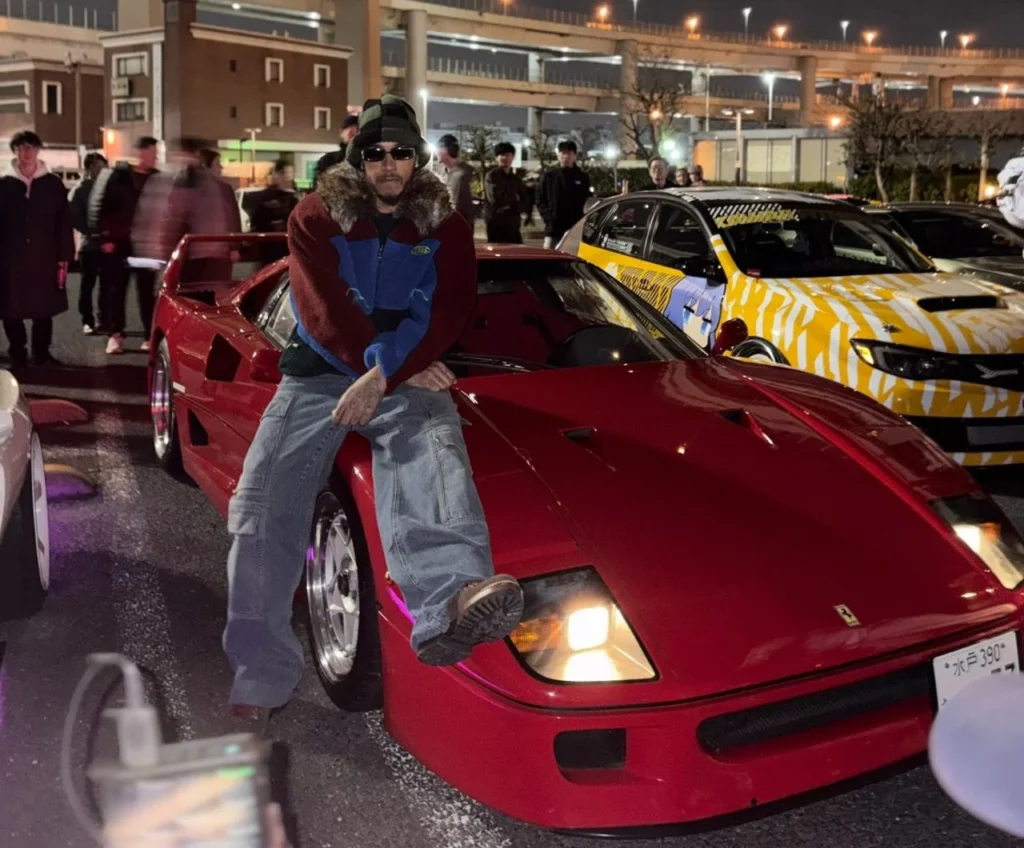
Here’s the part that makes this less of a reveal and more of a reveal about a reveal. We caught Hamilton showing up to a Tokyo car meet in a red F40 back in March, and a few weeks later he was drifting a red F40 at Daikoku Parking Area with Kim Kardashian riding shotgun, days before the Japanese Grand Prix. Both outings happened months before this Instagram post. Whatever restoration timeline Hamilton is describing now, the finished car was clearly done, registered, and being driven hard well before he decided to tell the story behind it.
Why Reviving a 30-Year-Dormant F40 Isn’t a Weekend Job
Cars that sit for decades don’t just need a wash and a fresh battery. Rubber perishes — fuel lines, brake hoses, and seals all harden and crack whether the car moves or not, and F40s are particularly unforgiving here because the fuel system runs at higher pressure than a typical period Ferrari and the turbochargers don’t take kindly to stale gasoline gumming up their oil feeds. Tires that have sat for thirty years are structurally compromised even when the tread looks fine. A proper recommissioning means draining and replacing every fluid, pressure-testing the fuel system, and usually pulling the engine to inspect bearings and seals that degrade from disuse as much as from mileage — which lines up with the stripped chassis and engine-out photos Hamilton shared. Shops that specialize in this kind of work routinely bill well into six figures for a comprehensive F40 restoration, and that’s before sourcing parts for a car Ferrari stopped building in 1992.
Having Maranello’s own technicians do the work instead of an independent restorer matters beyond bragging rights. Ferrari’s factory heritage division keeps original build records and can source or fabricate parts to exact factory specification, which is the kind of documentation that keeps a restoration from being viewed skeptically once the car changes hands. For an F40 — a model where matching numbers and originality drive huge swings in auction results — a full factory-backed rebuild is about as close to a clean bill of health as this car will ever get.
The F40 Was Always Going to Be the Exception
None of this actually contradicts what Hamilton told reporters last September. He didn’t say he was done with cars forever; he said the F40 was the one he’d make an exception for, and he wasn’t shy about why. It’s the car Ferrari built to mark its 40th anniversary in 1987, the last new model Enzo Ferrari personally signed off on before he died the following year, and, depending on which spec you’re talking about, the first production car sold with a genuine claim to 200-plus mph. No power steering, no ABS, no radio, not even carpet. Just a twin-turbo V8 wrapped in a body made from Kevlar and carbon composite panels over a tube frame, built in numbers just north of 1,300. Clean examples now trade in the low seven figures at auction, and a documented factory restoration with this kind of celebrity paper trail won’t hurt the number whenever this particular car resurfaces on the market, not that Hamilton sounds like he’s selling anytime soon, especially given he’s already lobbied Ferrari for an analog, driver-focused supercar of his own.
The Takeaway for the Rest of Us
Most of us aren’t finding dust-caked F40s in a garage, but the broader lesson holds for anyone hunting classics: cars that have been sitting for decades are still out there, and they’re not automatically parts cars. Plenty just need someone willing to pay for the teardown. We’ve seen it with a Ferrari 512TR that spent 14 years in a storage unit and a Buick Gran Sport that surfaced with just 12,000 original miles. Hamilton’s version just happens to come with a Formula 1 championship resume and Maranello’s own service department on speed dial. Compare that to a collection like Lionel Messi’s, built for volume and status rather than one dream car, and it’s clear not every athlete’s garage tells the same story. Everyone else just gets a specialist shop and a much longer wait for parts.
About the Author