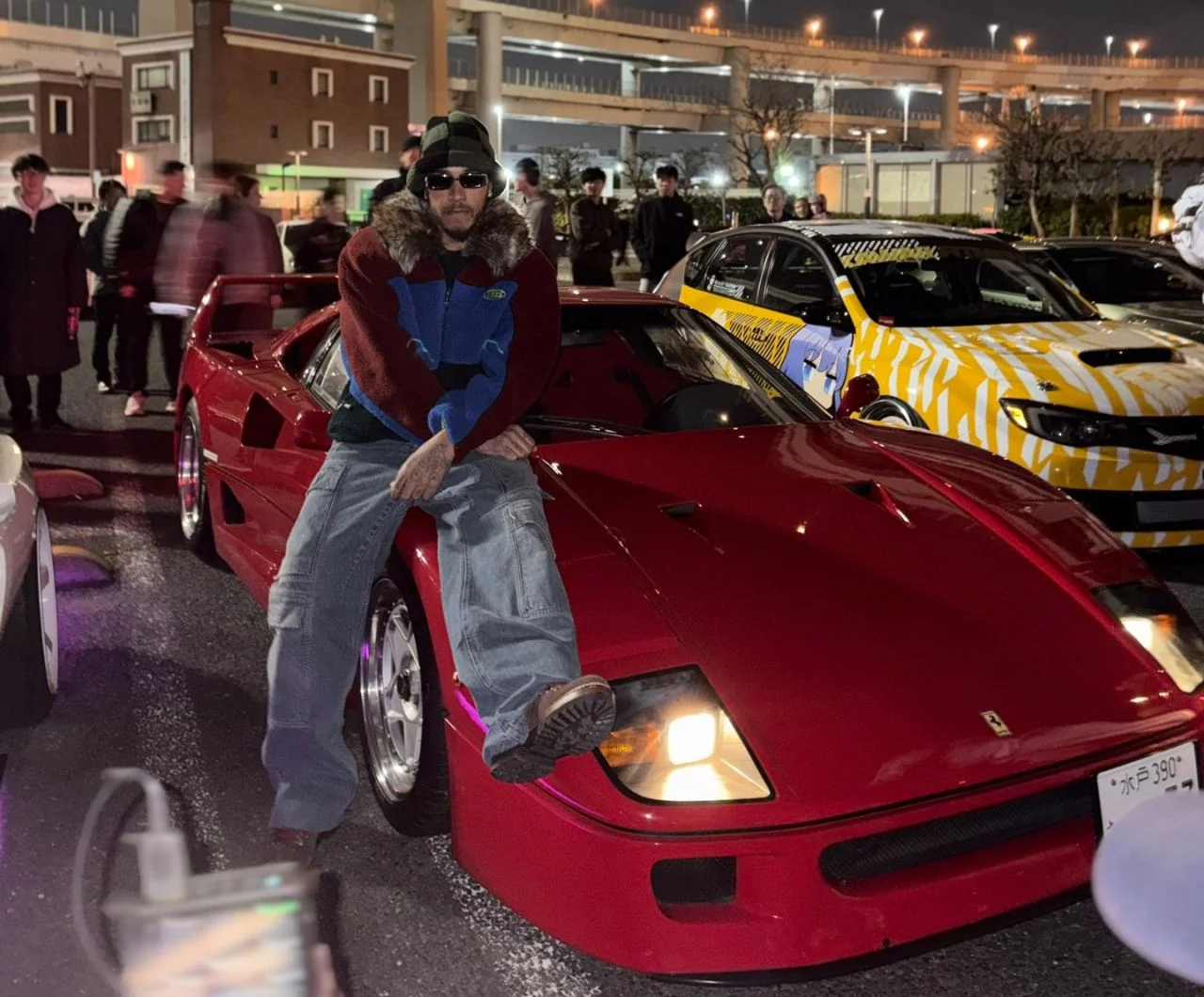
Just days before the Japanese Grand Prix, Lewis Hamilton didn’t stay tucked away in a hotel room or simulator session. Instead, the seven-time Formula 1 champion showed up somewhere far less predictable: Tokyo’s legendary Daikoku Parking Area, one of the most iconic car meet locations anywhere in the world. And he didn’t arrive quietly — Hamilton rolled in driving a Ferrari F40, one of the rawest, most analog, and instantly recognizable supercars ever built. In a place known for wild builds, rare imports, and underground car culture, even Daikoku regulars don’t see something like that every night.
Not a PR Stunt — Just Hamilton Being Hamilton
This wasn’t a staged appearance or a branded event. By all accounts, Hamilton simply showed up and blended into the chaos of Daikoku, a spot famous for pulling in everything from slammed VIP sedans to high-horsepower JDM legends and exotic supercars in a single night.
That’s what makes the moment land harder than a typical celebrity car sighting. Daikoku isn’t a polished car show — it’s unpredictable, crowded, and exactly where Japan’s car scene comes alive after dark. Hamilton choosing to go there, in an F40 of all things, says a lot about how he engages with car culture outside of Formula 1. This is the same driver who, despite being one of the most recognizable athletes on the planet, still seeks out grassroots car scenes wherever he travels.
Why the F40 Choice Says Everything
Of all the cars Hamilton could have shown up in, the Ferrari F40 stands out for a specific reason. It isn’t modern, it isn’t comfortable, and it doesn’t lean on technology to be fast — it’s loud, mechanical, and genuinely unforgiving, a car that demands real skill and respect from whoever’s behind the wheel. Hamilton has previously named the F40 his favorite supercar, which makes this appearance even more telling. At a time when most celebrity drivers gravitate toward hypercars loaded with digital driving aids, Hamilton showed up in something far more raw, a choice that fits Daikoku’s whole ethos: no filters, no polish, just cars and the people who genuinely care about them.
A History With Japan’s Car Scene
This isn’t Hamilton’s first encounter with Japanese car culture, and it likely won’t be his last. Back in 2022, he made headlines after being spotted driving a Nissan Skyline GT-R R34 through Tokyo, with footage showing him drifting and doing donuts on public streets. The video went viral quickly, but it also drew criticism, particularly from the rental company tied to the car. Reaction to that moment split fairly evenly: some viewed it as reckless behavior on public roads, while others saw it as one of the rare instances of a modern F1 driver actually engaging with the car culture fans care about rather than keeping it at arm’s length. Either way, it made one thing clear — Hamilton doesn’t just fly in for a race weekend and leave. He explores.
Why Daikoku Still Matters
To outsiders, Daikoku Parking Area might look like little more than a highway rest stop. In reality, it’s one of the most important gathering points in global car culture. On any given night, you’ll find classic Japanese performance cars, heavily modified street builds, rare imports, and the occasional hypercar, all in the same lot with no official schedule, no judging panel, and no curated guest list — people show up simply because they want to be there. That’s exactly why Hamilton’s appearance resonates the way it does: he didn’t choose a controlled environment for a photo opportunity. He went straight into the heart of an unscripted scene.
The Contrast With Modern F1 Culture
Moments like this stand out even more given how tightly managed Formula 1 drivers’ public appearances typically are. Between sponsor obligations, media commitments, and packed schedules, most drivers rarely get the chance, or don’t take the risk, of showing up somewhere like Daikoku unannounced. Hamilton continues to be the exception. Even now, driving for Ferrari under one of the most scrutinized teams in motorsport, he still finds ways to step outside that structure — whether through fashion, music, or car culture, he’s consistently shown a willingness to move beyond what’s expected of an F1 driver.
A Rare Crossover Moment
What makes this moment unique isn’t just the car or the location on their own — it’s the combination of all three: one of the most successful drivers in F1 history, one of the most iconic Ferrari models ever built, and one of the most authentic car meet locations in the world, all in the same parking lot on the same night. That combination doesn’t happen often, and it didn’t feel forced. Hamilton’s appearance at Daikoku reinforces something that often gets overlooked about him: he’s not just a Formula 1 driver, he’s a car enthusiast who actually engages with the culture beyond the track. Whether it’s a controversial moment like the 2022 R34 incident or a quieter appearance like this one, he keeps showing up in places that matter to people who genuinely care about cars.
The Bigger Picture
In an era when car culture increasingly gets filtered through social media, sponsorship deals, and curated content, moments like this cut through the noise. There’s no script when you pull into Daikoku — no controlled lighting, no planned audience, just cars, people, and whatever happens next. Hamilton showing up in an F40 didn’t just turn heads for a night. It was a reminder that even at the highest level of motorsport, the connection to real car culture still matters, and sometimes it shows up in the most unexpected parking lot in Tokyo.
About the Author