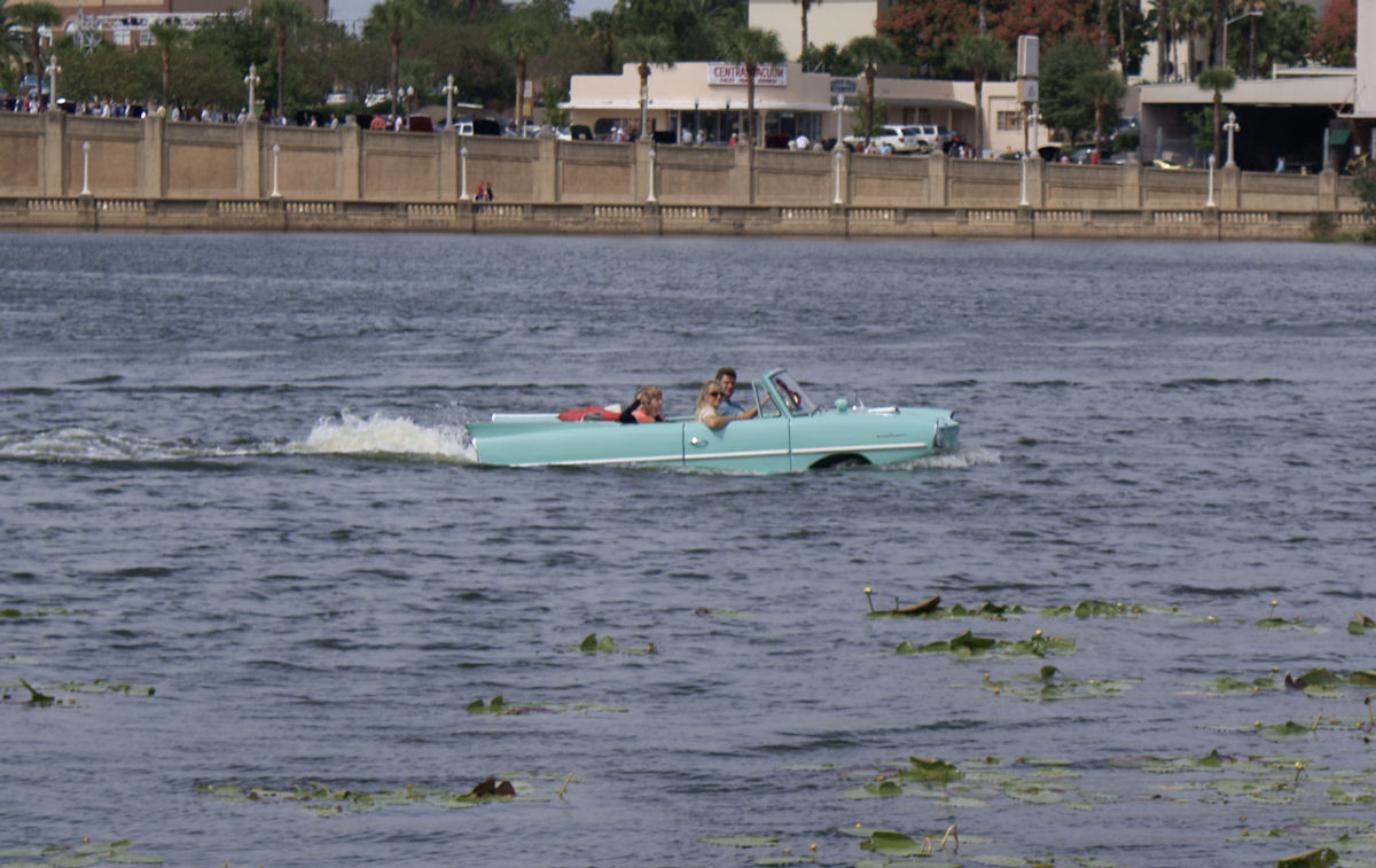
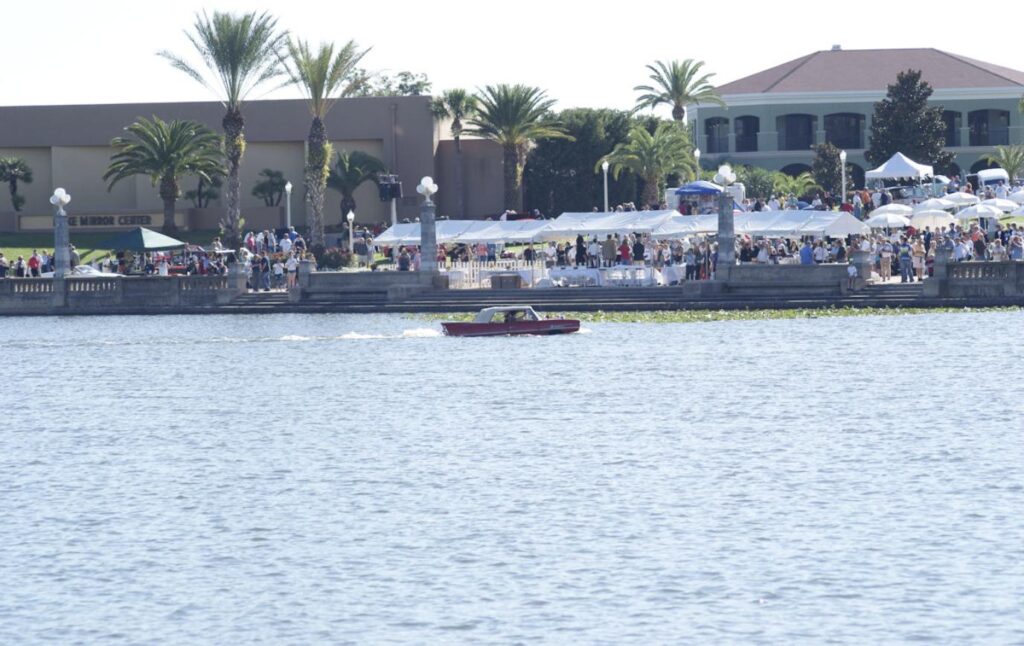
An Amphicar 770 swimming at a car show. Photo: Valder137, Wikimedia Commons (CC BY 2.0)
Sixty-one years ago today, two small convertibles rolled onto the stand at the Frankfurt Motor Show still damp from the English Channel. The day before, four British servicemen had driven those same two cars off the beach at Dover and pointed them straight into the water, aiming for Calais, 21 miles away. One of the two nearly didn’t make it. Both finished anyway, then covered roughly 375 more miles by road to reach Germany in time for the show.
It remains one of the strangest, most literal press stunts in car history, and it worked because the car underneath the stunt could genuinely back it up. The Amphicar 770 had already earned its spot among the oddest entries on Backfire’s list of the 10 strangest car features ever made, a full amphibious drivetrain bolted to what was otherwise an ordinary early-1960s convertible. What the Frankfurt run proved is that the joke worked at scale: not a stunt double in a swimming pool, but two showroom-stock cars crossing one of the busiest, choppiest shipping lanes on earth.
A Crossing That Almost Needed a Tow
Four men made the trip. Captain Michael Bailey of the Royal Electrical and Mechanical Engineers and Captain Peter Tappenden of the Royal Army Ordnance Corps crewed one Amphicar; Sergeant Joe Minto of the Royal Army Service Corps and Timothy Dill-Russell, a professional escape artist, crewed the other. If any road trip needed an escape artist on standby, this was the one.
They left London before dawn, reached Dover around 7:30 a.m., and drove off the beach and into the harbor at 8:50 a.m. on Thursday, September 16, 1965. The Channel did not cooperate. High winds and driving rain hit almost immediately, and partway across, one of the two Amphicars lost power, with period accounts pointing to a fouled bilge pump and water working into the electrical system. The second car took it under tow for the rest of the trip, and the crew also hadn’t accounted for how much fuel a wallowing, underpowered crossing would burn, forcing a mid-Channel refuel by dropping the convertible top and feeding the nose-mounted tank through a makeshift snorkel.
Both cars reached the French coast north of Calais at 4:30 p.m., about seven and a half hours after entering the water for a crossing a Channel ferry makes in ninety minutes. After a night to dry out and service the damaged car, the crew drove on to Frankfurt, arriving September 17 in time for the motor show.
The Engineer Behind the Stunt Once Ran Bugatti’s Factory
The Amphicar was the work of Hans Trippel, a German engineer who had been building amphibious vehicles since before the war and designed the Trippel SG6, an amphibious military vehicle, during it. When Germany invaded France in 1940, Trippel was installed to run the occupied Bugatti factory in Molsheim, a detail that rarely makes it into Amphicar sales literature. He spent three years interned by French authorities after the war as a war profiteer before his release in 1949, then pivoted back to civilian design work, eventually contributing to the Mercedes-Benz 300SL’s gullwing doors and, in 1961, the Amphicar itself.
Trippel wasn’t the only engineer of his era solving the problem of driving into water. Backfire has covered how WWII military Jeeps were built to drive underwater using deep-wading kits and sealed ignition systems rather than a boat hull, a cruder, more brute-force approach than the Amphicar’s dedicated twin-propeller drivetrain, but proof the idea didn’t come from nowhere.
What Made the Amphicar Actually Work
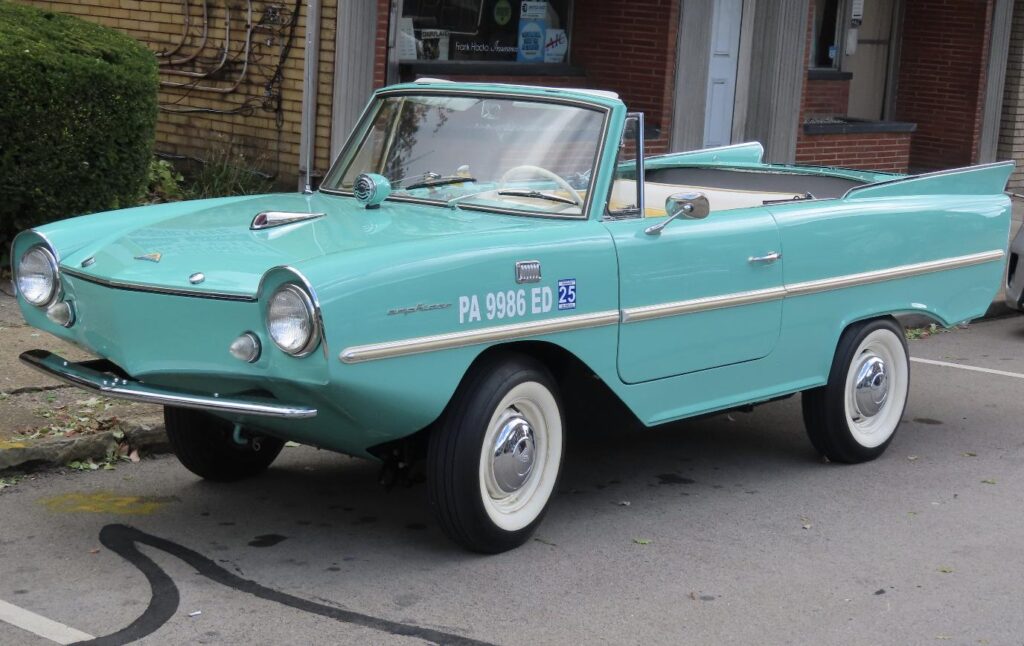
Under the steel body sat a 1,147cc Triumph Herald four-cylinder making roughly 43 horsepower, driving the rear wheels on land through a four-speed manual and switching to twin rear-mounted propellers in the water. Amphicar claimed 70 mph on the road and about 7 knots, roughly 8 mph, on the water, modest by either standard, but enough that period owners joked it was the fastest car on the water and the slowest boat on the road. Front-wheel steering worked in both modes, which sounds convenient until you’re actually holding a line in a crosswind with no rudder.
Quandt Group built roughly 3,878 Amphicars in Lübeck and Berlin between 1961 and 1968, and only 97 of them left the factory right-hand drive, which means two of the roughly one hundred RHD cars built were, for one week in September 1965, doing the hardest job any Amphicar would ever do.
Why Enthusiasts Still Care
The Amphicar’s other famous driver made sure its reputation as a rolling practical joke stuck. Lyndon B. Johnson kept one at his Texas ranch and used it on visiting reporters almost exactly the way you’d expect a president with a car that could drive into a lake to use it: aim it at the water, yell that the brakes had failed, and enjoy the reaction as the car splashed in and kept going.
That reputation is exactly why the car still has a following. Owners hold organized swim-ins every year, Disney Springs has run public Amphicar rides on its waterways since 2015, and clean originals draw real money at auction, with recent sales averaging around $77,000 and a strong example bringing $93,500 in late 2025. Prices vary widely because so few cars survive in swimming condition. Salt water and 1960s electrics do not get along, as the Channel crossing itself proved in real time. The Frankfurt stunt is the reason anyone believed the claims on the brochure in the first place: not a rendering or a test tank, but two production cars driven by soldiers across one of the roughest stretches of water in Europe, arriving late, soaked, and exactly on schedule for the world’s press.
Sixty-one years later, the lesson holds up better than most car-show stunts: if you’re going to promise a car can swim, the only way anyone believes you is to actually put it in the ocean.
About the Author